


Outbreak of Listeriosis in South Africa Associated with Processed Meat
Supporting Files

-
2 13 2020
-
File Language:
English
Details
-
Alternative Title:N Engl J Med
-
Personal Author:Thomas, J. ; Govender, N. ; McCarthy, K.M. ; Erasmus, L.K. ; Doyle, T.J. ; Allam, M. ; Ismail, A ; Ramalwa, N. ; Sekwadi, P. ; Ntshoe, G. ; Shonhiwa, A. ; Essel, V. ; Tau, N. ; Smouse, S. ; Ngomane, H.M. ; Disenyeng, B. ; Page, N.A. ; Govender, N.P. ; Duse, A.G. ; Stewar, R. ; Thomas, T. ; Mahoney, D. ; Tourdjman, M. ; Disson, O. ; Thouvenot, P. ; Maury, M.M. ; Leclercq, A. ; Lecuit, M. ; Smith, A.M. ; Blumberg, L.H.
-
Description:BACKGROUND
An outbreak of listeriosis was identified in South Africa in 2017. The source was unknown.
METHODS
We conducted epidemiologic, trace-back, and environmental investigations and used whole-genome sequencing to type Listeria monocytogenes isolates. A case was defined as laboratory-confirmed L. monocytogenes infection during the period from June 11, 2017, to April 7, 2018.
RESULTS
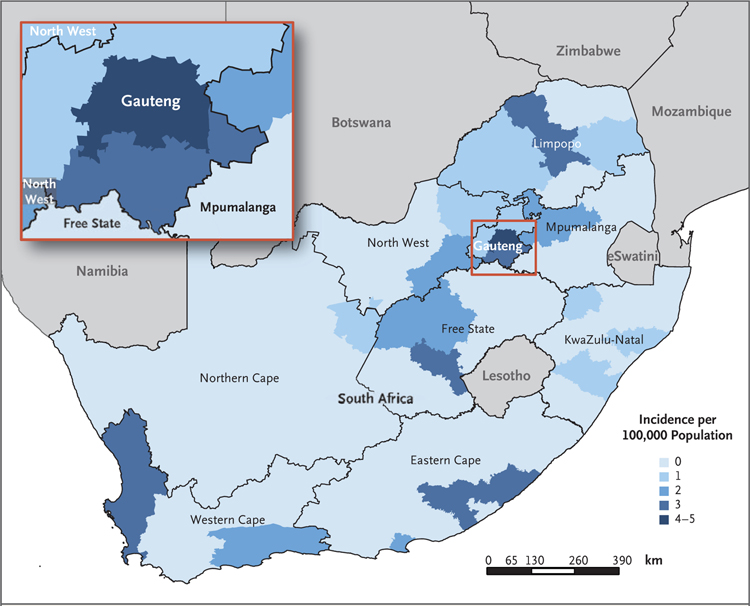
A total of 937 cases were identified, of which 465 (50%) were associated with pregnancy; 406 of the pregnancy-associated cases (87%) occurred in neonates. Of the 937 cases, 229 (24%) occurred in patients 15 to 49 years of age (excluding those who were pregnant). Among the patients in whom human immunodeficiency virus (HIV) status was known, 38% of those with pregnancy-associated cases (77 of 204) and 46% of the remaining patients (97 of 211) were infected with HIV. Among 728 patients with a known outcome, 193 (27%) died. Clinical isolates from 609 patients were sequenced, and 567 (93%) were identified as sequence type 6 (ST6). In a case–control analysis, patients with ST6 infections were more likely to have eaten polony (a ready-to-eat processed meat) than those with non-ST6 infections (odds ratio, 8.55; 95% confidence interval, 1.66 to 43.35). Polony and environmental samples also yielded ST6 isolates, which, together with the isolates from the patients, belonged to the same core-genome multilocus sequence typing cluster with no more than 4 allelic differences; these findings showed that polony produced at a single facility was the outbreak source. A recall of ready-to-eat processed meat products from this facility was associated with a rapid decline in the incidence of L. monocytogenes ST6 infections.
CONCLUSIONS
This investigation showed that in a middle-income country with a high prevalence of HIV infection, L. monocytogenes caused disproportionate illness among pregnant girls and women and HIV-infected persons. Whole-genome sequencing facilitated the detection of the outbreak and guided the trace-back investigations that led to the identification of the source.
-
Subjects:
-
Source:N Engl J Med. 382(7):632-643
-
Pubmed ID:32053299
-
Pubmed Central ID:PMC7301195
-
Document Type:
-
Funding:
-
Volume:382
-
Issue:7
-
Collection(s):
-
Main Document Checksum:urn:sha256:9ffadbb4c3e18ca9eb34484768f22fafae387c530951292c8d636a8ff9b0889b
-
Download URL:
-
File Type:
 [PDF
- 868.82 KB
]
[PDF
- 868.82 KB
]
Supporting Files


File Language:
English
ON THIS PAGE




CDC STACKS serves as an archival repository of CDC-published products including
scientific findings,
journal articles, guidelines, recommendations, or other public health information authored or
co-authored by CDC or funded partners.
As a repository, CDC STACKS retains documents in their original published format to ensure public access to scientific information.
As a repository, CDC STACKS retains documents in their original published format to ensure public access to scientific information.
You May Also Like
COLLECTION
CDC Public Access