


The Severe Typhoid Fever in Africa Program: Study Design and Methodology to Assess Disease Severity, Host Immunity, and Carriage Associated With Invasive Salmonellosis
Supporting Files
Public Domain

-
October 30 2019
-
File Language:
English
Details
-
Alternative Title:Clin Infect Dis
-
Personal Author:Park, Se Eun ; Toy, Trevor ; Cruz Espinoza, Ligia Maria ; Panzner, Ursula ; Mogeni, Ondari D ; Im, Justin ; Poudyal, Nimesh ; Pak, Gi Deok ; Seo, Hyeongwon ; Chon, Yun ; Schütt-Gerowitt, Heidi ; Mogasale, Vittal ; Ramani, Enusa ; Dey, Ayan ; Park, Ju Yeong ; Kim, Jong-Hoon ; Seo, Hye Jin ; Jeon, Hyon Jin ; Haselbeck, Andrea ; Conway Roy, Keriann ; MacWright, William ; Adu-Sarkodie, Yaw ; Owusu-Dabo, Ellis ; Osei, Isaac ; Owusu, Michael ; Rakotozandrindrainy, Raphaël ; Soura, Abdramane Bassiahi ; Kabore, Leon Parfait ; Teferi, Mekonnen ; Okeke, Iruka N ; Kehinde, Aderemi ; Popoola, Oluwafemi ; Jacobs, Jan ; Lunguya Metila, Octavie ; Meyer, Christian G ; Crump, John A ; Elias, Sean ; Maclennan, Calman A ; Parry, Christopher M ; Baker, Stephen ; Mintz, Eric D ; Breiman, Robert F ; Clemens, John D ; Marks, Florian
-
Description:Background
Invasive salmonellosis is a common community-acquired bacteremia in persons residing in sub-Saharan Africa. However, there is a paucity of data on severe typhoid fever and its associated acute and chronic host immune response and carriage. The Severe Typhoid Fever in Africa (SETA) program, a multicountry surveillance study, aimed to address these research gaps and contribute to the control and prevention of invasive salmonellosis.
Methods
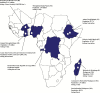
A prospective healthcare facility–based surveillance with active screening of enteric fever and clinically suspected severe typhoid fever with complications was performed using a standardized protocol across the study sites in Burkina Faso, the Democratic Republic of Congo (DRC), Ethiopia, Ghana, Madagascar, and Nigeria. Defined inclusion criteria were used for screening of eligible patients for enrollment into the study. Enrolled patients with confirmed invasive salmonellosis by blood culture or patients with clinically suspected severe typhoid fever with perforation were eligible for clinical follow-up. Asymptomatic neighborhood controls and immediate household contacts of each case were enrolled as a comparison group to assess the level of Salmonella-specific antibodies and shedding patterns. Healthcare utilization surveys were performed to permit adjustment of incidence estimations. Postmortem questionnaires were conducted in medically underserved areas to assess death attributed to invasive Salmonella infections in selected sites.
Results
Research data generated through SETA aimed to address scientific knowledge gaps concerning the severe typhoid fever and mortality, long-term host immune responses, and bacterial shedding and carriage associated with natural infection by invasive salmonellae.
Conclusions
SETA supports public health policy on typhoid immunization strategy in Africa.
-
Subjects:
-
Source:Clin Infect Dis. 2019; 69(Suppl 6):S422-S434
-
Pubmed ID:31665779
-
Pubmed Central ID:PMC6821161
-
Document Type:
-
Place as Subject:
-
Volume:69
-
Collection(s):
-
Main Document Checksum:urn:sha256:d199b6f2f09d1c1b1c6c8a1fb6389532318757218edabfb20fc697aaabe4b0e2
-
Download URL:
-
File Type:
 [PDF
- 1020.92 KB
]
[PDF
- 1020.92 KB
]
Supporting Files


File Language:
English
ON THIS PAGE


CDC STACKS serves as an archival repository of CDC-published products including
scientific findings,
journal articles, guidelines, recommendations, or other public health information authored or
co-authored by CDC or funded partners.
As a repository, CDC STACKS retains documents in their original published format to ensure public access to scientific information.
As a repository, CDC STACKS retains documents in their original published format to ensure public access to scientific information.
You May Also Like
COLLECTION
CDC Public Access