


Effectiveness of Monovalent Rotavirus Vaccine Against Hospitalization With Acute Rotavirus Gastroenteritis in Kenyan Children
Supporting Files

-
May 23 2020
-
File Language:
English
Details
-
Alternative Title:Clin Infect Dis
-
Personal Author:Khagayi, Sammy ; Omore, Richard ; Otieno, Grieven P ; Ogwel, Billy ; Ochieng, John B ; Juma, Jane ; Apondi, Evans ; Bigogo, Godfrey ; Onyango, Clayton ; Ngama, Mwanajuma ; Njeru, Regina ; Owor, Betty E ; Mwanga, Mike J ; Addo, Yaw ; Tabu, Collins ; Amwayi, Anyangu ; Mwenda, Jason M ; Tate, Jacqueline E ; Parashar, Umesh D ; Breiman, Robert F ; Nokes, D James ; Verani, Jennifer R
-
Description:Background
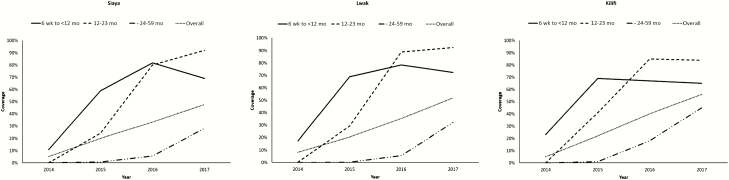
Rotavirus remains a leading cause of pediatric diarrheal illness and death worldwide. Data on rotavirus vaccine effectiveness in sub-Saharan Africa are limited. Kenya introduced monovalent rotavirus vaccine (RV1) in July 2014. We assessed RV1 effectiveness against rotavirus-associated hospitalization in Kenyan children.
Methods
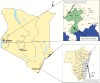
Between July 2014 and December 2017, we conducted surveillance for acute gastroenteritis (AGE) in 3 Kenyan hospitals. From children age-eligible for ≥1 RV1 dose, with stool tested for rotavirus and confirmed vaccination history we compared RV1 coverage among rotavirus positive (cases) vs rotavirus negative (controls) using multivariable logistic regression and calculated effectiveness based on adjusted odds ratio.
Results
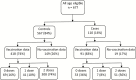
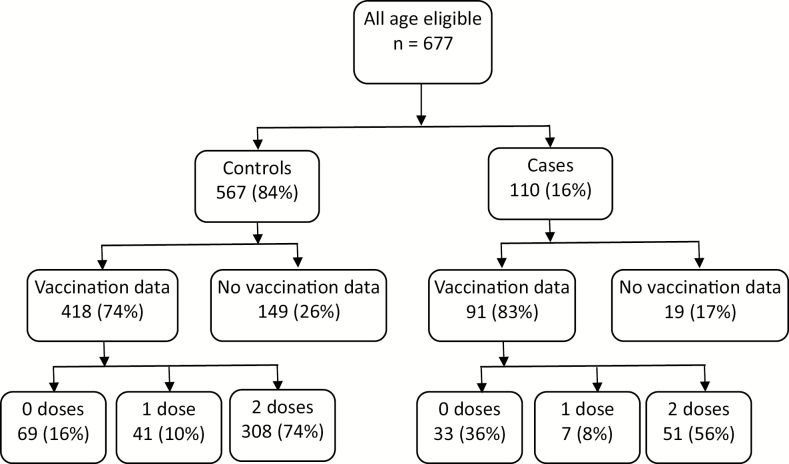
Among 677 eligible children, 110 (16%) were rotavirus positive. Vaccination data were available for 91 (83%) cases; 51 (56%) had 2 RV1 doses and 33 (36%) 0 doses. Among 567 controls, 418 (74%) had vaccination data; 308 (74%) had 2 doses and 69 (16%) 0 doses. Overall 2-dose effectiveness was 64% (95% confidence interval [CI], 35%–80%); effectiveness was 67% (95% CI, 30%–84%) for children aged <12 months and 72% (95% CI, 10%–91%) for children aged ≥12 months. Significant effectiveness was seen in children with normal weight for age, length/height for age and weight for length/height; however, no protection was found among underweight, stunted, or wasted children.
Conclusions
RV1 in the Kenyan immunization program provides significant protection against rotavirus-associated hospitalization which persisted beyond infancy. Malnutrition appears to diminish vaccine effectiveness. Efforts to improve rotavirus uptake and nutritional status are important to maximize vaccine benefit.
-
Subjects:
-
Source:Clin Infect Dis. 2019; 70(11):2298-2305
-
Pubmed ID:31326980
-
Pubmed Central ID:PMC7245145
-
Document Type:
-
Funding:
-
Place as Subject:
-
Volume:70
-
Issue:11
-
Collection(s):
-
Main Document Checksum:urn:sha256:dbbf645ec1aafdd0cd97d9cefeb1f20556dcce4b9aa5592a76755d5fc87b21d5
-
Download URL:
-
File Type:
 [PDF
- 8.37 MB
]
[PDF
- 8.37 MB
]
Supporting Files


File Language:
English
ON THIS PAGE


CDC STACKS serves as an archival repository of CDC-published products including
scientific findings,
journal articles, guidelines, recommendations, or other public health information authored or
co-authored by CDC or funded partners.
As a repository, CDC STACKS retains documents in their original published format to ensure public access to scientific information.
As a repository, CDC STACKS retains documents in their original published format to ensure public access to scientific information.
You May Also Like
COLLECTION
CDC Public Access