


Zoonotic Vectorborne Pathogens and Ectoparasites of Dogs and Cats in Eastern and Southeast Asia
Supporting Files
Public Domain

-
Jun 2020
-
File Language:
English
Details
-
Alternative Title:Emerg Infect Dis
-
Personal Author:Colella, Vito ; Nguyen, Viet L. ; Tan, Do Y. ; Lu, Na ; Fang, Fang ; Zhijuan, Yin ; Wang, Jiangwei ; Liu, Xin ; Chen, Xinghui ; Dong, Junyan ; Nurcahyo, Wisnu ; Hadi, Upik K. ; Venturina, Virginia ; Tong, Kenneth B.Y. ; Tsai, Yi-Lun ; Taweethavonsawat, Piyanan ; Tiwananthagorn, Saruda ; Le, Thong Q. ; Bui, Khanh L. ; Watanabe, Malaika ; Rani, Puteri A.M.A. ; Annoscia, Giada ; Beugnet, Frédéric ; Otranto, Domenico ; Halos, Lénaïg
-
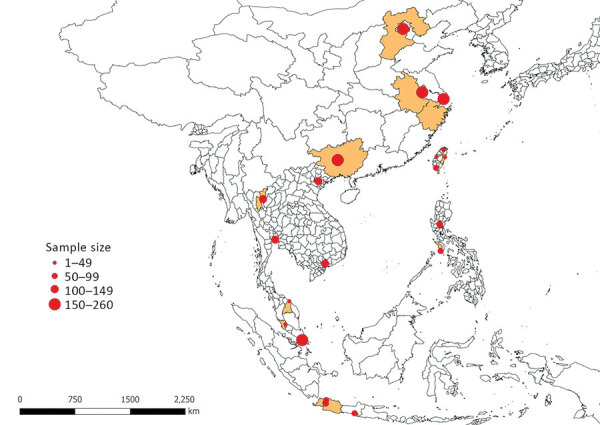
Description:To provide data that can be used to inform treatment and prevention strategies for zoonotic pathogens in animal and human populations, we assessed the occurrence of zoonotic pathogens and their vectors on 2,381 client-owned dogs and cats living in metropolitan areas of 8 countries in eastern and Southeast Asia during 2017-2018. Overall exposure to ectoparasites was 42.4% in dogs and 31.3% in cats. Our data cover a wide geographic distribution of several pathogens, including Leishmania infantum and zoonotic species of filariae, and of animals infested with arthropods known to be vectors of zoonotic pathogens. Because dogs and cats share a common environment with humans, they are likely to be key reservoirs of pathogens that infect persons in the same environment. These results will help epidemiologists and policy makers provide tailored recommendations for future surveillance and prevention strategies.
-
Subjects:
-
Source:Emerg Infect Dis. 26(6):1221-1233
-
Pubmed ID:32441628
-
Pubmed Central ID:PMC7258489
-
Document Type:
-
Volume:26
-
Issue:6
-
Collection(s):
-
Main Document Checksum:urn:sha256:e733e3a7e5b08ddab29edadcb96fd69b41cdcae8363899ccdf1eaf831eaffd8e
-
Download URL:
-
File Type:
 [PDF
- 4.50 MB
]
[PDF
- 4.50 MB
]
Supporting Files


File Language:
English
ON THIS PAGE



CDC STACKS serves as an archival repository of CDC-published products including
scientific findings,
journal articles, guidelines, recommendations, or other public health information authored or
co-authored by CDC or funded partners.
As a repository, CDC STACKS retains documents in their original published format to ensure public access to scientific information.
As a repository, CDC STACKS retains documents in their original published format to ensure public access to scientific information.
You May Also Like
COLLECTION
Emerging Infectious Diseases