



Nationwide Monitoring for Plasmodium falciparum Drug-Resistance Alleles to Chloroquine, Sulfadoxine, and Pyrimethamine, Haiti, 2016–2017
Supporting Files
Public Domain

-
May 2020
File Language:
English
Details
-
Alternative Title:Emerg Infect Dis
-
Personal Author:Rogier, Eric ; Herman, Camelia ; Huber, Curtis S. ; Hamre, Karen E.S. ; Pierre, Baby ; Mace, Kimberly E. ; Présumé, Jacquelin ; Mondélus, Gina ; Romilus, Ithamare ; Elismé, Tamara ; Eisele, Thomas P. ; Druetz, Thomas ; Existe, Alexandre ; Boncy, Jacques ; Lemoine, Jean F. ; Udhayakumar, Venkatachalam ; Chang, Michelle A.
-
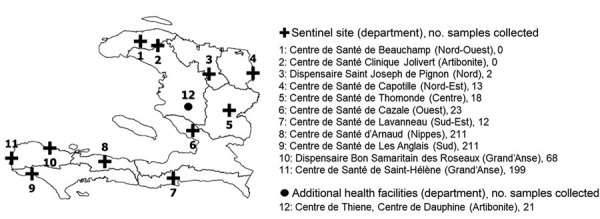
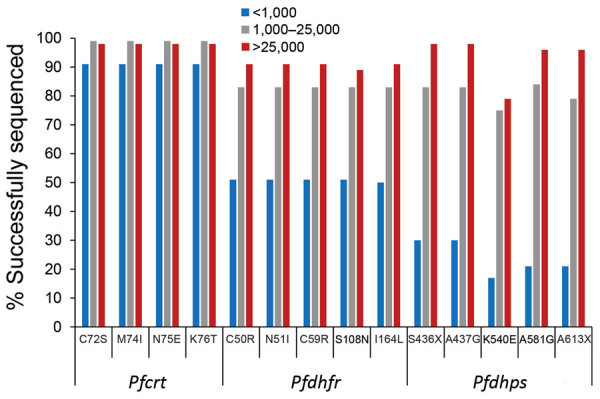
Description:Haiti is striving for zero local malaria transmission by the year 2025. Chloroquine remains the first-line treatment, and sulfadoxine/pyrimethamine (SP) has been used for mass drug-administration pilot programs. In March 2016, nationwide molecular surveillance was initiated to assess molecular resistance signatures for chloroquine and SP. For 778 samples collected through December 2017, we used Sanger sequencing to investigate putative resistance markers to chloroquine (Pfcrt codons 72, 74, 75, and 76), sulfadoxine (Pfdhps codons 436, 437, 540, 581, 613), and pyrimethamine (Pfdhfr codons 50, 51, 59, 108, 164). No parasites harbored Pfcrt point mutations. Prevalence of the Pfdhfr S108N single mutation was 47%, and we found the triple mutant Pfdhfr haplotype (108N, 51I, and 59R) in a single isolate. We observed no Pfdhps variants except in 1 isolate (A437G mutation). These data confirm the lack of highly resistant chloroquine and SP alleles in Haiti and support the continued use of chloroquine and SP.
-
Subjects:
-
Source:Emerg Infect Dis. 26(5):902-909
-
Pubmed ID:32310062
-
Pubmed Central ID:PMC7181918
-
Document Type:
-
Place as Subject:
-
Volume:26
-
Issue:5
-
Download URL:
-
File Type:
 [PDF - 1.44 MB]
 -
Collection(s):
-
Main Document Checksum:urn:sha256:8eebbfd9e1934d5a107b6f063089dd21ced060b01a0adfee6e8a79beeca04f67
Supporting Files


File Language:
English
 Was this page helpful?
 Found an issue?

CDC STACKS serves as an archival repository of CDC-published products including
scientific findings, journal articles, guidelines, recommendations, or other public health information authored or
co-authored by CDC or funded partners.
As a repository, CDC STACKS retains documents in their original published format to ensure public access to scientific information.
As a repository, CDC STACKS retains documents in their original published format to ensure public access to scientific information.
You May Also Like
COLLECTION
Emerging Infectious Diseases