



Factors Associated With Latent Tuberculosis Infection Treatment Failure Among Patients With Commercial Health Insurance—United States, 2005–2016
Supporting Files

-
Jul-Aug 2021
-
Available in CDC Stacks on 2021-04-30T00:00:00Z
File Language:
English
Details
-
Journal Article:J Public Health Manag Pract
-
Personal Author:
-
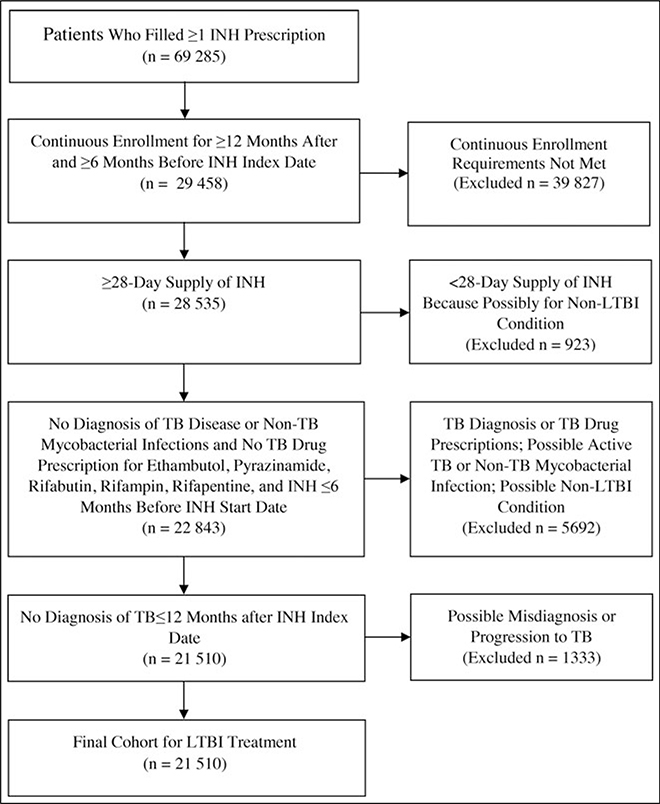
Description:Context ; Approximately 80% of US tuberculosis (TB) cases verified during 2015–2016 were attributed to untreated latent TB infection (LTBI). Identifying factors associated with LTBI treatment failure might improve treatment effectiveness. ; Objective ; To identify patients with indicators of isoniazid (INH) LTBI treatment initiation, completion, and failure. ; Methods ; We searched inpatient and outpatient claims for International Classification of Diseases (Ninth and Tenth Revisions), National Drug, and Current Procedural Terminology codes. We defined treatment completion as 180 days or more of INH therapy during a 9-month period. We defined LTBI treatment failure as an active TB disease diagnosis more than 1 year after starting LTBI treatment among completers and used exact logistic regression to model possible differences between groups. Among treatment completers, we matched 1 patient who failed treatment with 2 control subjects and fit regression models with covariates documented on medical claims paid 6 months or less before INH treatment initiation. ; Participants ; Commercially insured US patients in a large commercial database with insurance claims paid during 2005–2016. ; Main Outcome Measures ; (1) Trends in treatment completion; (2) odds ratios (ORs) for factors associated with treatment completion and treatment failure. ; Results ; Of 21 510 persons who began LTBI therapy during 2005–2016, 10 725 (49.9%) completed therapy. Treatment noncompletion is associated with those younger than 45 years, living in the Northeast or South Census regions, and women. Among persons who completed treatment, 30 (0.3%) progressed to TB disease. Diagnoses of rheumatoid arthritis during the 6 months before treatment initiation and being aged 65 years or older (reference: ages 0–24 years) were significantly associated with INH LTBI treatment failure (adjusted exact OR = 5.1; 95% CI, 1.2–28.2; and adjusted exact OR = 5.1; 95% CI, 1.2–25.3, respectively). ; Conclusion ; Approximately 50% of persons completed INH LTBI therapy, and of those, treatment failure was associated with rheumatoid arthritis and persons 65 years or older among a cohort of US LTBI patients with commercial health insurance.
-
Subjects:
-
Keywords:
- administrative data
- arthritis
- claims data
- epidemiology
- failure
- health service delivery
- isoniazid
- latent
- latent tuberculosis infection
- LTBI
- medication adherence
- Mycobacterium tuberculosis infection
- public health practice
- rheumatoid
- treatment
- treatment completion
- treatment failures
- tuberculosis infection
-
Source:J Public Health Manag Pract. 27(4):E151-E161
-
DOI:
-
Pubmed ID:31688742
-
Pubmed Central ID:PMC7190404
-
Document Type:
-
Funding:
-
Genre:
-
Volume:27
-
Issue:4
-
Download URL:
-
File Type:
 [PDF - 603.25 KB]
 -
Collection(s):
-
Main Document Checksum:urn:sha-512:70a7c75b91655cd2ee5e10e3de7d48700c932a29ac835d77f54b995dd81ddf96a127807e4d9c250951c00d822efe0c2a3a823059312bf2d592fb33e8a5215401
Supporting Files


File Language:
English
 Was this page helpful?
 Found an issue?

CDC STACKS serves as an archival repository of CDC-published products including
scientific findings, journal articles, guidelines, recommendations, or other public health information authored or
co-authored by CDC or funded partners.
As a repository, CDC STACKS retains documents in their original published format to ensure public access to scientific information.
As a repository, CDC STACKS retains documents in their original published format to ensure public access to scientific information.
You May Also Like
COLLECTION
CDC Public Access