


Potential of the Community Counts registry to characterize rare bleeding disorders
Supporting Files

-
2019 November
-
File Language:
English
Details
-
Alternative Title:Haemophilia
-
Personal Author:
-
Description:Introduction:
Rare bleeding disorders (RBDs) comprise of heterogeneous coagulation factor deficiencies and platelet disorders that are underreported worldwide.
Aim:
First report on RBD data from United States haemophilia treatment center network (USHTCN).
Methods:
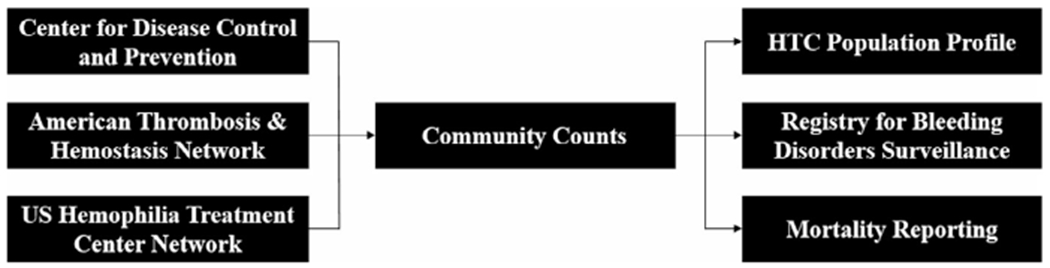
A national surveillance system for the federally recognized USHTCN developed in collaboration with the Centers for Disease Control and Prevention (CDC) and American Thrombosis and Haemostasis Network (ATHN) was queried for patients with RBDs. Patient counts were extracted from the HTC Population Profile (HTC PP) component including limited data on patients followed through the USHTCN, and from the Registry component, including patient authorized, detailed clinical data. The prevalence of RBDs in the United States was estimated based on the HTC PP data and compared to the expected national prevalence based on data extrapolated from Orphanet, an international registry.
Results:
Based on the estimated prevalence of RBD in the overall 2017 US population, the cases in the HTC network were lower than expected for FI, FII, FX, and FV + FVIII deficiencies by 36%, 61%, 75% and 94%, respectively, and higher than expected for FXIII, FV, FVII, and FXI deficiencies by 7%, 14%, 33% and 185%, respectively. The proportion of RBD patients reported in the HTC PP, enrolled in the Registry, was 10.8%.
Conclusions:
There is a clear need to identify individuals with RBDs who could benefit from the comprehensive care provided in the USHTCN. In addition, increased enrolment of people with all RBDs in the Registry is needed to improve knowledge of treatment outcomes of patients with RBDs in the United States.
-
Subjects:
-
Source:Haemophilia. 25(6):1045-1050
-
Pubmed ID:31509320
-
Pubmed Central ID:PMC7189335
-
Document Type:
-
Funding:
-
Volume:25
-
Issue:6
-
Collection(s):
-
Main Document Checksum:urn:sha256:63be36e299baed6b4419db17eb30189e90e2de6a0632138a820bc649874c9243
-
Download URL:
-
File Type:
 [PDF
- 102.15 KB
]
[PDF
- 102.15 KB
]
Supporting Files


File Language:
English
ON THIS PAGE


CDC STACKS serves as an archival repository of CDC-published products including
scientific findings,
journal articles, guidelines, recommendations, or other public health information authored or
co-authored by CDC or funded partners.
As a repository, CDC STACKS retains documents in their original published format to ensure public access to scientific information.
As a repository, CDC STACKS retains documents in their original published format to ensure public access to scientific information.
You May Also Like
COLLECTION
CDC Public Access