



Use of benzodiazepine medications during pregnancy and potential risk for birth defects, National Birth Defects Prevention Study, 1997-2011
Supporting Files

-
2019/03/19
-
Available in CDC Stacks on June 01, 2020, 12:00 AM
File Language:
English
Details
-
Alternative Title:Birth Defects Res
-
Personal Author:
-
Description:Background
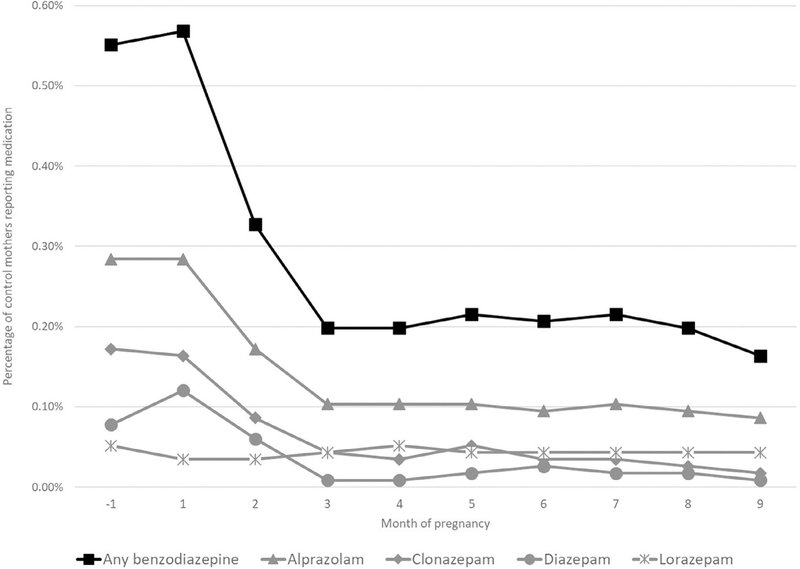
Benzodiazepine medications can be used to treat anxiety, a condition affecting 15% of women of childbearing age in the United States. Studies have shown conflicting results for the association between benzodiazepine use during pregnancy and birth defects.
Methods
We analyzed 1997-2011 data from the National Birth Defects Prevention Study, a multisite, population-based case-control study. We assessed the prevalence of and factors associated with benzodiazepine use in pregnancy among mothers of live-born infants without a birth defect (control mothers). We used logistic regression to estimate adjusted odds ratios (aORs) and 95% confidence intervals (CIs) for the association between specific birth defects and benzodiazepine use; we estimated crude odds ratios (cORs) for defect categories with 3-4 exposed cases.
Results
Exposure to benzodiazepines during pregnancy was rare (N = 93/11,614; 0.8%). Benzodiazepine use was more common among control mothers who were ≥30 years, non-Hispanic white, had more education, smoked, and took antidepressant medication. We observed significantly elevated ORs for any benzodiazepine and Dandy-Walker malformation (cOR: 3.1; 95% CI: 1.1, 8.6); for alprazolam and anophthalmia or microphthalmia (cOR: 4.0; 95% CI: 1.2, 13.1) and esophageal atresia or stenosis (aOR: 2.7; 95% CI: 1.2, 5.9); and lorazepam and pulmonary valve stenosis (cOR: 4.1; 95% CI: 1.2, 14.2), but sample sizes were limited and therefore CIs were wide.
Conclusions
Our findings suggest that benzodiazepines use is rare and may be associated with risk for certain birth defects. However, these results need replication and should be interpreted with caution. -
Subjects:
-
Source:Birth Defects Res. 111(10):613-620
-
Pubmed ID:30891943
-
Pubmed Central ID:PMC7186570
-
Document Type:
-
Funding:
-
Genre:
-
Volume:111
-
Issue:10
-
Download URL:
-
File Type:
 [PDF - 443.78 KB]
 -
Collection(s):
-
Main Document Checksum:urn:sha-512:b50c313e0be3b5d98aa11febd64e13cef4b2dc8e092b42dd98ae607f1c4a2e71215d1e5d009c09b35a102aea987880a66b4818e2eeaae39715ff9e7ae25da673
Supporting Files


File Language:
English
 Was this page helpful?
 Found an issue?


CDC STACKS serves as an archival repository of CDC-published products including
scientific findings, journal articles, guidelines, recommendations, or other public health information authored or
co-authored by CDC or funded partners.
As a repository, CDC STACKS retains documents in their original published format to ensure public access to scientific information.
As a repository, CDC STACKS retains documents in their original published format to ensure public access to scientific information.
You May Also Like
COLLECTION
CDC Public Access