


Inflammatory, structural, and pain biochemical biomarkers may reflect radiographic disc space narrowing: The Johnston County Osteoarthritis Project
Supporting Files

-
December 04 2019
-
File Language:
English
Details
-
Alternative Title:J Orthop Res
-
Personal Author:
-
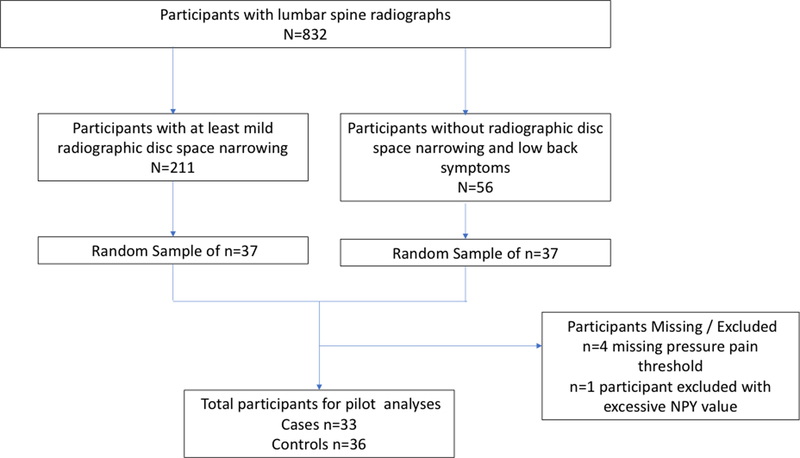
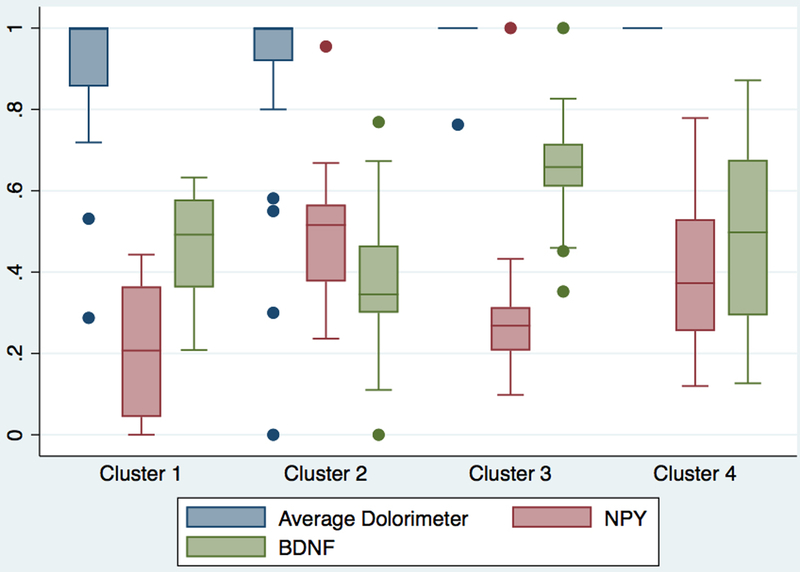
Description:The purpose of this work is to determine the relationship between biomarkers of inflammation, structure, and pain with radiographic disc space narrowing (DSN) in community-based participants. A total of 74 participants (37 cases and 37 controls) enrolled in the Johnston County Osteoarthritis Project during 2006-2010 were selected. The cases had at least mild radiographic DSN and low back pain (LBP). The controls had neither radiographic evidence of DSN nor LBP. The measured analytes from human serum included N-cadherin, Keratin-19, Lumican, CXCL6, RANTES, IL-17, IL-6, BDNF, OPG, and NPY. A standard dolorimeter measured pressure-pain threshold. The coefficients of variation were used to evaluate inter- and intra-assay reliability. Participants with similar biomarker profiles were grouped together using cluster analysis. The binomial regression models were used to estimate risk ratios (RR) and 95% confidence intervals (CI) in propensity score-matched models. Significant associations were found between radiographic DSN and OPG (RR = 3.90; 95% CI: 1.83, 8.31), IL-6 (RR = 2.54; 95% CI: 1.92, 3.36), and NPY (RR = 2.06 95% CI: 1.62, 2.63). Relative to a cluster with low levels of biomarkers, a cluster representing elevated levels of OPG, RANTES, Lumican, Keratin-19, and NPY (RR = 3.04; 95% CI: 1.22, 7.54) and a cluster representing elevated levels of NPY (RR = 2.91; 95% CI: 1.15, 7.39) were significantly associated with radiographic DSN. Clinical Significance: These findings suggest that individual and combinations of biochemical biomarkers may reflect radiographic DSN. This is just one step toward understanding the relationships between biochemical biomarkers and DSN that may lead to improved intervention delivery. © 2019 Orthopaedic Research Society. Published by Wiley Periodicals, Inc. J Orthop Res 38:1027-1037, 2020.
-
Subjects:
-
Source:J Orthop Res. 38(5):1027-1037
-
Pubmed ID:31750565
-
Pubmed Central ID:PMC7162706
-
Document Type:
-
Funding:R01 AR067743/AR/NIAMS NIH HHS/United States ; P60 AR049465/AR/NIAMS NIH HHS/United States ; U01 DP006266/DP/NCCDPHP CDC HHS/United States ; P60 AR030701/AR/NIAMS NIH HHS/United States ; R01 AR075399/AR/NIAMS NIH HHS/United States ; R01 AR065527/AR/NIAMS NIH HHS/United States ; P60 AR064166/AR/NIAMS NIH HHS/United States ; U01 DP003206/DP/NCCDPHP CDC HHS/United States ; R01 AR071440/AR/NIAMS NIH HHS/United States ; R01 AR074800/AR/NIAMS NIH HHS/United States ; P30 AR072580/AR/NIAMS NIH HHS/United States ; L30 AR057661/AR/NIAMS NIH HHS/United States ; P30 AG028716/AG/NIA NIH HHS/United States
-
Volume:38
-
Issue:5
-
Collection(s):
-
Main Document Checksum:urn:sha256:247adbb8467af8700aea4387398d7c4d455033f8b01bf7d6478163bbe96ee485
-
Download URL:
-
File Type:
 [PDF
- 898.29 KB
]
[PDF
- 898.29 KB
]
Supporting Files


File Language:
English
ON THIS PAGE





CDC STACKS serves as an archival repository of CDC-published products including
scientific findings,
journal articles, guidelines, recommendations, or other public health information authored or
co-authored by CDC or funded partners.
As a repository, CDC STACKS retains documents in their original published format to ensure public access to scientific information.
As a repository, CDC STACKS retains documents in their original published format to ensure public access to scientific information.
You May Also Like
COLLECTION
CDC Public Access