



Ecology and Epidemiology of Tickborne Pathogens, Washington, USA, 2011–2016
Supporting Files
Public Domain

-
Apr 2020
File Language:
English
Details
-
Alternative Title:Emerg Infect Dis
-
Personal Author:
-
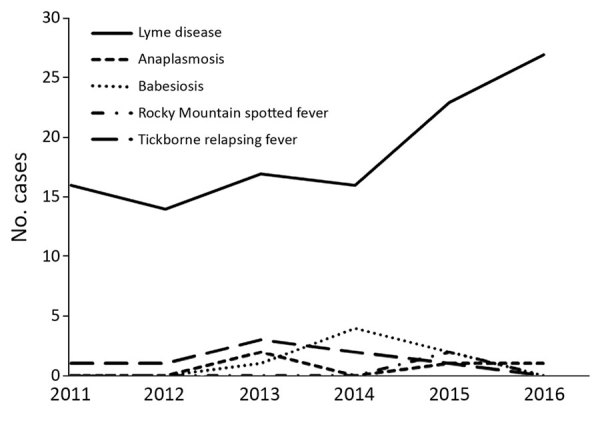
Description:Tickborne diseases are rare in Washington, USA, and the ecology of these pathogens is poorly understood. We integrated surveillance data from humans and ticks to better describe their epidemiology and ecology. During 2011-2016, a total of 202 tickborne disease cases were reported in Washington residents. Of these, 68 (34%) were autochthonous, including cases of Lyme disease, Rocky Mountain spotted fever, tickborne relapsing fever, and tularemia. During May 2011-December 2016, we collected 977 host-seeking ticks, including Ixodes pacificus, I. angustus, I. spinipalpis, I. auritulus, Dermacentor andersoni, and D. variabilis ticks. The prevalence of Borrelia burgdorferi sensu stricto in I. pacificus ticks was 4.0%; of B. burgdorferi sensu lato, 3.8%; of B. miyamotoi, 4.4%; and of Anaplasma phagocytophilum, 1.9%. We did not detect Rickettsia rickettsii in either Dermacentor species. Case-patient histories and detection of pathogens in field-collected ticks indicate that several tickborne pathogens are endemic to Washington.
-
Subjects:
-
Source:Emerg Infect Dis. 26(4):648-657
-
Pubmed ID:32187009
-
Pubmed Central ID:PMC7101130
-
Document Type:
-
Place as Subject:
-
Location:
-
Volume:26
-
Issue:4
-
Download URL:
-
File Type:
 [PDF - 2.68 MB]
 -
Collection(s):
-
Main Document Checksum:urn:sha256:58b99a01d0ae7f7b25b11affd77902911741eff164e78223c7e7c8b56f45ef5f
Supporting Files


File Language:
English
 Was this page helpful?
 Found an issue?





CDC STACKS serves as an archival repository of CDC-published products including
scientific findings, journal articles, guidelines, recommendations, or other public health information authored or
co-authored by CDC or funded partners.
As a repository, CDC STACKS retains documents in their original published format to ensure public access to scientific information.
As a repository, CDC STACKS retains documents in their original published format to ensure public access to scientific information.
You May Also Like
COLLECTION
Emerging Infectious Diseases