


Obesity and Risk for Second Malignant Neoplasms in Childhood Cancer Survivors: A Case-Control Study Utilizing the California Cancer Registry
Supporting Files

-
10 2019
-
File Language:
English
Details
-
Journal Article:Cancer Epidemiol Biomarkers Prev
-
Personal Author:
-
Description:Background:
Obesity is a known modifiable risk factor associated with adverse outcomes in children with cancer. We sought to determine if obesity during childhood cancer treatment increases risk for second malignant neoplasms (SMNs).
Methods:
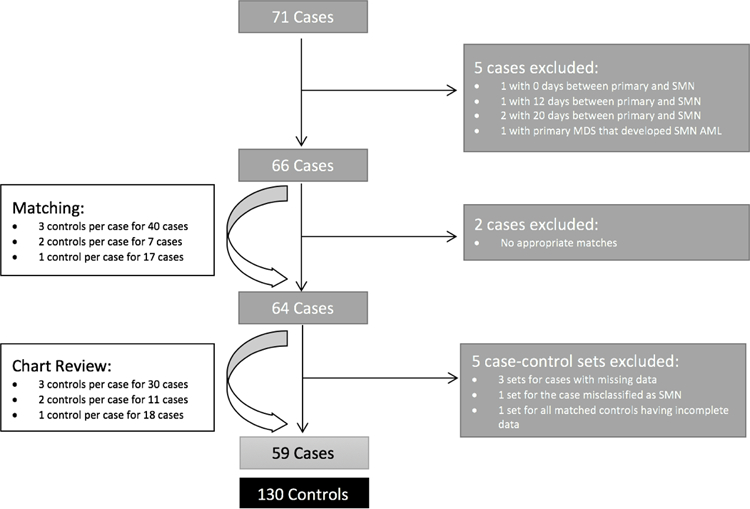
In this case-control study, cases (with SMN) and controls (with a single primary cancer) were selected from the California Cancer Registry who had primary cancer diagnosed <21 years treated at Children’s Hospital Los Angeles (CHLA) between 1988–2014. Controls were matched 3:1 to cases at the registry level by clinical factors. Medical records were abstracted for cancer treatment exposures, cancer predisposition syndrome, body mass index (BMI), BMI Z-score, and BMI category at diagnosis and EOT.
Results:
Fifty-nine cases and 130 controls were included. Median age at primary cancer diagnosis was 6 years, 64.5% were male, median time from primary cancer to SMN was 7.5 years, and 31.7% were obese or overweight. In matched multivariable analyses, there were elevated but non-significant associations between SMN and higher BMI Z-score at diagnosis (OR 1.27 [0.99–1.63]) and higher BMI categories at diagnosis (adjusted OR [aOR] overweight 1.25 [0.55–2.52]; aOR obese 2.51 [1.00–6.29]). There was a significantly increased risk for SMN among patients who were obese at both diagnosis and EOT (aOR 4.44 [1.37–14.34]).
Conclusions:
This study suggests obesity during childhood cancer treatment may be associated with increased risk for SMNs, particularly among those obese throughout therapy.
Impact:
Additional studies to confirm these findings and to develop interventions have the potential to impact SMN development in children with cancer.
-
Subjects:
-
Source:Cancer Epidemiol Biomarkers Prev. 28(10):1612-1620
-
DOI:
-
Pubmed ID:31337641
-
Pubmed Central ID:PMC6774883
-
Document Type:
-
Funding:HHSN261201800009C/CA/NCI NIH HHSUnited States/ ; NU58DP006344/DP/NCCDPHP CDC HHSUnited States/ ; T32 CA009659/CA/NCI NIH HHSUnited States/ ; HHSN261201800015I/CA/NCI NIH HHSUnited States/ ; HHSN261201800010I/CA/NCI NIH HHSUnited States/ ; UL1 TR001855/TR/NCATS NIH HHSUnited States/ ; HHSN261201800015C/CA/NCI NIH HHSUnited States/ ; HHSN261201800010C/CA/NCI NIH HHSUnited States/ ; HHSN261201800009I/CA/NCI NIH HHSUnited States/
-
Genre:
-
Volume:28
-
Issue:10
-
Collection(s):
-
Main Document Checksum:urn:sha-512:c15607ee1af55831978d31abe7319ca94667a78ad29632aa320c5b334635531b4dbfb5039a988037472b9515e5b965e946970ddd793c9be634d24ab6a58edbb8
-
Download URL:
-
File Type:
 [PDF
- 193.49 KB
]
[PDF
- 193.49 KB
]
Supporting Files


File Language:
English
ON THIS PAGE

CDC STACKS serves as an archival repository of CDC-published products including
scientific findings,
journal articles, guidelines, recommendations, or other public health information authored or
co-authored by CDC or funded partners.
As a repository, CDC STACKS retains documents in their original published format to ensure public access to scientific information.
As a repository, CDC STACKS retains documents in their original published format to ensure public access to scientific information.
You May Also Like
COLLECTION
CDC Public Access