



Job complexity and hazardous working conditions: How do they explain educational gradient in mortality?
Supporting Files

-
6-2020
-
Available in CDC Stacks on 2021-06-01T00:00:00Z
File Language:
English
Details
-
Journal Article:J Occup Health Psychol
-
Personal Author:
-
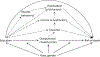
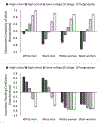
Description:Although education's protective effects on health have been well recognized, specific mechanisms through which higher education is associated with better health are still debated. Occupation, although strongly shaped by education, has rarely been examined as a mediating mechanism. Education attainment is patterned by race in the United States, and the same education does not lead to similar occupations for members of different racial/ethnic groups. Therefore, examining the link from education to jobs to mortality can illuminate potential mechanisms that create racial health disparities. Using a large U.S. national cohort of Black and White men and women, we examined if 2 occupational characteristics, substantive complexity of work and hazardous working conditions, mediate the effect of education on mortality. Data on occupation were collected between 2011 and 2013, and mortality follow-up data up to March 2018 were included in this analysis. The race- and gender-stratified analyses showed that among White men, the association between higher education and lower mortality was mediated by lower hazard on the job. Among Black men and White women, higher complexity of work explained the association between higher education and lower mortality. Among Black women, neither job characteristic mediated the association. These results suggest that occupational characteristics help explain health inequalities not only by education but also by race and gender. Investigating occupation explicitly in the causal chain of health disparities will help us better understand the mechanism of and potential solutions for health inequalities. (PsycInfo Database Record (c) 2020 APA, all rights reserved).
-
Keywords:
- socioeconomic status
- occupational hazards
- substantive complexity of work
- mediation analysis
- health disparities
- Black or African American
- Cohort Studies
- Educational Status
- Female
- Health Status Disparities
- Humans
- Male
- Middle Aged
- Mortality
- Occupational Exposure
- Sex Distribution
- United States
- White People
-
Source:J Occup Health Psychol. 25(3):176-186
-
DOI:
-
Pubmed ID:31566401
-
Pubmed Central ID:PMC7103547
-
Document Type:
-
Funding:
-
Genre:
-
Volume:25
-
Issue:3
-
Download URL:
-
File Type:
 [PDF - 1.31 MB]
 -
Collection(s):
-
Main Document Checksum:urn:sha-512:f2dd2289f684c6fee13cc19777e768614b42fa46a4df85602b99d17e11f0fe6308f4e9b329a6c304e2c7f5c5fce9800dd29cb4fea0da6fb4550d76b4ec1d6fce
Supporting Files


File Language:
English
 Was this page helpful?
 Found an issue?



CDC STACKS serves as an archival repository of CDC-published products including
scientific findings, journal articles, guidelines, recommendations, or other public health information authored or
co-authored by CDC or funded partners.
As a repository, CDC STACKS retains documents in their original published format to ensure public access to scientific information.
As a repository, CDC STACKS retains documents in their original published format to ensure public access to scientific information.
You May Also Like
COLLECTION
CDC Public Access