



Prevalence and Trends of Developmental Disabilities among Children in the US: 2009-2017
Supporting Files

-
2019/10/01
-
Available in CDC Stacks on 2020-10-01T00:00:00Z
File Language:
English
Details
-
Alternative Title:Pediatrics
-
Personal Author:
-
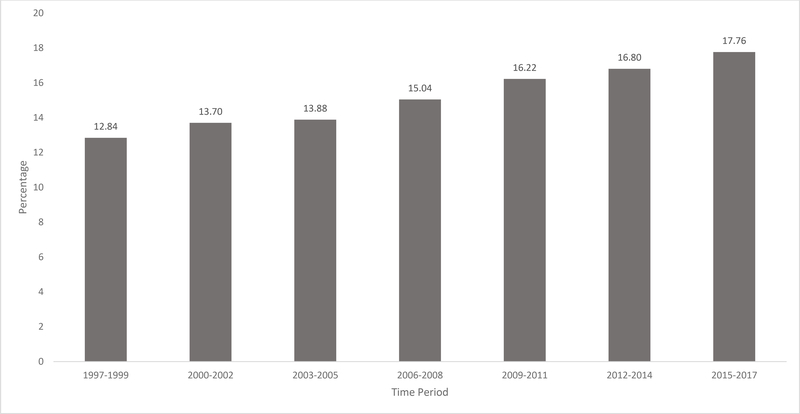
Description:Objective ; To study the national prevalence of ten developmental disabilities in US children aged 3-17 years and explore changes over time by associated demographic and socioeconomic characteristics using the 2009-2017 National Health Interview Survey (NHIS). ; Methods ; Data come from the NHIS, a nationally-representative survey of the civilian noninstitutionalized population. Parents reported physician or other health care professional diagnoses of attention-deficit/hyperactivity disorder (ADHD); autism spectrum disorder (ASD); blindness; cerebral palsy; moderate to profound hearing loss; learning disability (LD); intellectual disability (ID); seizures; stuttering or stammering; and other developmental delays. Weighted percentages for each of the selected developmental disabilities and any developmental disability were calculated between 2009-2017 and stratified by selected demographic/socioeconomic characteristics. ; Results ; From 2009-2011 to 2015-2017, there were overall significant increases in the prevalence of any developmental disability (16.2% to 17.8%, p<.001), ADHD (8.5% to 9.5%, p<.01), ASD (1.1% to 2.5%, p<.001), and ID (0.9% to 1.2%, p<.05), but a significant decrease for any other developmental delay (4.7% to 4.1%, p<.05). The prevalence of any developmental disability increased among boys, children ages 12-17, non-Hispanic white and Hispanic children, children with private insurance only, and children with birthweights ≥2,500 grams. An increase in prevalence of any developmental disability was also seen for children living in urban areas and with less educated mothers. ; Conclusions ; The prevalence of developmental disability among US children aged 3-17 years increased between 2009-2017. Changes by demographic and socioeconomic subgroups may be related to improvements in awareness and access to health care.
-
Subjects:
- Adolescent
- Age Factors
- Attention Deficit Disorder with Hyperactivity
- Autism Spectrum Disorder
- Blindness
- Cerebral Palsy
- Child
- Child, Preschool
- Developmental Disabilities
- Educational Status
- Female
- Hearing Loss
- Humans
- Insurance Coverage
- Intellectual Disability
- Male
- Population Dynamics
- Prevalence
- Seizures
- Sex Factors
-
Source:Pediatrics. 144(4)
-
Pubmed ID:31558576
-
Pubmed Central ID:PMC7076808
-
Document Type:
-
Funding:
-
Genre:
-
Place as Subject:
-
Volume:144
-
Issue:4
-
Download URL:
-
File Type:
 [PDF - 213.47 KB]
 -
Collection(s):
-
Main Document Checksum:urn:sha-512:9670fcdeef96efa691cf581fbcbc3ddc0fdb479775396362aa14a31637ce41d613aaf897a076d6696c3c3c3907e9c6c24ca42ff90e068b07429a1c582bcf6b5a
Supporting Files


File Language:
English
 Was this page helpful?
 Found an issue?

CDC STACKS serves as an archival repository of CDC-published products including
scientific findings, journal articles, guidelines, recommendations, or other public health information authored or
co-authored by CDC or funded partners.
As a repository, CDC STACKS retains documents in their original published format to ensure public access to scientific information.
As a repository, CDC STACKS retains documents in their original published format to ensure public access to scientific information.
You May Also Like
COLLECTION
CDC Public Access