



Clinical Characteristics of Disseminated Strongyloidiasis, Japan, 1975–2017
Supporting Files
Public Domain

-
Mar 2020
File Language:
English
Details
-
Alternative Title:Emerg Infect Dis
-
Personal Author:
-
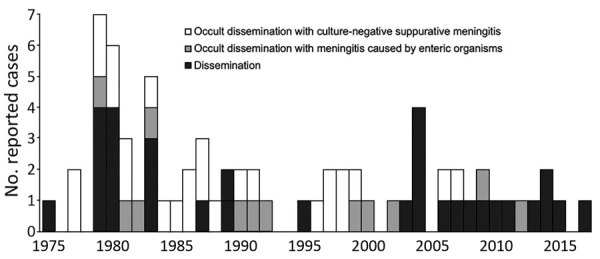
Description:Clinical characteristics of disseminated strongyloidiasis, the severest form of strongyloidiasis, are not well described. We conducted a retrospective, consecutive chart review of patients with disseminated strongyloidiasis admitted to Okinawa Chubu Hospital in Okinawa, Japan, during January 1975-December 2017. The 70 patients were classified into 3 clinical phenotypes: dissemination (32 patients 45.7%), occult dissemination with meningitis caused by enteric organisms (12 patients 17.1%), and occult dissemination with culture-negative suppurative meningitis (26 patients 37.1%). Associated mortality rates were 56.3%, 16.7%, and 11.5%, respectively, and sepsis occurred in 40.6%, 58.3%, and 11.5% of cases, respectively. Common symptoms included fever (52.9% of patients), headache (32.9%), and altered mental status (24.3%). Patients were treated with thiabendazole (before 2003) or ivermectin (after 2003). Our findings show that disseminated strongyloidiasis has clinical phenotypes in terms of severity and that identification of occult dissemination, a mild form with prominent neurologic manifestations, is lifesaving.
-
Subjects:
-
Source:Emerg Infect Dis. 26(3):401-408
-
Pubmed ID:32091375
-
Pubmed Central ID:PMC7045830
-
Document Type:
-
Place as Subject:
-
Location:
-
Volume:26
-
Issue:3
-
Download URL:
-
File Type:
 [PDF - 1.51 MB]
 -
Collection(s):
-
Main Document Checksum:urn:sha256:e2e8fd0892f8daddce788814f53d78567f2c8b8c34eebda700ed319bcb0b7758
Supporting Files


File Language:
English
 Was this page helpful?
 Found an issue?

CDC STACKS serves as an archival repository of CDC-published products including
scientific findings, journal articles, guidelines, recommendations, or other public health information authored or
co-authored by CDC or funded partners.
As a repository, CDC STACKS retains documents in their original published format to ensure public access to scientific information.
As a repository, CDC STACKS retains documents in their original published format to ensure public access to scientific information.
You May Also Like
COLLECTION
Emerging Infectious Diseases