



Intimate Partner Violence and Controlling Behaviors Experienced by Emergency Department Patients: Differences by Sexual Orientation and Gender Identification
Supporting Files

-
June 2021
-
Available in CDC Stacks on 2020-02-22T00:00:00Z
File Language:
English
Details
-
Alternative Title:J Interpers Violence
-
Personal Author:
-
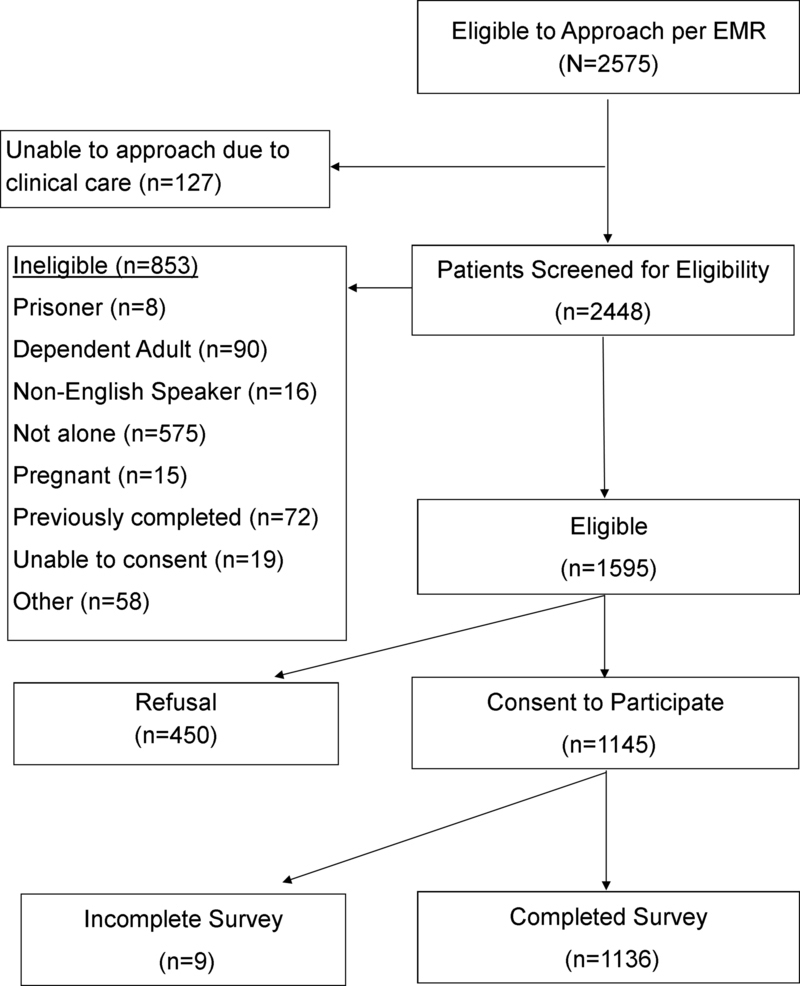
Description:Purpose ; The objective of this study was to estimate the prevalence of intimate partner violence (IPV) in an emergency department (ED) by sexual orientation and gender identification. ; Methods ; We conducted a cross-sectional survey of adult patients (n=1,136) presenting to a Level I Trauma Center ED from November 2015-November 2016. Multivariable logistic regression analysis was used to estimate the adjusted odds (aOR) of reporting any IPV or IPV subtypes (physical or sexual IPV or battering) by sexual orientation and gender identification, controlling for confounders. ; Results ; Overall, 11.6% (132/1136) of those surveyed were IPV positive. The prevalence of IPV was significantly higher in LGBTQ patients than in heterosexuals (18.3% vs 10.8%, p=0.0151); prevalence was highest among bisexuals (21.6%) and gay men (18.5%). IPV prevalence did not differ significantly in females versus males (13.5% vs 9.2%, p=0.0872). After controlling for age, the odds of reporting any IPV was highest among females (aOR=1.67 1.10–2.53); no significant differences were found by sexual orientation. Gay patients (aOR=5.50 1.60–18.94) and females (aOR=2.70 1.46–9.99) had significantly higher odds of reporting physical or sexual IPV than heterosexuals and males, respectively. ; Conclusions ; The study is among the first to report IPV prevalence by sexual orientation in an ED patient population. The reported IPV was higher among LGBTQ patients than heterosexual patients although this relationship diminished when controlling for covariates. These data begin to define the scope of IPV among LGBTQ ED patients and may be used to inform brief interventions to reduce the IPV-related morbidity experienced by ED patients.
-
Subjects:
-
Source:J Interpers Violence. 36(11-12):NP6125-NP6143
-
Pubmed ID:30465625
-
Pubmed Central ID:PMC7034778
-
Document Type:
-
Funding:
-
Volume:36
-
Download URL:
-
File Type:
 [PDF - 213.89 KB]
 -
Collection(s):
-
Main Document Checksum:urn:sha256:a189295a2d7d040ba7c99e4631d20f1ccfbd00ee400e542ba8f3f64566124a27
Supporting Files


File Language:
English
 Was this page helpful?
 Found an issue?

CDC STACKS serves as an archival repository of CDC-published products including
scientific findings, journal articles, guidelines, recommendations, or other public health information authored or
co-authored by CDC or funded partners.
As a repository, CDC STACKS retains documents in their original published format to ensure public access to scientific information.
As a repository, CDC STACKS retains documents in their original published format to ensure public access to scientific information.
You May Also Like
COLLECTION
CDC Public Access