



Job Strain, Time Strain, and Well-Being: A Longitudinal, Person-Centered Approach in Two Industries
Supporting Files

-
October 31 2018
-
File Language:
English
Details
-
Alternative Title:J Vocat Behav
-
Personal Author:
-
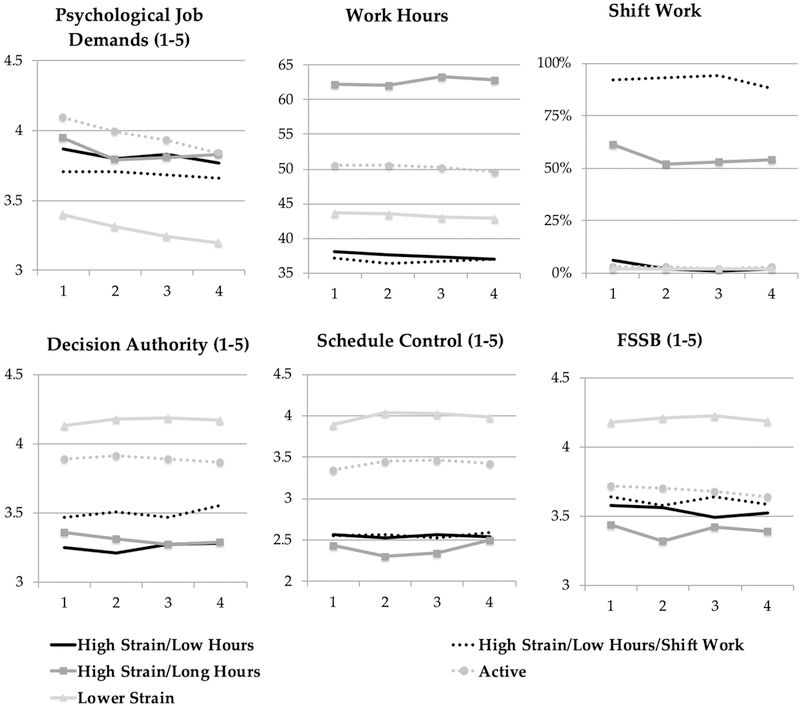
Description:The notion of constellations is central to many occupational health theories; empirical research is nevertheless dominated by variable-centered methodologies. Guided by the job demands-resources framework, we use a person-centered longitudinal approach to identify constellations of job demands and resources (task-based and time-based) over time that predict changes in well-being. We situate our research in two dissimilar, but growing, industries in the United States-information technology (IT) and long-term care. Drawing on data collected over 18 months, we identify five patterned, stable constellations of job demands/resources using group-based multi-trajectory modeling: (1) |, (2) |, (3) |, (4) | and (5) |. IT workers are overrepresented in the lower-strain and active constellations, whereas long-term care providers are more often in high-strain constellations. Workers in the lower-strain constellation experience increased job satisfaction and decreased emotional exhaustion, work-family conflict and psychological distress over 18 months. In comparison, workers in high-strain job constellations fare worse on these outcomes, as do those in the active constellation. Industrial contexts matter, however: Compared with long-term care workers, IT workers' well-being is more at risk when working in the "high strain/long hours" constellation. As the labor market continues to experience structural changes, scholars and policy makers need to attend to redesigning the ecological contexts of work conditions to promote workers' well-being while taking into account industrial differences.
-
Subjects:
-
Source:J Vocat Behav. 110(Pt A):102-116
-
Pubmed ID:31607754
-
Pubmed Central ID:PMC6788792
-
Document Type:
-
Funding:U01 HD051217/HD/NICHD NIH HHS/United States ; U01 HD051256/HD/NICHD NIH HHS/United States ; T03 OH008435/OH/NIOSH CDC HHS/United States ; U01 OH008788/OH/NIOSH CDC HHS/United States ; U01 AG027669/AG/NIA NIH HHS/United States ; U01 HD059773/HD/NICHD NIH HHS/United States ; U01 HD051276/HD/NICHD NIH HHS/United States ; U01 HD051218/HD/NICHD NIH HHS/United States
-
Volume:110
-
Collection(s):
-
Main Document Checksum:urn:sha256:c96f71994fef47373fe0e01c2929b19369446eb9fc993998d66858704e235cba
-
Download URL:
-
File Type:
 [PDF
- 329.89 KB
]
[PDF
- 329.89 KB
]
Supporting Files


File Language:
English
 Was this page helpful?
 Found an issue?


CDC STACKS serves as an archival repository of CDC-published products including
scientific findings,
journal articles, guidelines, recommendations, or other public health information authored or
co-authored by CDC or funded partners.
As a repository, CDC STACKS retains documents in their original published format to ensure public access to scientific information.
As a repository, CDC STACKS retains documents in their original published format to ensure public access to scientific information.
You May Also Like
COLLECTION
CDC Public Access