



Case Definitions Used During the First 6 Months of the 10th Ebola Virus Disease Outbreak in the Democratic Republic of the Congo — Four Neighboring Countries, August 2018–February 2019
Supporting Files
Public Domain

-
January 10 2020
File Language:
English
Details
-
Journal Article:Morbidity and Mortality Weekly Report (MMWR)
-
Personal Author:Medley, Alexandra M. ; Mavila, Oscar ; Makumbi, Issa ; Nizeyemana, Felicien ; Umutoni, Angela ; Balisanga, Hélène ; Manoah, Yona Kenyi ; Geissler, Aimee ; Bunga, Sudhir ; MacDonald, Gene ; Homsy, Jaco ; Ojwang, Joseph ; Ewetola, Raimi ; Raghunathan, Pratima L. ; MacGurn, Amanda ; Singler, Kimberly ; Ward, Sarah ; Roohi, Shahrokh ; Brown, Vance ; Shoemaker, Trevor ; Lako, Richard ; Kabeja, Adeline ; Muruta, Allan ; Lubula, Leopold ; Merrill, Rebecca
-
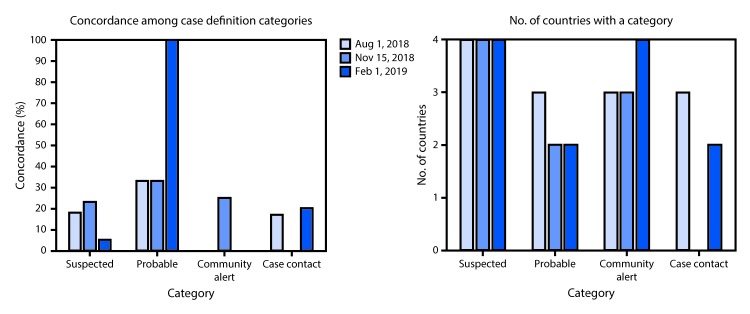
Description:On August 1, 2018, the Democratic Republic of the Congo (DRC) declared its 10th Ebola Virus disease (Ebola) outbreak in an area with a high volume of cross-border population movement to and from neighboring countries. The World Health Organization (WHO) designated Rwanda, South Sudan, and Uganda as the highest priority countries for Ebola preparedness because of the high risk for cross-border spread from DRC (1). Countries might base their disease case definitions on global Standards; however, Historyical context and perceived risk often affect why countries modify and adapt definitions over time, moving toward or away from regional harmonization. Discordance in case definitions among countries might reduce the effectiveness of cross-border initiatives during outbreaks with high risk for regional spread. CDC worked with the ministries of health (MOHs) in DRC, Rwanda, South Sudan, and Uganda to collect MOH-approved Ebola case definitions used during the first 6 months of the outbreak to assess concordance (i.e., commonality in category case definitions) among countries. Changes in MOH-approved Ebola case definitions were analyzed, referencing the WHO standard case definition, and concordance among the four countries for Ebola case categories (i.e., community alert, suspected, probable, confirmed, and case contact) was assessed at three dates (2). The number of country-level revisions ranged from two to four, with all countries revising Ebola definitions by February 2019 after a December 2018 peak in incidence in DRC. Case definition complexity increased over time; all countries included more criteria per category than the WHO standard definition did, except for the "case contact" and "confirmed" categories. Low case definition concordance and lack of awareness of regional differences by national-level health officials could reduce effectiveness of cross-border communication and collaboration. Working toward regional harmonization or considering systematic approaches to addressing country-level differences might increase efficiency in cross-border information sharing.
-
Subjects:
-
Source:MMWR Morbidity Mortal Weekly Rep. 69(1):14-19
-
Series:
-
ISSN:0149-2195 (print) ; 1545-861X (digital)
-
Pubmed ID:31917783
-
Pubmed Central ID:PMC6973343
-
Document Type:
-
Place as Subject:
-
Pages in Document:6 pdf pages
-
Volume:69
-
Issue:1
-
Download URL:
-
File Type:
 [PDF - 329.47 KB]
 -
Collection(s):
-
Main Document Checksum:urn:sha-512:7f610f0d2d70a8fd1a80ff1245ddc63a94958074f9ad76665286df68b6b79e094ebf8335d271a18e62211a0aca78439b9bd969a9a9b54b0df945eb461335153d
Supporting Files


File Language:
English
 Was this page helpful?
 Found an issue?

CDC STACKS serves as an archival repository of CDC-published products including
scientific findings, journal articles, guidelines, recommendations, or other public health information authored or
co-authored by CDC or funded partners.
As a repository, CDC STACKS retains documents in their original published format to ensure public access to scientific information.
As a repository, CDC STACKS retains documents in their original published format to ensure public access to scientific information.
You May Also Like
COLLECTION
Morbidity and Mortality Weekly Report (MMWR)