


Evaluation of Oklahoma’s Electronic Death Registration System and Event Fatality Markers for Disaster-Related Mortality Surveillance – Oklahoma USA, May 2013
Supporting Files

-
Apr 2019
-
File Language:
English
Details
-
Alternative Title:Prehosp Disaster Med
-
Personal Author:
-
Description:Introduction:
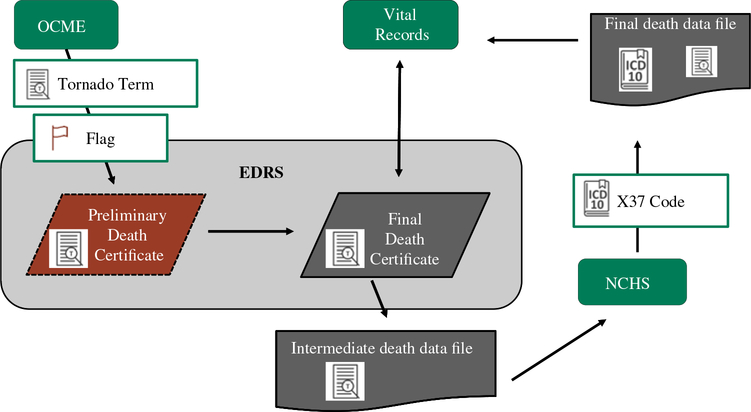
Official counts of deaths attributed to disasters are often under-reported, thus adversely affecting public health messaging designed to prevent further mortality. During the Oklahoma (USA) May 2013 tornadoes, Oklahoma State Health Department Division of Vital Records (VR; Oklahoma City, Oklahoma USA) piloted a flagging procedure to track tornado-attributed deaths within its Electronic Death Registration System (EDRS). To determine if the EDRS was capturing all tornado-attributed deaths, the Centers for Disease Control and Prevention (CDC; Atlanta, Georgia USA) evaluated three event fatality markers (EFM), which are used to collate information about deaths for immediate response and retrospective research efforts.
Methods:
Oklahoma identified 48 tornado-attributed deaths through a retrospective review of hospital morbidity and mortality records. The Centers for Disease Control and Prevention (CDC; Atlanta, Georgia USA) analyzed the sensitivity, timeliness, and validity for three EFMs, which included: (1) a tornado-specific flag on the death record; (2) a tornado-related term in the death certificate; and (3) X37, the International Classification of Diseases, 10thRevision (ICD-10) code in the death record for Victim of a Cataclysmic Storm, which includes tornadoes.
Results:
The flag was the most sensitive EFM (89.6%; 43/48), followed by the tornado term (75.0%; 36/48), and the X37 code (56.2%; 27/48). The most-timely EFM was the flag, which took 2.0 median days to report (range 0–10 days), followed by the tornado term (median 3.5 days; range 1–21), and the X37 code (median >10 days; range 2–122). Over one-half (52.1%; 25/48) of the tornado-attributed deaths were missing at least one EFM. Twenty-six percent (11/43) of flagged records had no tornado term, and 44.1% (19/43) had no X37 code. Eleven percent (4/36) of records with a tornado term did not have a flag.
Conclusion:
The tornado-specific flag was the most sensitive and timely EFM. Using the flag to collate death records and identify additional deaths without the tornado term and X37 code may improve immediate response and retrospective investigations. Moreover, each of the EFMs can serve as quality controls for the others to maximize capture of all disaster-attributed deaths from vital statistics records in the EDRS.
-
Subjects:
-
Source:Prehosp Disaster Med. 34(2):125-131
-
Pubmed ID:31046868
-
Pubmed Central ID:PMC6953479
-
Document Type:
-
Funding:
-
Place as Subject:
-
Volume:34
-
Issue:2
-
Collection(s):
-
Main Document Checksum:urn:sha256:1e284b08b309448b75b72abe1e71a6387a7b1bb6834bd14fe94401bd48788405
-
Download URL:
-
File Type:
 [PDF
- 450.42 KB
]
[PDF
- 450.42 KB
]
Supporting Files


File Language:
English
ON THIS PAGE




CDC STACKS serves as an archival repository of CDC-published products including
scientific findings,
journal articles, guidelines, recommendations, or other public health information authored or
co-authored by CDC or funded partners.
As a repository, CDC STACKS retains documents in their original published format to ensure public access to scientific information.
As a repository, CDC STACKS retains documents in their original published format to ensure public access to scientific information.
You May Also Like
COLLECTION
CDC Public Access