



Proximity to Major Roadways and Asthma Symptoms in the School Inner-City Asthma Study
Supporting Files

-
1 2020
-
Available in CDC Stacks on 2021-01-01T00:00:00Z
File Language:
English
Details
-
Journal Article:J Allergy Clin Immunol
-
Personal Author:
-
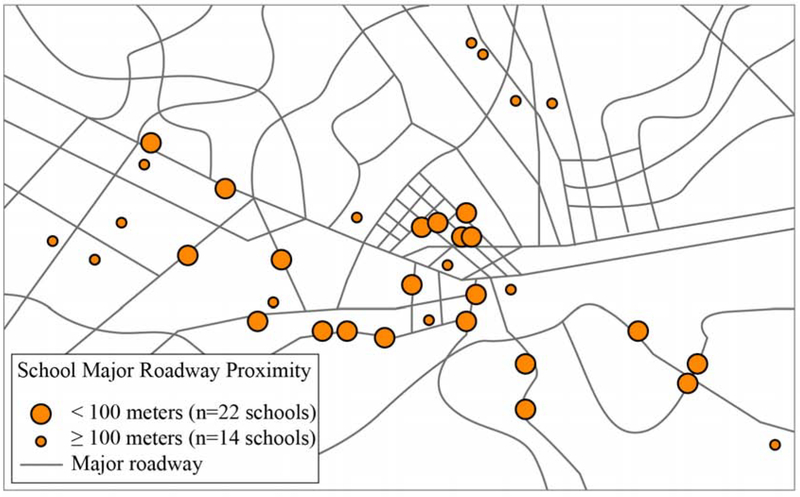
Description:Objective: ; To use spatial analysis methodology to analyze residential and school proximity to major roadways and pediatric asthma morbidity. ; Methods: ; The School Inner-City Asthma Study (n=350) recruited school-aged children with asthma. Each participant’s school and home addresses were geocoded and distances from major roadways were measured to calculate a composite measurement accounting for both home and school traffic exposure. Generalized estimated equation models were clustered by subject and adjusted for age, race/ethnicity, gender, income, environmental tobacco smoke, controller medication, upper respiratory tract infections and seasonality. ; Results: ; The majority of participants (62%) attended schools within 100 meters from major roadways and 40% also resided within 100 meters of major roadways. In multivariate analyses, major roadway proximity was independently associated with increased asthma symptom days. Above a threshold of 100 meters, children had 29% less odds of a symptom day over the past 2 weeks for each 100 meter increase in distance from major roadway (OR 0.71; 95% CI:0.58–0.87; p <0.01). Children farther from a major roadway also had significantly less reported health care utilization (OR 0.63; 95% CI: 0.47–0.85; p<0.01); and significantly less likely to have poor asthma control (OR 0.80; 95% CI: 0.69–0.94; p< 0.01). There was not a meaningful association between distance to major roadway and lung function outcomes. ; Conclusions: ; Proximity to major roadway, a composite measurement of home and school exposure, primarily driven by home exposure, was associated with greater asthma morbidity. More studies are needed to evaluate the independent effect of school distance to roadway on asthma morbidity.
-
Subjects:
-
Keywords:
-
Source:J Allergy Clin Immunol. 145(1):119-126.e4
-
DOI:
-
Pubmed ID:31557500
-
Pubmed Central ID:PMC6949366
-
Document Type:
-
Funding:U01 AI110397/AI/NIAID NIH HHSUnited States/ ; K23 AI104780/AI/NIAID NIH HHSUnited States/ ; U19 AR069525/AR/NIAMS NIH HHSUnited States/ ; UL1 TR001102/TR/NCATS NIH HHSUnited States/ ; K23 ES023700/ES/NIEHS NIH HHSUnited States/ ; K24 AI106822/AI/NIAID NIH HHSUnited States/ ; R01 AI073964/AI/NIAID NIH HHSUnited States/ ; P01 ES009825/ES/NIEHS NIH HHSUnited States/ ; R01 HL137192/HL/NHLBI NIH HHSUnited States/ ; P30 ES000002/ES/NIEHS NIH HHSUnited States/ ; U61 TS000237/TS/ATSDR CDC HHSUnited States/ ; K23 AI106945/AI/NIAID NIH HHSUnited States/ ; L40 AI107923/AI/NIAID NIH HHSUnited States/ ; R01 ES030100/ES/NIEHS NIH HHSUnited States/ ; U10 HL098102/HL/NHLBI NIH HHSUnited States/
-
Genre:
-
Volume:145
-
Issue:1
-
Download URL:
-
File Type:
 [PDF - 766.46 KB]
 -
Collection(s):
-
Main Document Checksum:urn:sha-512:e804b5e81dcd9d0fbc72050c741cd8f65587d6f1989737d3853025f58d8d960560b63154c769102a575c88a91f1b6729e5c99949fd49962c713a45f941f633c7
Supporting Files


File Language:
English
 Was this page helpful?
 Found an issue?




CDC STACKS serves as an archival repository of CDC-published products including
scientific findings, journal articles, guidelines, recommendations, or other public health information authored or
co-authored by CDC or funded partners.
As a repository, CDC STACKS retains documents in their original published format to ensure public access to scientific information.
As a repository, CDC STACKS retains documents in their original published format to ensure public access to scientific information.
You May Also Like
COLLECTION
CDC Public Access