


Quantifying the risk of undetected HIV, hepatitis B virus, or hepatitis C virus infection in Public Health Service increased risk donors
Supporting Files

-
May 10 2019
-
File Language:
English
Details
-
Alternative Title:Am J Transplant
-
Personal Author:
-
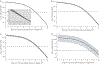
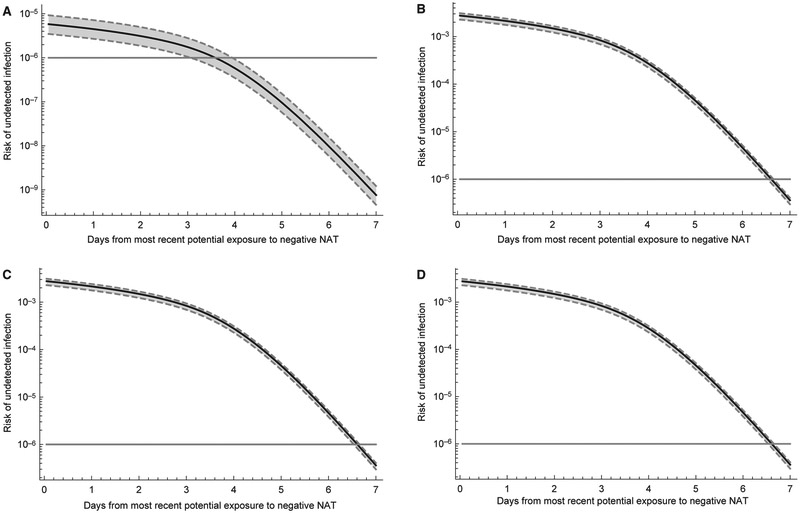
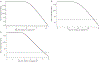
Description:To reduce the risk of HIV, hepatitis B virus (HBV), and hepatitis C virus (HCV) transmission through organ transplantation, donors are universally screened for these infections by nucleic acid tests (NAT). Deceased organ donors are classified as "increased risk" if they engaged in specific behaviors during the 12 months before death. We developed a model to estimate the risk of undetected infection for HIV, HBV, and HCV among NAT-negative donors specific to the type and timing of donors' potential risk behavior to guide revisions to the 12-month timeline. Model parameters were estimated, including risk of disease acquisition for increased risk groups, number of virions that multiply to establish infection, virus doubling time, and limit of detection by NAT. Monte Carlo simulation was performed. The risk of undetected infection was <1/1 000 000 for HIV after 14 days, for HBV after 35 days, and for HCV after 7 days from the time of most recent potential exposure to the day of a negative NAT. The period during which reported donor risk behaviors result in an "increased risk" designation can be safely shortened.
-
Subjects:
-
Source:Am J Transplant. 19(9):2583-2593
-
Pubmed ID:30980600
-
Pubmed Central ID:PMC6946117
-
Document Type:
-
Funding:
-
Name as Subject:
-
Place as Subject:
-
Volume:19
-
Issue:9
-
Collection(s):
-
Main Document Checksum:urn:sha256:67c30ab9feb2e21431e0ec8349d0c132391bbe79c341e779b6aea7e92a1ccc0b
-
Download URL:
-
File Type:
 [PDF
- 843.40 KB
]
[PDF
- 843.40 KB
]
Supporting Files


File Language:
English
ON THIS PAGE




CDC STACKS serves as an archival repository of CDC-published products including
scientific findings,
journal articles, guidelines, recommendations, or other public health information authored or
co-authored by CDC or funded partners.
As a repository, CDC STACKS retains documents in their original published format to ensure public access to scientific information.
As a repository, CDC STACKS retains documents in their original published format to ensure public access to scientific information.
You May Also Like
COLLECTION
CDC Public Access