



A biomonitoring assessment of secondhand exposures to electronic cigarette emissions
Supporting Files

-
6 2019
-
Available in CDC Stacks on 2020-06-01T00:00:00Z
File Language:
English
Details
-
Journal Article:Int J Hyg Environ Health
-
Personal Author:Johnson, Jona M. ; Naeher, Luke P. ; Yu, Xiaozhong ; Sosnoff, Connie ; Wang, Lanqing ; Rathbun, Stephen L. ; De Jesús, Víctor R. ; Xia, Baoyun ; Holder, Cory ; Muilenburg, Jessica L. ; Wang, Jia-Sheng
-
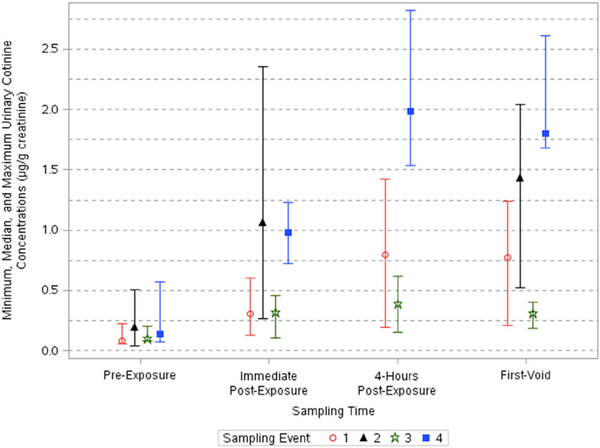
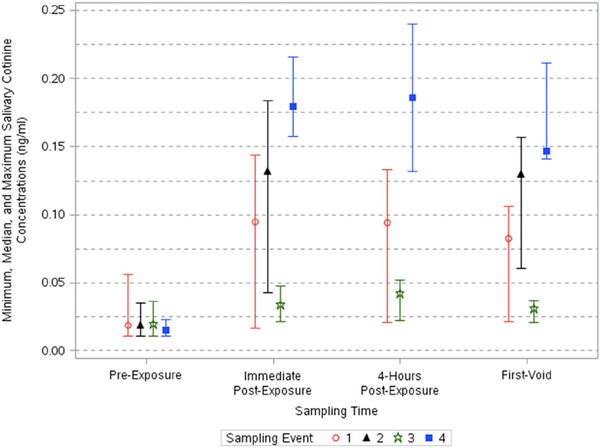
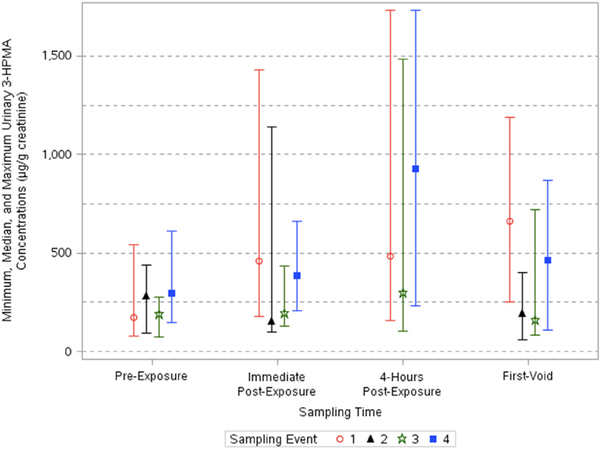
Description:Background: ; Electronic cigarette (e-cigarette) conventions regularly bring together thousands of users around the world. In these environments, secondhand exposures to high concentrations of e-cigarette emissions are prevalent. Some biomarkers for tobacco smoke exposure may be used to characterize secondhand e-cigarette exposures in such an environment. ; Methods: ; Participants who did not use any tobacco product attended four separate e-cigarette events for approximately six hours. Urine and saliva samples were collected from participants prior to the event, immediately after the event, 4-h after the event, and the next morning (first void). Urine samples from 34 participants were analyzed for cotinine, trans-3′-hydroxycotinine, S-(3-hydroxypropyl)-N-acetylcysteine (3-HPMA), S-carboxyethyl-N-acetylcysteine (CEMA), select tobacco-specific nitrosamines (TSNAs), and 8-isoprostane. Saliva samples were analyzed for cotinine and trans-3′-hydroxycotinine. ; Results: ; Data from 28 of 34 participants were used in the data analysis. Creatinine-adjusted urinary cotinine concentrations increased up to 13-fold and peaked 4-h after completed exposure (range of adjusted geometric means AGMs = 0.352–2.31 μg/g creatinine). Salivary cotinine concentrations were also the highest 4-h after completed exposure (range of AGMs = 0.0373–0.167 ng/mL). Salivary cotinine and creatinine-corrected concentrations of urinary cotinine, trans-3′-hydroxycotinine, CEMA, and 3-HPMA varied significantly across sampling times. Urinary and salivary cotinine, urinary trans-3′-hydroxycotinine, and urinary 3-HPMA concentrations also varied significantly across events. ; Conclusion: ; Secondhand e-cigarette exposures lasting six hours resulted in significant changes in exposure biomarker concentrations of both nicotine and acrolein but did not change exposure to tobacco-specific nitrosamines. Additional research is needed to understand the relationship between biomarker concentrations and environmental concentrations of toxicants in e-cigarette emissions.
-
Keywords:
-
Source:Int J Hyg Environ Health. 222(5):816-823
-
DOI:
-
Pubmed ID:31085112
-
Pubmed Central ID:PMC6938228
-
Document Type:
-
Funding:
-
Genre:
-
Volume:222
-
Issue:5
-
Download URL:
-
File Type:
 [PDF - 721.05 KB]
 -
Collection(s):
-
Main Document Checksum:urn:sha-512:f58ba71f2f18ba084180e0112704ffb624297491110670d2579594ea0f44916f02d11d4725916932f8205075d20186cae969d6f48d96f3f6237e011844704c96
Supporting Files


File Language:
English
 Was this page helpful?
 Found an issue?



CDC STACKS serves as an archival repository of CDC-published products including
scientific findings, journal articles, guidelines, recommendations, or other public health information authored or
co-authored by CDC or funded partners.
As a repository, CDC STACKS retains documents in their original published format to ensure public access to scientific information.
As a repository, CDC STACKS retains documents in their original published format to ensure public access to scientific information.
You May Also Like
COLLECTION
CDC Public Access