


Monitoring exposure to polycyclic aromatic hydrocarbons in an Australian population using pooled urine samples
Supporting Files

-
3 2016
-
File Language:
English
Details
-
Alternative Title:Environ Int
-
Personal Author:
-
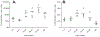
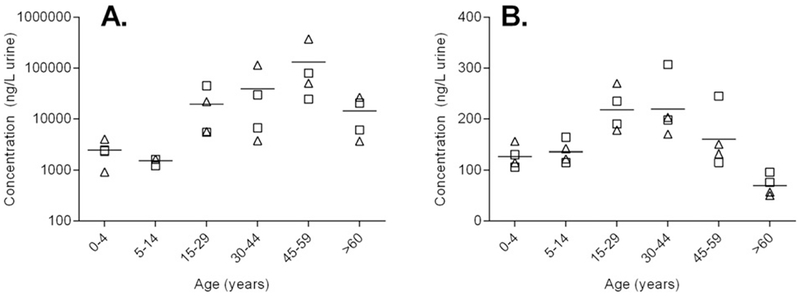
Description:Integrated exposure to polycyclic aromatic hydrocarbons (PAHs) can be assessed through monitoring of urinary mono-hydroxylated PAHs (OH-PAHs). The aim of this study was to provide the first assessment of exposure to PAHs in a large sample of the population in Queensland, Australia including exposure to infant (0-4years). De-identified urine specimens, obtained from a pathology laboratory, were stratified by age and sex, and pooled (n=24 pools of 100) and OH-PAHs were measured by gas chromatography-isotope dilution-tandem mass spectrometry. Geometric mean (GM) concentrations ranged from 30ng/L (4-hydroxyphenanthrene) to 9221ng/L (1-naphthol). GM of 1-hydroxypyrene, the most commonly used PAH exposure biomarker, was 142ng/L. The concentrations of OH-PAHs found in this study are consistent with those in developed countries and lower than those in developing countries. We observed no association between sex and OH-PAH concentrations. However, we observed lower urinary concentrations of all OH-PAHs in samples from infants (0-4years), children (5-14years) and the elderly (>60year old) compared with samples from other age groups (15-29, 30-44 and 45-59years) which may be attributed to age-dependent behaviour-specific exposure sources.
-
Subjects:
-
Keywords:
-
Source:Environ Int. 88:30-35
-
Pubmed ID:26700419
-
Pubmed Central ID:PMC6936263
-
Document Type:
-
Funding:
-
Place as Subject:
-
Volume:88
-
Collection(s):
-
Main Document Checksum:urn:sha256:890eca543ef2f3bc7179ac24d9cc13d10d7953553769162b96df32918969c22a
-
Download URL:
-
File Type:
 [PDF
- 382.81 KB
]
[PDF
- 382.81 KB
]
Supporting Files


File Language:
English
ON THIS PAGE

CDC STACKS serves as an archival repository of CDC-published products including
scientific findings,
journal articles, guidelines, recommendations, or other public health information authored or
co-authored by CDC or funded partners.
As a repository, CDC STACKS retains documents in their original published format to ensure public access to scientific information.
As a repository, CDC STACKS retains documents in their original published format to ensure public access to scientific information.
You May Also Like
COLLECTION
CDC Public Access