


Tao negatively regulates BMP signaling during neuromuscular junction development in Drosophila
Supporting Files

-
4 2019
-

File Language:
English
Details
-
Alternative Title:Dev Neurobiol
-
Personal Author:
-
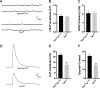
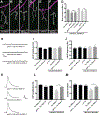
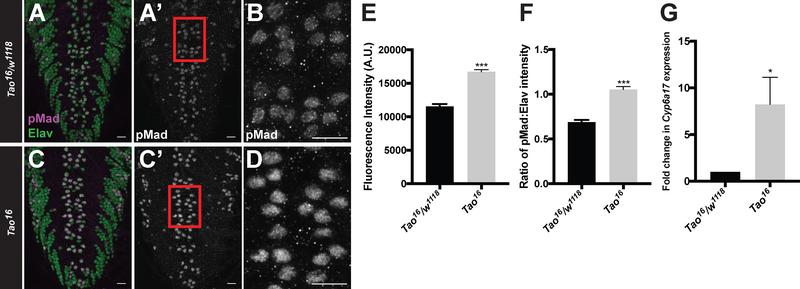
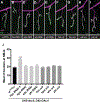
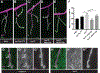
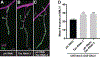
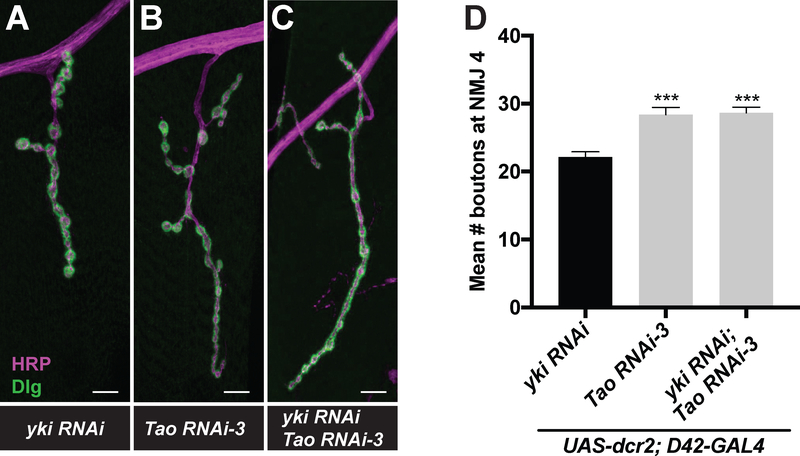
Description:The coordinated growth and development of synapses is critical for all aspects of neural circuit function and mutations that disrupt these processes can result in various neurological defects. Several anterograde and retrograde signaling pathways, including the canonical Bone Morphogenic Protein (BMP) pathway, regulate synaptic development in vertebrates and invertebrates. At the Drosophila larval neuromuscular junction (NMJ), the retrograde BMP pathway is a part of the machinery that controls NMJ expansion concurrent with larval growth. We sought to determine whether the conserved Hippo pathway, critical for proportional growth in other tissues, also functions in NMJ development. We found that neuronal loss of the serine-threonine protein kinase Tao, a regulator of the Hippo signaling pathway, results in supernumerary boutons which contain a normal density of active zones. Tao is also required for proper synaptic function, as reduction of Tao results in NMJs with decreased evoked excitatory junctional potentials. Surprisingly, Tao function in NMJ growth is independent of the Hippo pathway. Instead, our experiments suggest that Tao negatively regulates BMP signaling as reduction of Tao leads to an increase in pMad levels in motor neuron nuclei and an increase in BMP target gene expression. Taken together, these results support a role for Tao as a novel inhibitor of BMP signaling in motor neurons during synaptic development and function.
-
Subjects:
-
Keywords:
-
Source:Dev Neurobiol. 79(4):335-349
-
Pubmed ID:31002474
-
Pubmed Central ID:PMC6848449
-
Document Type:
-
Funding:
-
Volume:79
-
Issue:4
-
Collection(s):
-
Main Document Checksum:urn:sha256:925f530713d50411455a9ffe6d5dbe1b9e3c15028e3e142fda0c4b67234cc968
-
Download URL:
-
File Type:
 [PDF
- 2.38 MB
]
[PDF
- 2.38 MB
]

Supporting Files


File Language:
English
ON THIS PAGE








CDC STACKS serves as an archival repository of CDC-published products including
scientific findings,
journal articles, guidelines, recommendations, or other public health information authored or
co-authored by CDC or funded partners.
As a repository, CDC STACKS retains documents in their original published format to ensure public access to scientific information.
As a repository, CDC STACKS retains documents in their original published format to ensure public access to scientific information.
You May Also Like
COLLECTION
CDC Public Access