


Children with Oral Clefts Are at Greater Risk for Persistent Low Achievement in School than Classmates
Supporting Files

-
September 07 2015
-
File Language:
English
Details
-
Alternative Title:Arch Dis Child
-
Personal Author:
-
Description:Objectives
To examine trajectories in academic achievement for children with oral clefts versus unaffected classmates and explore predictors of persistently low achievement among children with oral clefts.
Design
Longitudinal cohort study of academic achievement in a population-based sample.
Setting and Participants
Children born from 1983 through 2003 with oral clefts were identified from the Iowa Registry for Congenital and Inherited Disorders and matched to unaffected classmates by sex, school/school district, and month and year of birth.
Main Outcome Measures
Academic achievement was measured from Iowa Testing Programs (ITP) data. Outcomes included achievement scores in reading, language, and mathematics.
Results
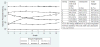
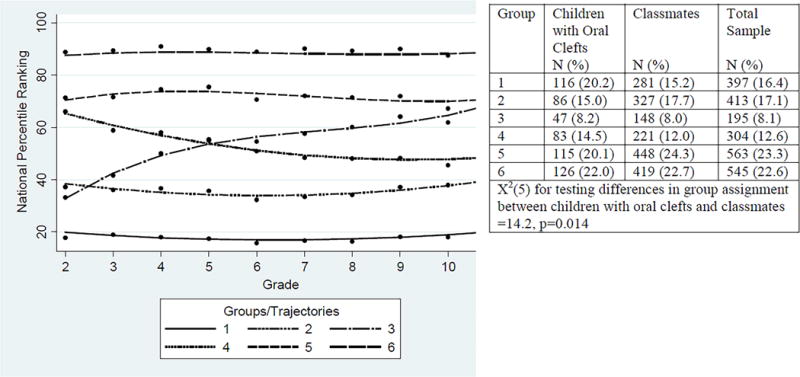
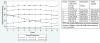
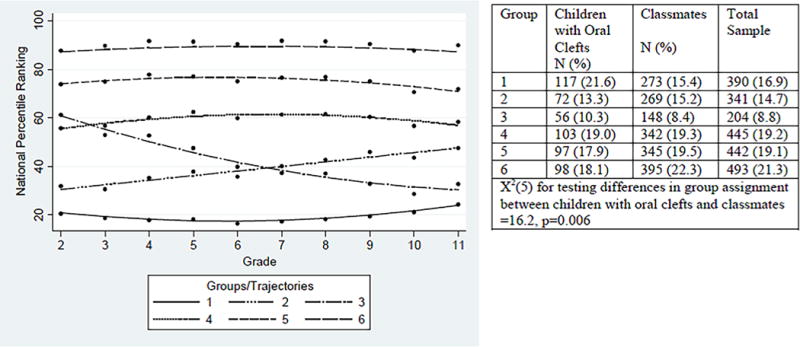
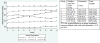
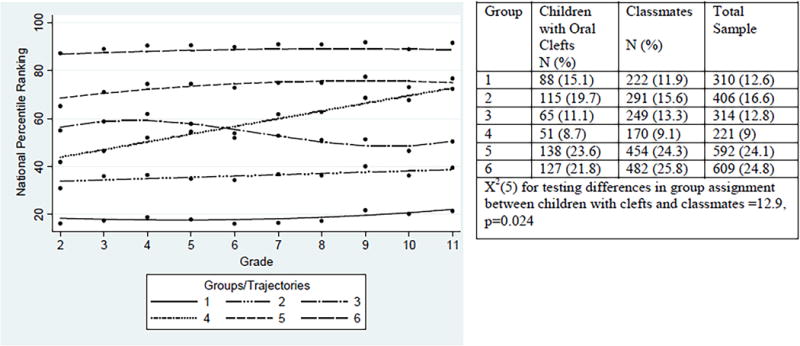
Academic achievement data were available for 586 children with oral clefts and 1,873 unaffected classmates. Achievement trajectories were stable for both groups. Children with oral clefts were more likely than their classmates to be classified into persistent, low achievement trajectories, including when adjusting for socioeconomic differences: OR=1.63, 95% CI: 1.23–2.16 for reading; OR=1.73, 95% CI: 1.29–2.31 for language; OR=1.45, 95% CI: 1.05–1.99 for math. Predictors of low achievement were cleft palate only (versus other cleft types), adolescent mothers, low maternal education, and less frequent use of prenatal care.
Conclusions
Most children have steady academic trajectories and children with oral clefts are at greater risk for persistent, low achievement in school than unaffected classmates. These findings support the need for routine, early screening for academic deficits in this population. Cleft palate only, low parental education and adolescent mothers are associated with increased risk for persistent low achievement.
-
Subjects:
-
Source:Arch Dis Child. 100(12):1148-1154
-
Pubmed ID:26347387
-
Pubmed Central ID:PMC5018039
-
Document Type:
-
Funding:
-
Volume:100
-
Issue:12
-
Collection(s):
-
Main Document Checksum:urn:sha256:306b029c58e68c98301dcbb51bfc4e59aa43032bcad672069306d5d674e34677
-
Download URL:
-
File Type:
 [PDF
- 650.29 KB
]
[PDF
- 650.29 KB
]
Supporting Files


File Language:
English
ON THIS PAGE

CDC STACKS serves as an archival repository of CDC-published products including
scientific findings,
journal articles, guidelines, recommendations, or other public health information authored or
co-authored by CDC or funded partners.
As a repository, CDC STACKS retains documents in their original published format to ensure public access to scientific information.
As a repository, CDC STACKS retains documents in their original published format to ensure public access to scientific information.
You May Also Like
COLLECTION
CDC Public Access