



Trends in Incidence of Methicillin-resistant Staphylococcus aureus Bloodstream Infections Differ by Strain Type and Healthcare Exposure, United States, 2005–2013
Supporting Files

-
1 01 2020
-
Available in CDC Stacks on January 01, 2021, 12:00 AM
File Language:
English
Details
-
Journal Article:Clin Infect Dis
-
Personal Author:
-
Description:Background.
Previous reports suggested that US methicillin-resistant Staphylococcus aureus (MRSA) strain epidemiology has changed since the rise of USA300 MRSA. We describe invasive MRSA trends by strain type.
Methods.
Data came from 5 Centers for Disease Control and Prevention Emerging Infections Program sites conducting population-based surveillance and collecting isolates for invasive MRSA (ie, from normally sterile body sites), 2005–2013. MRSA bloodstream infection (BSI) incidence per 100 000 population was stratified by strain type and epidemiologic classification of healthcare exposures. Invasive USA100 vs USA300 case characteristics from 2013 were compared through logistic regression.
Results.
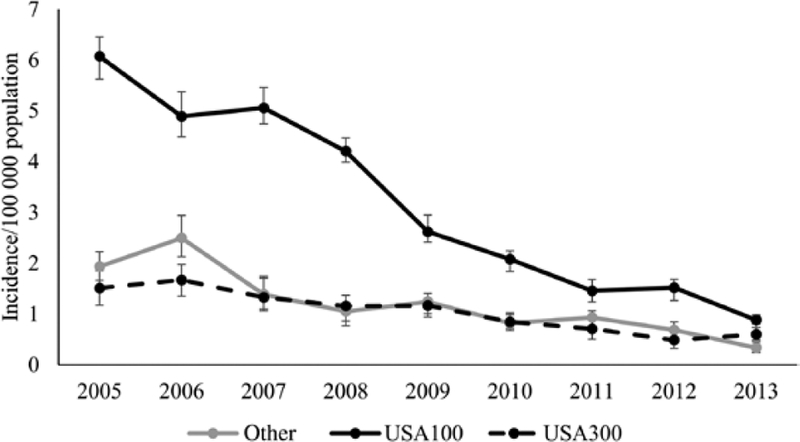
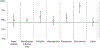
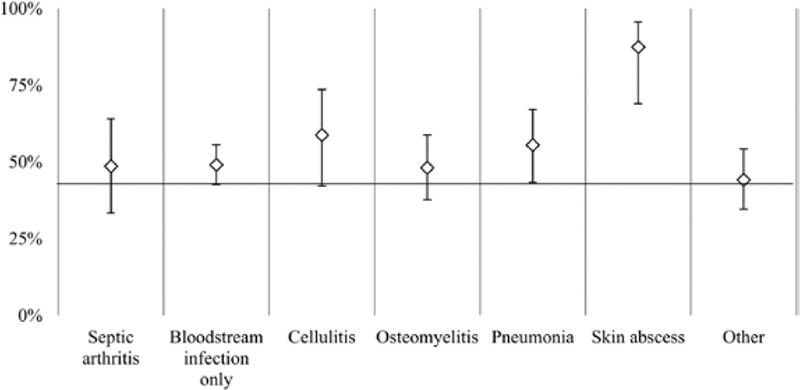
From 2005 to 2013, USA100 incidence decreased most notably for hospital-onset (6.1 vs 0.9/100 000 persons, P < .0001) and healthcare-associated, community-onset (10.7 vs 4.9/100 000 persons, P < .0001) BSIs. USA300 incidence for hospital-onset BSIs also decreased (1.5 vs 0.6/100 000 persons, P < .0001). However, USA300 incidence did not significantly change for health-care-associated, community-onset (3.9 vs 3.3/100 000 persons, P = .05) or community-associated BSIs (2.5 vs 2.4/100 000 persons, P = .19). Invasive MRSA was less likely to be USA300 in patients who were older (adjusted odds ratio aOR, 0.97 per year 95% confidence interval {CI}, .96–.98), previously hospitalized (aOR, 0.36 95% CI, .24–.54), or had central lines (aOR, 0.44 95% CI, .27–.74), and associated with USA300 in people who inject drugs (aOR, 4.58 95% CI, 1.16–17.95).
Conclusions.
Most of the decline in MRSA BSIs was from decreases in USA100 BSI incidence. Prevention of USA300 MRSA BSIs in the community will be needed to further reduce burden from MRSA BSIs. -
Keywords:
- MRSA
- epidemiology
- bloodstream infections
- strains
- infection control
- Adult
- Aged
- Bacteremia
- Community-Acquired Infections
- Cross Infection
- Female
- Humans
- Incidence
- Logistic Models
- Male
- Methicillin-Resistant Staphylococcus aureus
- Middle Aged
- Population Surveillance
- Staphylococcal Infections
- United States
- Young Adult
-
Source:Clin Infect Dis. 70(1):19-25
-
DOI:
-
Pubmed ID:30801635
-
Pubmed Central ID:PMC6708714
-
Document Type:
-
Funding:
-
Genre:
-
Volume:70
-
Issue:1
-
Download URL:
-
File Type:
 [PDF - 684.79 KB]
 -
Collection(s):
-
Main Document Checksum:urn:sha-512:1c282fc35e51b28f85e93102c1281710af11941d9681daf5b06ee28cda02d5ede3bac07f6e4ce5c5635328874a13de1863a1b16e4469c34e04c0b7dad27bfce8
Supporting Files


File Language:
English
 Was this page helpful?
 Found an issue?




CDC STACKS serves as an archival repository of CDC-published products including
scientific findings, journal articles, guidelines, recommendations, or other public health information authored or
co-authored by CDC or funded partners.
As a repository, CDC STACKS retains documents in their original published format to ensure public access to scientific information.
As a repository, CDC STACKS retains documents in their original published format to ensure public access to scientific information.
You May Also Like
COLLECTION
CDC Public Access