



Impact of Preexisting Adenovirus Vector Immunity on Immunogenicity and Protection Conferred with an Adenovirus-Based H5N1 Influenza Vaccine
Supporting Files
Public Domain

-
Mar 14 2012
File Language:
English
Details
-
Alternative Title:PLoS One
-
Personal Author:
-
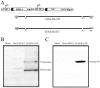
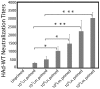
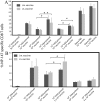
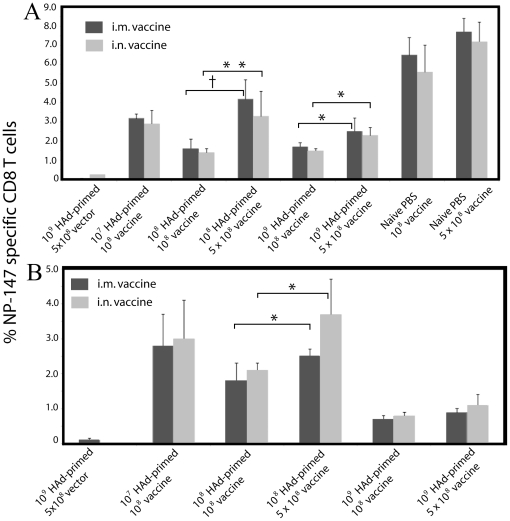
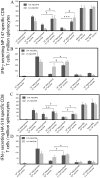
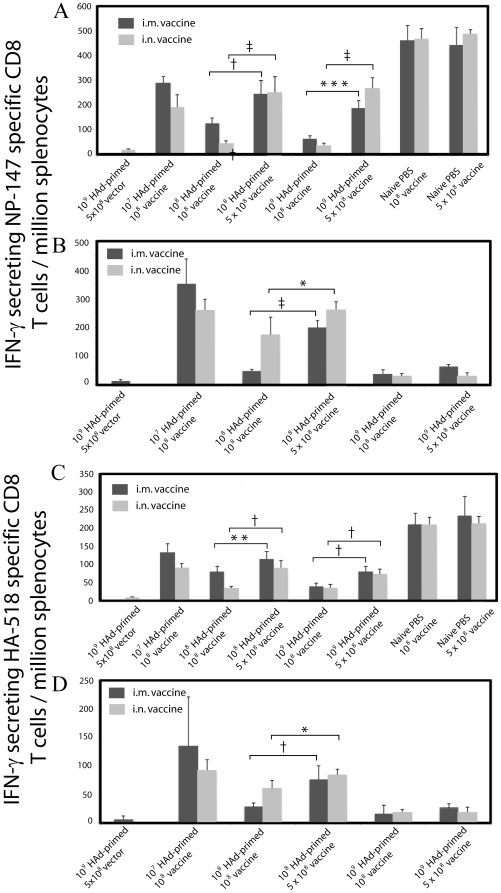
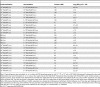
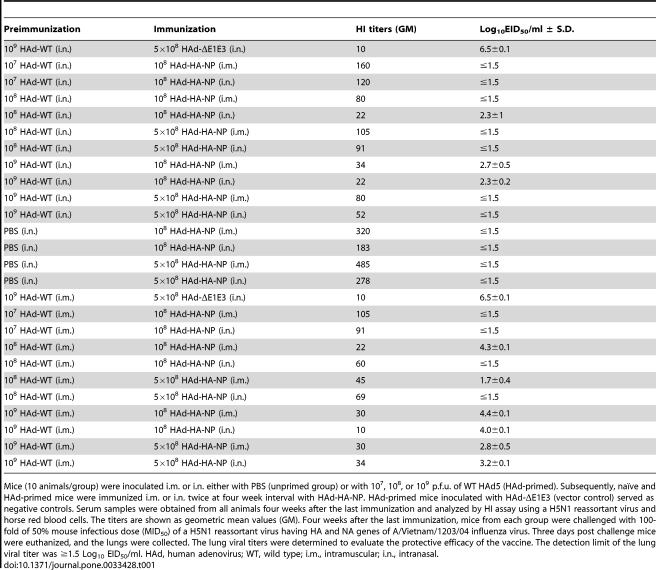
Description:The prevalence of preexisting immunity to adenoviruses in the majority of the human population might adversely impact the development of adaptive immune responses against adenovirus vector-based vaccines. To address this issue, we primed BALB/c mice either intranasally (i.n.) or intramuscularly (i.m.) with varying doses of wild type (WT) human adenovirus subtype 5 (HAd5). Following the development of immunity against HAd5, we immunized animals via the i.n. or i.m. route of inoculation with a HAd vector (HAd-HA-NP) expressing the hemagglutinin (HA) and nucleoprotein (NP) of A/Vietnam/1203/04 (H5N1) influenza virus. The immunogenicity and protection results suggest that low levels of vector immunity (<520 virus-neutralization titer) induced by priming mice with up to 10(7) plaque forming units (p.f.u.) of HAd-WT did not adversely impact the protective efficacy of the vaccine. Furthermore, high levels of vector immunity (approximately 1500 virus-neutralization titer) induced by priming mice with 10(8) p.f.u. of HAd-WT were overcome by either increasing the vaccine dose or using alternate routes of vaccination. A further increase in the priming dose to 10(9) p.f.u. allowed only partial protection. These results suggest possible strategies to overcome the variable levels of human immunity against adenoviruses, leading to better utilization of HAd vector-based vaccines.
-
Subjects:
- Adenoviridae
- Animals
- Antibodies, Neutralizing
- Antibodies, Viral
- CD8-Positive T-Lymphocytes
- Epitopes
- Genetic Vectors
- Hemagglutination Inhibition Tests
- Hemagglutinin Glycoproteins, Influenza Virus
- Humans
- Immunity
- Immunity, Cellular
- Immunity, Humoral
- Immunization
- Influenza A Virus, H5N1 Subtype
- Influenza Vaccines
- Influenza, Human
- Interferon-gamma
- Mice
- Orthomyxoviridae Infections
- RNA-Binding Proteins
- Reassortant Viruses
- Viral Core Proteins
- Virus Replication
-
Source:PLoS One. 2012; 7(3).
-
Document Type:
-
Volume:7
-
Issue:3
-
Download URL:
-
File Type:
 [PDF - 397.07 KB]
 -
Collection(s):
-
Main Document Checksum:urn:sha256:c3d70701f3ca95185886ee391b1c752a6a12fdf0c98875f116593678c1190f4d
Supporting Files


File Language:
English
 Was this page helpful?
 Found an issue?



CDC STACKS serves as an archival repository of CDC-published products including
scientific findings, journal articles, guidelines, recommendations, or other public health information authored or
co-authored by CDC or funded partners.
As a repository, CDC STACKS retains documents in their original published format to ensure public access to scientific information.
As a repository, CDC STACKS retains documents in their original published format to ensure public access to scientific information.
You May Also Like
COLLECTION
CDC Public Access