


A Multicenter Evaluation of Diagnostic Tools to Define Endpoints for Programs to Eliminate Bancroftian Filariasis
Supporting Files
Public Domain

-
Jan 17 2012
-
File Language:
English
Details
-
Alternative Title:PLoS Negl Trop Dis
-
Personal Author:Gass, Katherine ; Beau de Rochars, Madsen V. E. ; Boakye, Daniel ; Bradley, Mark ; Fischer, Peter U. ; Gyapong, John ; Itoh, Makoto ; Ituaso-Conway, Nese ; Joseph, Hayley ; Kyelem, Dominique ; Laney, Sandra J. ; Legrand, Anne-Marie ; Liyanage, Tilaka S. ; Melrose, Wayne ; Mohammed, Khalfan ; Pilotte, Nils ; Ottesen, Eric A. ; Plichart, Catherine ; Ramaiah, Kapa ; Rao, Ramakrishna U. ; Talbot, Jeffrey ; Weil, Gary J. ; Williams, Steven A. ; Won, Kimberly Y. ; Lammie, Patrick
-
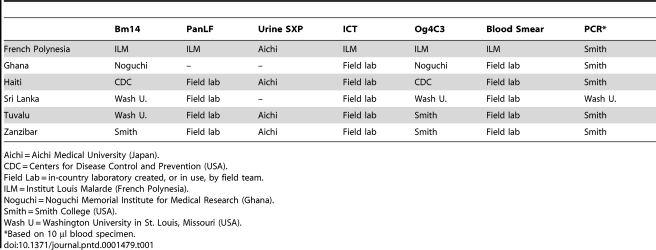
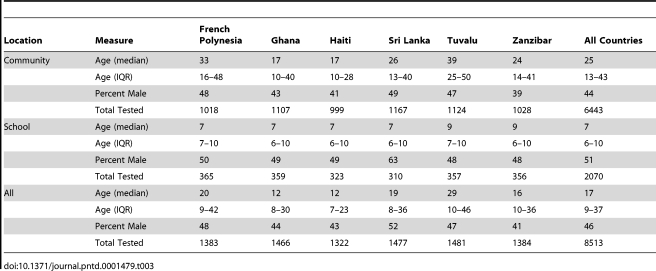
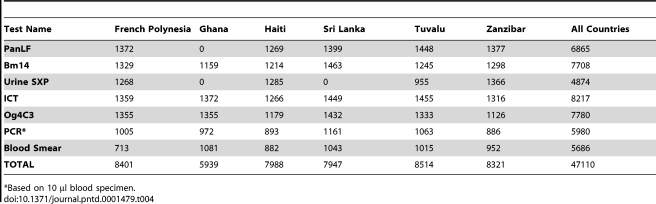
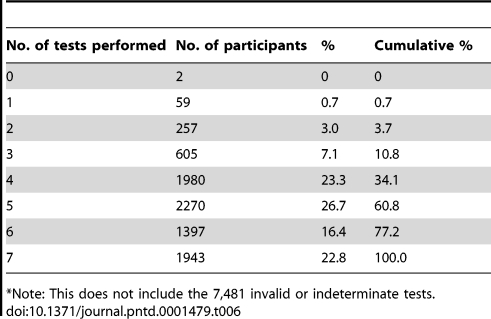
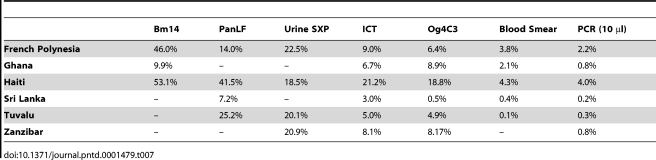
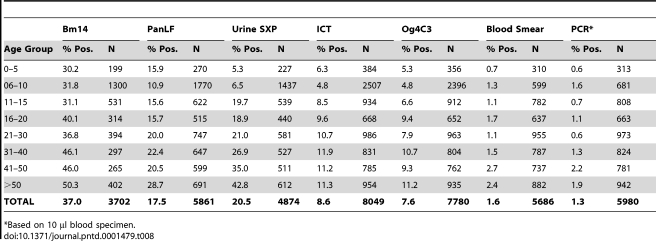
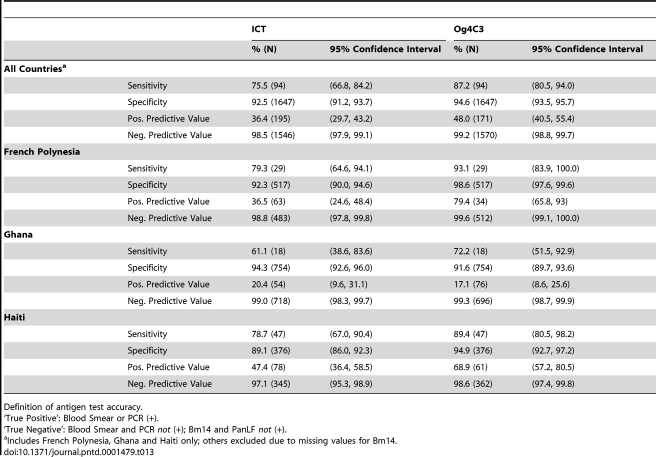
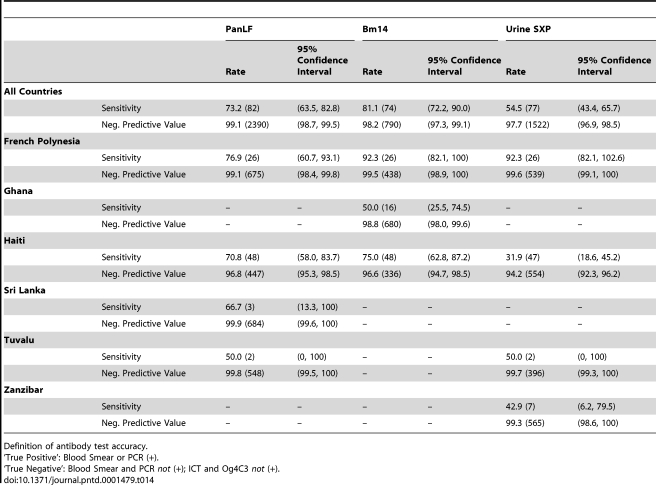
Description:Successful mass drug administration (MDA) campaigns have brought several countries near the point of Lymphatic Filariasis (LF) elimination. A diagnostic tool is needed to determine when the prevalence levels have decreased to a point that MDA campaigns can be discontinued without the threat of recrudescence. A six-country study was conducted assessing the performance of seven diagnostic tests, including tests for microfilariae (blood smear, PCR), parasite antigen (ICT, Og4C3) and antifilarial antibody (Bm14, PanLF, Urine SXP). One community survey and one school survey were performed in each country. A total of 8,513 people from the six countries participated in the study, 6,443 through community surveys and 2,070 through school surveys. Specimens from these participants were used to conduct 49,585 diagnostic tests. Each test was seen to have both positive and negative attributes, but overall, the ICT test was found to be 76% sensitive at detecting microfilaremia and 93% specific at identifying individuals negative for both microfilariae and antifilarial antibody; the Og4C3 test was 87% sensitive and 95% specific. We conclude, however, that the ICT should be the primary tool recommended for decision-making about stopping MDAs. As a point-of-care diagnostic, the ICT is relatively inexpensive, requires no laboratory equipment, has satisfactory sensitivity and specificity and can be processed in 10 minutes-qualities consistent with programmatic use. Og4C3 provides a satisfactory laboratory-based diagnostic alternative.
-
Subjects:
-
Source:PLoS Negl Trop Dis. 2012; 6(1).
-
Document Type:
-
Volume:6
-
Issue:1
-
Collection(s):
-
Main Document Checksum:urn:sha256:ec5107f008547b9e02d85866169699feed2a4f87bdc5da83a9a4f7b962539d5e
-
Download URL:
-
File Type:
 [PDF
- 173.40 KB
]
[PDF
- 173.40 KB
]
Supporting Files


File Language:
English
ON THIS PAGE












CDC STACKS serves as an archival repository of CDC-published products including
scientific findings,
journal articles, guidelines, recommendations, or other public health information authored or
co-authored by CDC or funded partners.
As a repository, CDC STACKS retains documents in their original published format to ensure public access to scientific information.
As a repository, CDC STACKS retains documents in their original published format to ensure public access to scientific information.
You May Also Like
COLLECTION
CDC Public Access