


A Field Trial of Alternative Targeted Screening Strategies for Chagas Disease in Arequipa, Peru
Supporting Files
Public Domain

-
Jan 10 2012
-
File Language:
English
Details
-
Alternative Title:PLoS Negl Trop Dis
-
Personal Author:
-
Description:Background
Chagas disease is endemic in the rural areas of southern Peru and a growing urban problem in the regional capital of Arequipa, population ∼860,000. It is unclear how to implement cost-effective screening programs across a large urban and periurban environment.
Methods
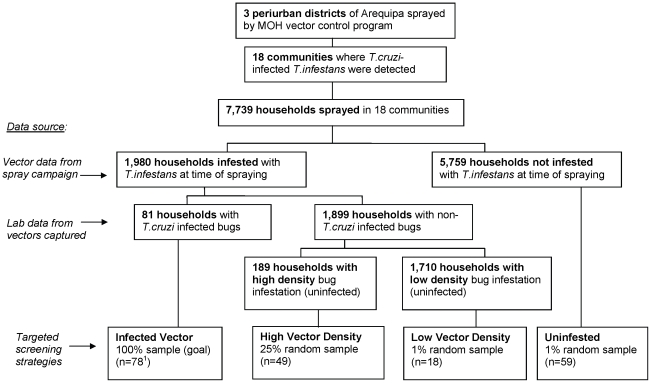
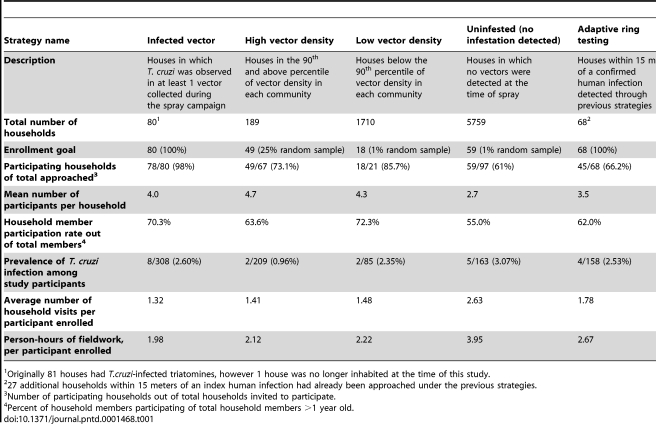
We compared four alternative screening strategies in 18 periurban communities, testing individuals in houses with 1) infected vectors; 2) high vector densities; 3) low vector densities; and 4) no vectors. Vector data were obtained from routine Ministry of Health insecticide application campaigns. We performed ring case detection (radius of 15 m) around seropositive individuals, and collected data on costs of implementation for each strategy.
Results
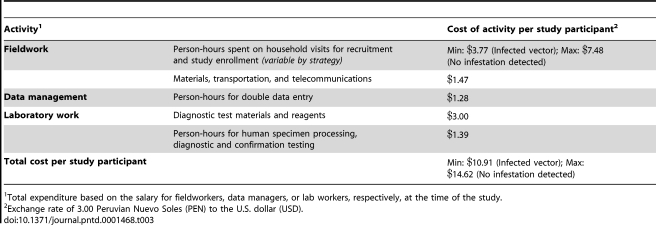
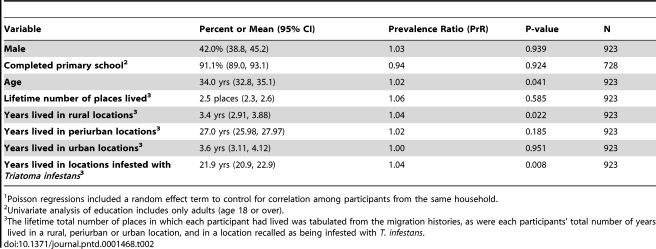
Infection was detected in 21 of 923 (2.28%) participants. Cases had lived more time on average in rural places than non-cases (7.20 years versus 3.31 years, respectively). Significant risk factors on univariate logistic regression for infection were age (OR 1.02; p = 0.041), time lived in a rural location (OR 1.04; p = 0.022), and time lived in an infested area (OR 1.04; p = 0.008). No multivariate model with these variables fit the data better than a simple model including only the time lived in an area with triatomine bugs. There was no significant difference in prevalence across the screening strategies; however a self-assessment of disease risk may have biased participation, inflating prevalence among residents of houses where no infestation was detected. Testing houses with infected-vectors was least expensive. Ring case detection yielded four secondary cases in only one community, possibly due to vector-borne transmission in this community, apparently absent in the others.
Conclusions
Targeted screening for urban Chagas disease is promising in areas with ongoing vector-borne transmission; however, these pockets of epidemic transmission remain difficult to detect a priori. The flexibility to adapt to the epidemiology that emerges during screening is key to an efficient case detection intervention. In heterogeneous urban environments, self-assessments of risk and simple residence history questionnaires may be useful to identify those at highest risk for Chagas disease to guide diagnostic efforts.
-
Subjects:
-
Source:PLoS Negl Trop Dis. 2012; 6(1).
-
Document Type:
-
Place as Subject:
-
Volume:6
-
Issue:1
-
Collection(s):
-
Main Document Checksum:urn:sha256:171857b9644d7e5be783769d8ac9d7847716496bd92540d6e7b2f4125e15c5c0
-
Download URL:
-
File Type:
 [PDF
- 221.77 KB
]
[PDF
- 221.77 KB
]
Supporting Files


File Language:
English
ON THIS PAGE



CDC STACKS serves as an archival repository of CDC-published products including
scientific findings,
journal articles, guidelines, recommendations, or other public health information authored or
co-authored by CDC or funded partners.
As a repository, CDC STACKS retains documents in their original published format to ensure public access to scientific information.
As a repository, CDC STACKS retains documents in their original published format to ensure public access to scientific information.
You May Also Like
COLLECTION
CDC Public Access