


The Association between Stressful Life Events and Respiratory Infections During the First Four Years of Life: The Environmental Determinants of Diabetes in the Young (TEDDY) Study
Supporting Files

-
April 04 2019
-
File Language:
English
Details
-
Alternative Title:Stress Health
-
Personal Author:
-
Corporate Authors:
-
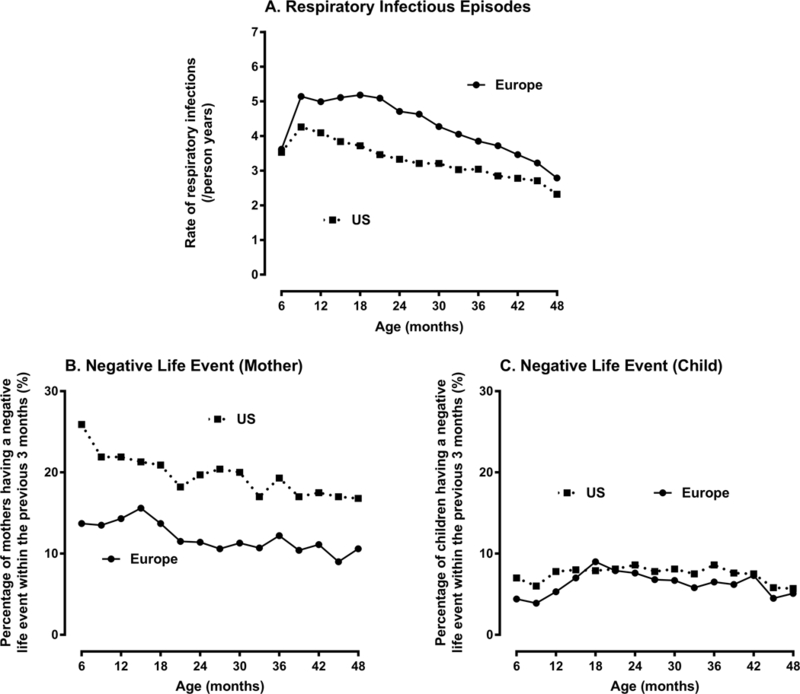
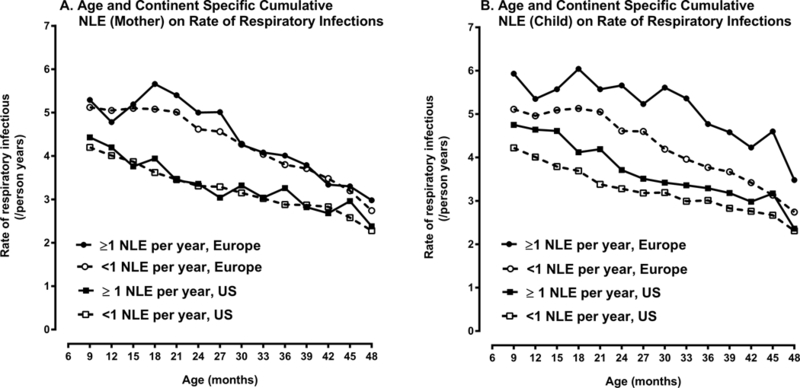
Description:The aim of this study was to conduct a prospective analysis of the association between negative life events (NLEs) and respiratory infections in children genetically at risk for islet autoimmunity (IA) and type 1 diabetes (T1D). Long- and short-term temporal associations between NLEs and rate of respiratory infection episodes (RIEs) in 5,618 children in The Environmental Determinants of Diabetes in the Young study for at least 1 up to 4 years were analysed. All models were adjusted for demographic, day care, season of infection, and psychosocial factors associated with the rate of child RIEs between study visits. The rate of child RIEs was 26% higher in Europe (Sweden, Finland, Germany) than in the United States (rate ratio [RR] = 1.26, p < 0.001). However, the percentage of child NLEs (odds ratio [OR] = 1.18, p < 0.001) and mother NLEs (OR = 1.83, p < 0.001) was higher in the United States compared with Europe. In both continents (Europe, RR = 1.12, p < 0.001; United States, RR = 1.07, p = 0.006), high child cumulative NLEs (>1 NLE per year since study inception) was significantly associated with an increased rate of child RIEs. This large-scale prospective study confirms observations that stress may increase the susceptibility for infections in paediatric populations and suggests at least one mechanism by which stress could increase risk for IA and T1D in genetically at risk children.
-
Subjects:
-
Source:Stress Health. 35(3):289-303
-
Pubmed ID:30768831
-
Pubmed Central ID:PMC6697245
-
Document Type:
-
Funding:UC4 DK63836/DK/NIDDK NIH HHS/United States ; HHSN267200700014C/DK/NIDDK NIH HHS/United States ; U01 DK063790/DK/NIDDK NIH HHS/United States ; UL1 TR001082/TR/NCATS NIH HHS/United States ; U01 DK63863/DK/NIDDK NIH HHS/United States ; U01 DK63865/DK/NIDDK NIH HHS/United States ; U01 DK63821/DK/NIDDK NIH HHS/United States ; National Institute of Child Health and Human Development/ ; CC/CDC HHS/United States ; UC4 DK63829/DK/NIDDK NIH HHS/United States ; U01 DK063821/DK/NIDDK NIH HHS/United States ; UC4 DK063863/DK/NIDDK NIH HHS/United States ; UC4 DK63865/DK/NIDDK NIH HHS/United States ; UC4 DK63821/DK/NIDDK NIH HHS/United States ; U01 DK63790/DK/NIDDK NIH HHS/United States ; UL1 TR000064/TR/NCATS NIH HHS/United States ; U01 DK063836/DK/NIDDK NIH HHS/United States ; Juvenile Diabetes Research Foundation International/ ; National Institute of Allergy and Infectious Diseases/ ; U01 DK063829/DK/NIDDK NIH HHS/United States ; UC4 DK095300/DK/NIDDK NIH HHS/United States ; U01 DK063865/DK/NIDDK NIH HHS/United States ; U01 DK63836/DK/NIDDK NIH HHS/United States ; U01 DK63861/DK/NIDDK NIH HHS/United States ; UC4 DK063861/DK/NIDDK NIH HHS/United States ; UC4 DK63863/DK/NIDDK NIH HHS/United States ; UC4 DK063829/DK/NIDDK NIH HHS/United States ; ES/NIEHS NIH HHS/United States ; UC4 DK063821/DK/NIDDK NIH HHS/United States ; UC4 DK117483/DK/NIDDK NIH HHS/United States ; UC4 DK063836/DK/NIDDK NIH HHS/United States ; UC4 DK112243/DK/NIDDK NIH HHS/United States ; U01 DK63829/DK/NIDDK NIH HHS/United States ; U01 DK063861/DK/NIDDK NIH HHS/United States ; UC4 DK063865/DK/NIDDK NIH HHS/United States ; U01 DK063863/DK/NIDDK NIH HHS/United States ; UC4 DK106955/DK/NIDDK NIH HHS/United States ; UC4 DK100238/DK/NIDDK NIH HHS/United States ; UC4 DK95300/DK/NIDDK NIH HHS/United States ; UC4 DK63861/DK/NIDDK NIH HHS/United States
-
Volume:35
-
Issue:3
-
Collection(s):
-
Main Document Checksum:urn:sha256:ecdc4d332312a9a97025c2d4a93263afa8eb30babed4691e2cc4804ea72109ee
-
Download URL:
-
File Type:
 [PDF
- 530.55 KB
]
[PDF
- 530.55 KB
]
Supporting Files


File Language:
English
ON THIS PAGE


CDC STACKS serves as an archival repository of CDC-published products including
scientific findings,
journal articles, guidelines, recommendations, or other public health information authored or
co-authored by CDC or funded partners.
As a repository, CDC STACKS retains documents in their original published format to ensure public access to scientific information.
As a repository, CDC STACKS retains documents in their original published format to ensure public access to scientific information.
You May Also Like
COLLECTION
CDC Public Access