


Effectiveness of Ambulatory Telemedicine Care in Older Adults: A Systematic Review
Supporting Files

-
8 2019
-
File Language:
English
Details
-
Journal Article:J Am Geriatr Soc
-
Personal Author:
-
Description:Background:
Disparities in healthcare access and delivery caused by transportation and health workforce difficulties negatively impact individuals living in rural areas. These challenges are especially prominent in older adults.
Design:
We systematically evaluated the feasibility, acceptability and effectiveness in providing telemedicine searching the English-language literature for studies (January 2012 to July 2018) in the following databases: Medline (PubMed); Cochrane Library (Wiley); Web of Science; CINAHL; EMBASE (Ovid); and PsycINFO (EBSCO).
Participants:
Older adults (mean age ≥65 and none were less than 60 years)
Interventions:
Interventions consisted of live, synchronous, two-way video-conferencing communication in non-hospital settings. All medical interventions were included.
Measurements:
Quality assessment using the Cochrane Collaboration’s Risk of Bias Tool was applied on all included articles, including a qualitative summary of all articles.
Results:
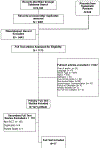
Of 6,616 citations, we reviewed the full text of 1,173 articles, excluding 1,047 that did not meet criteria. Of the 17 randomized controlled trials, the United States was the country with the most trials (6 [35%]) with cohort sizes ranging from 3–844 (median 35) participants. Risk of bias among included studies varied from low to high. Our qualitative analysis suggests that telemedicine can improve health outcomes in older adults and that it could be used in this population.
Conclusions:
Telemedicine is feasible and acceptable in delivering care to older adults. Research should focus on well-designed randomized trials to overcome the high degree of bias observed in our synthesis. Clinicians should consider using telemedicine in routine practice to overcome barriers of distance and access to care.
-
Subjects:
-
Keywords:
-
Source:J Am Geriatr Soc. 67(8):1737-1749
-
DOI:
-
Pubmed ID:31066916
-
Pubmed Central ID:PMC6684409
-
Document Type:
-
Funding:NIDA P30DA029926/AG/NIA NIH HHSUnited States/ ; NCI P30CA023108-37/AG/NIA NIH HHSUnited States/ ; P30 CA023108/CA/NCI NIH HHSUnited States/ ; UL1 TR001086/TR/NCATS NIH HHSUnited States/ ; P30 DA029926/DA/NIDA NIH HHSUnited States/ ; U48DP005018/ACL/ACL HHSUnited States/ ; K23 AG051681/AG/NIA NIH HHSUnited States/ ; CDC U48DP005018/AG/NIA NIH HHSUnited States/ ; NCATS UL1TR001086/AG/NIA NIH HHSUnited States/ ; K23AG051681/AG/NIA NIH HHSUnited States/
-
Genre:
-
Volume:67
-
Issue:8
-
Collection(s):
-
Main Document Checksum:urn:sha-512:65fc7c6309824c5044f89e1ce245a200a6648cf55502197221f07d56cd817b7181df4a3d622db164a792331587147047cad629ca6c2da85db9d86634ed0634e6
-
Download URL:
-
File Type:
 [PDF
- 322.26 KB
]
[PDF
- 322.26 KB
]
Supporting Files


File Language:
English
ON THIS PAGE


CDC STACKS serves as an archival repository of CDC-published products including
scientific findings,
journal articles, guidelines, recommendations, or other public health information authored or
co-authored by CDC or funded partners.
As a repository, CDC STACKS retains documents in their original published format to ensure public access to scientific information.
As a repository, CDC STACKS retains documents in their original published format to ensure public access to scientific information.
You May Also Like
COLLECTION
CDC Public Access