



Among Children Born Extremely Preterm a Higher Level of Circulating Neurotrophins Is Associated with Lower Risk of Cognitive Impairment at School Age
Supporting Files

-
July 18 2018
-
Available in CDC Stacks on 2019-08-06T00:00:00Z
File Language:
English
Details
-
Journal Article:J Pediatr
-
Personal Author:Kuban, Karl C. K. ; Heeren, Timothy ; O’Shea, T. Michael ; Joseph, Robert M. ; Fichorova, Raina N. ; Douglass, Laurie ; Jara, Hernan ; Frazier, Jean A. ; Hirtz, Deborah ; Taylor, H. Gerry ; Rollins, Julie Vanier ; Paneth, Nigel
-
Corporate Authors:
-
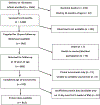
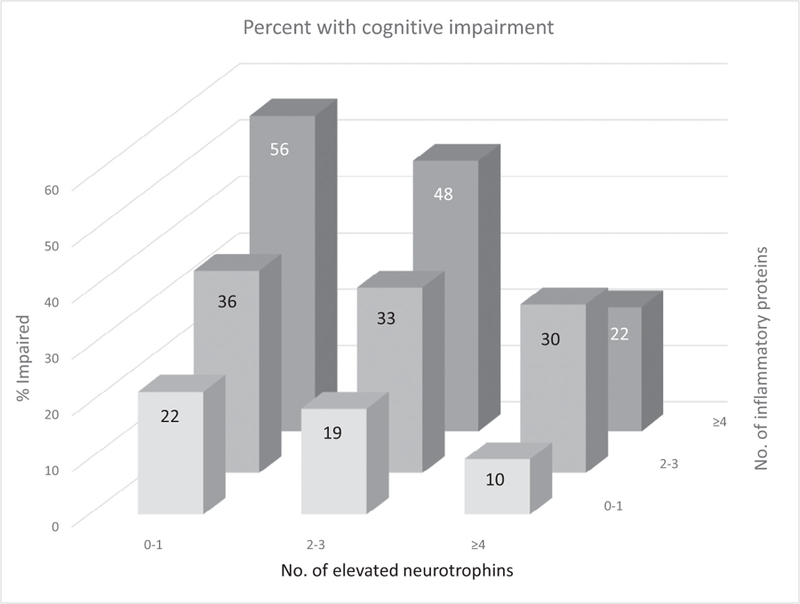
Description:Objectives ; To test the hypothesis that higher blood levels of neurotrophic proteins (proteins that support neuronal survival and function) in the first 2 weeks of life are associated with a lower risk of cognitive impairment at 10 years. ; Study design ; We evaluated 812 10-year-old children with neonatal blood specimens enrolled in the multicenter prospective Extremely Low Gestational Age Newborn Study, assessing 22 blood proteins collected on 3 days over the first 2 weeks of life. Using latent profile analysis, we derived a cognitive function level based on standardized cognitive and executive function tests. We defined high exposure as the top quartile neurotrophic protein blood level on ≥2 days either for ≥4 proteins or for a specific cluster of neurotrophic proteins (defined by latent class analysis). Multinomial logistic regression analyzed associations between high exposures and cognitive impairment. ; Results ; Controlling for the effects of inflammatory proteins, persistently elevated blood levels of ≥4 neurotrophic proteins were associated with reduced risk of moderate (OR, 0.35; 95% CI, 0.18–0.67) and severe cognitive impairment (OR, 0.22; 95% CI, 0.09–0.53). Children with a cluster of elevated proteins including angiopoietin 1, brain-derived neurotrophic factor, and regulated upon activation, normal T-cell expressed, and secreted had a reduced risk of adverse cognitive outcomes (OR range, 0.31–0.6). The risk for moderate to severe cognitive impairment was least with 0–1 inflammatory and >4 neurotrophic proteins. ; Conclusions ; Persisting elevations of circulating neurotrophic proteins during the first 2 weeks of life are associated with lowered risk of impaired cognition at 10 years of age, controlling for increases in inflammatory proteins.
-
Subjects:
- Article
- Angiopoietin-1
- Brain-Derived Neurotrophic Factor
- Chemokine CCL5
- Child
- Child Development
- Cognition
- Cognition Disorders
- Executive Function
- Female
- Humans
- Infant, Extremely Premature
- Infant, Newborn
- Male
- Nerve Growth Factors
- Prospective Studies
- Risk
- Severity of Illness Index
- T-Lymphocytes
- United States
-
Source:J Pediatr. 201:40-48.e4
-
DOI:
-
Pubmed ID:30029870
-
Pubmed Central ID:PMC6684153
-
Document Type:
-
Funding:R01 HD092374/NICHD NIH HHS/National Institute of Child Health & Human Development/United States ; U01 NS040069/NINDS NIH HHS/National Institute of Neurological Disorders and Stroke/United States ; UG3 OD023348/ODCDC CDC HHS/Office of the Director/United States ; UH3 OD023348/ODCDC CDC HHS/Office of the Director/United States
-
Genre:
-
Volume:201
-
Download URL:
-
File Type:
 [PDF - 528.32 KB]
 -
Collection(s):
-
Main Document Checksum:urn:sha-512:e06fea42b16640d8b49e11cb2d44fe97c09c44275f046e242e4f1da046585e763806c86f6fa610ec8b384254dc323e2fa82d1f42e7774b70c7e520153ed163e9
Supporting Files


File Language:
English
 Was this page helpful?
 Found an issue?



CDC STACKS serves as an archival repository of CDC-published products including
scientific findings, journal articles, guidelines, recommendations, or other public health information authored or
co-authored by CDC or funded partners.
As a repository, CDC STACKS retains documents in their original published format to ensure public access to scientific information.
As a repository, CDC STACKS retains documents in their original published format to ensure public access to scientific information.
You May Also Like
COLLECTION
CDC Public Access