


Endo-lysosomal Sorting of G Protein-coupled Receptors by Ubiquitin: Diverse Pathways for GPCR Destruction and Beyond
Supporting Files

-
November 18 2018
File Language:
English
Details
-
Alternative Title:Traffic
-
Personal Author:
-
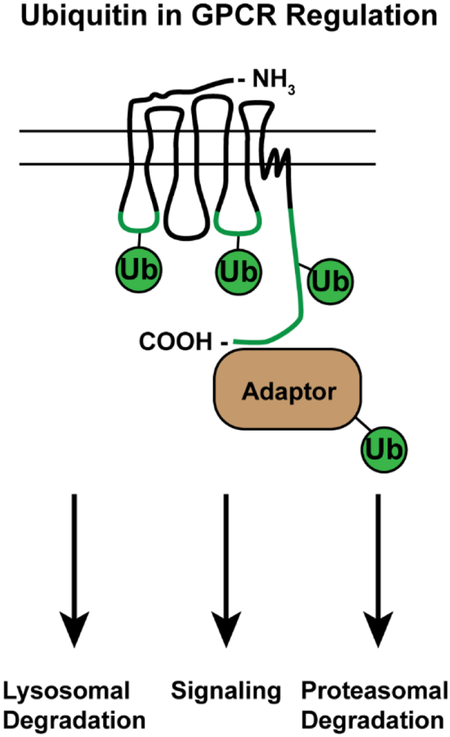
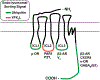
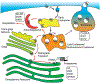
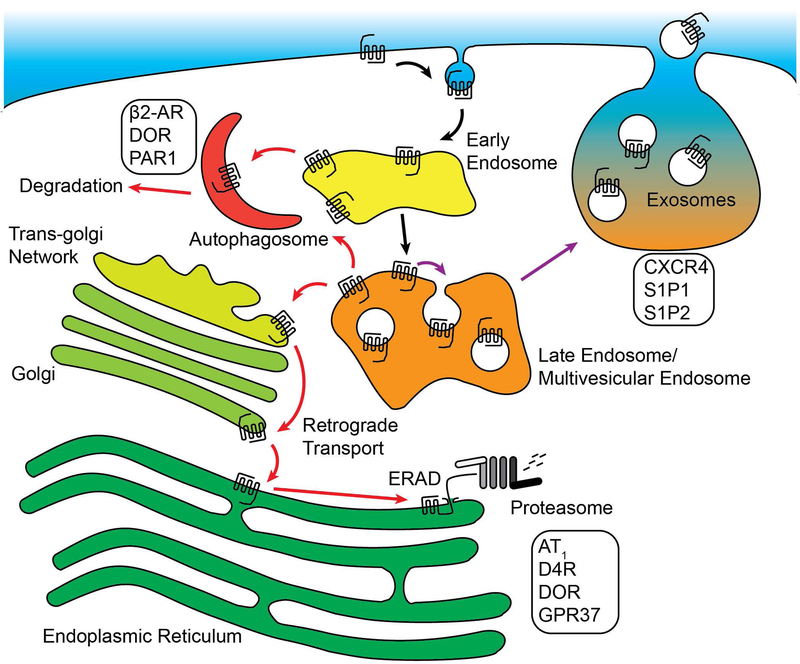
Description:Ubiquitin is covalently attached to substrate proteins in the form of a single ubiquitin moiety or polyubiquitin chains and has been generally linked to protein degradation, however, distinct types of ubiquitin linkages are also used to control other critical cellular processes like cell signaling. Over forty mammalian G protein-coupled receptors (GPCRs) have been reported to be ubiquitinated, but despite the diverse and rich complexity of GPCR signaling, ubiquitin has been largely ascribed to receptor degradation. Indeed, GPCR ubiquitination targets the receptors for degradation by lysosome, which is mediated by the Endosomal Sorting Complexes Required for Transport (ESCRT) machinery, and the proteasome. This has led to the view that ubiquitin and ESCRTs primarily function as the signal to target GPCRs for destruction. Contrary to this conventional view, studies indicate that ubiquitination of certain GPCRs and canonical ubiquitin-binding ESCRTs are not required for receptor degradation and revealed that diverse and complex pathways exist to regulate endo-lysosomal sorting of GPCRs. In other studies, GPCR ubiquitination has been shown to drive signaling and not receptor degradation and further revealed novel insight into the mechanisms by which GPCRs trigger the activity of the ubiquitination machinery. Here, we discuss the diverse pathways by which ubiquitin controls GPCR endo-lysosomal sorting and beyond.
-
Subjects:
-
Source:Traffic. 20(2):101-109
-
Pubmed ID:30353650
-
Pubmed Central ID:PMC6385894
-
Document Type:
-
Funding:
-
Volume:20
-
Issue:2
-
Collection(s):
-
Main Document Checksum:urn:sha256:42777e091c82ea39ec71167bd43605260a65c58c6e3a3baf8fb54c206ceb689c
-
Download URL:
-
File Type:
 [PDF
- 1.07 MB
]
[PDF
- 1.07 MB
]
Supporting Files


File Language:
English
ON THIS PAGE



CDC STACKS serves as an archival repository of CDC-published products including
scientific findings,
journal articles, guidelines, recommendations, or other public health information authored or
co-authored by CDC or funded partners.
As a repository, CDC STACKS retains documents in their original published format to ensure public access to scientific information.
As a repository, CDC STACKS retains documents in their original published format to ensure public access to scientific information.
You May Also Like
COLLECTION
CDC Public Access