


Assessing Fever Frequency After Pediatric Live Attenuated Versus Inactivated Influenza Vaccination
Supporting Files

-
Sep 01 2017
-
File Language:
English
Details
-
Alternative Title:J Pediatric Infect Dis Soc
-
Personal Author:
-
Description:Background.
Some studies have found a higher frequency of fever with trivalent live attenuated influenza vaccine (LAIV) than with inactivated influenza vaccine (IIV), but quadrivalent LAIV has not been assessed. Understanding fever is important for safety reviews and for parents and providers. In addition, there have been only a limited number of studies in which text messaging was used for vaccine adverse-event (AE) surveillance.
Methods.
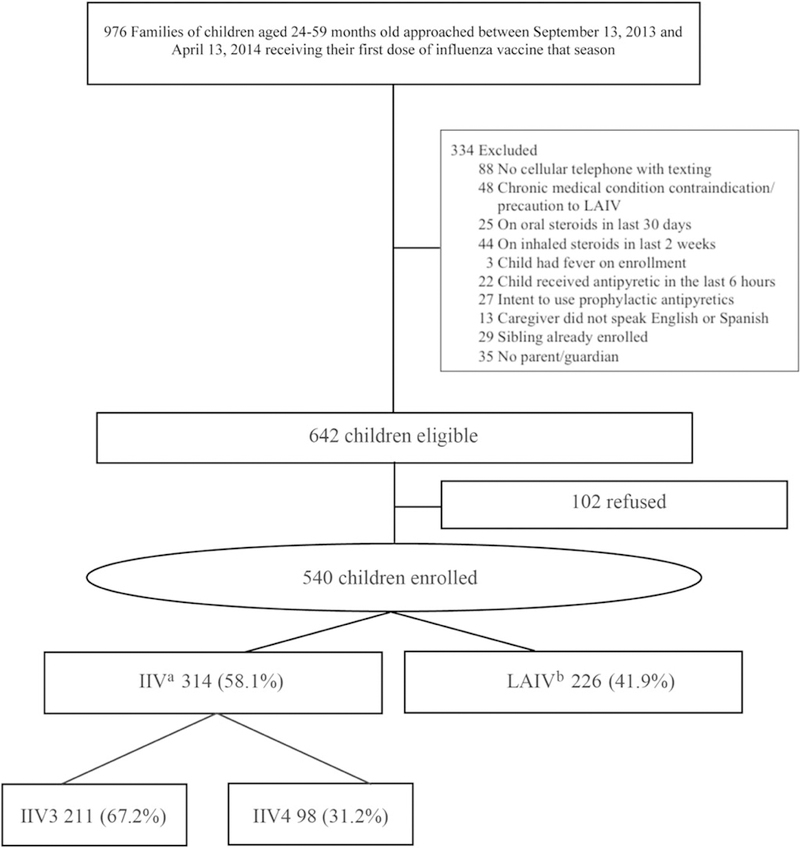
We conducted a prospective observational study in 3 community clinics in New York City to assess post-influenza vaccination fever in 24- to 59-month-olds during the 2013–2014 season. Enrolled families of children who received quadrivalent LAIV (LAIV4) or IIV (trivalent IIV3 or quadrivalent IIV4) replied to text messages that assessed their temperature on vaccination night and the next 10 nights (days 0 to 10); missing data were collected via telephone and a diary. We compared frequencies of fever (temperature ≥ 100.4°F) according to vaccine group on days 0 to 2 and 3 to 10 by using χ2 and multivariate log-binomial regression adjusted for age, previous influenza vaccination, and vaccine coadministration. We also assessed outcomes using all sources versus only text messages.
Results.
Most (84.1 % [n = 540]) eligible parents enrolled. Fever frequencies on days 0 to 2 did not differ between LAIV4 and any IIV (3.8% vs 5.7%, respectively; adjusted relative risk [aRR] [95% confidence interval], 0.60 [0.25–1.46]), between LAIV4 and IIV4 (4.2% vs 7.1%, respectively; aRR, 0.58 [0.19–1.72]), or between IIV4 and IIV3 (7.1% vs 6.0%, respectively; aRR, 1.02 [0.30–3.46]). The findings were similar when all data sources versus textmessage data alone were used. There were no significant differences on days 3 to 10.
Conclusions.
Postvaccination fever frequencies were low overall and did not differ according to influenza vaccine type during the 2013–2014 influenza season. The similarity of results when data were limited to text messages lends support to its use for surveillance of vaccine adverse events.
-
Subjects:
-
Source:J Pediatric Infect Dis Soc. 6(3):e7-e14
-
Pubmed ID:27302328
-
Pubmed Central ID:PMC6675416
-
Document Type:
-
Funding:
-
Volume:6
-
Issue:3
-
Collection(s):
-
Main Document Checksum:urn:sha256:6bb95606e8e10bd132a82c005b41c7540ea931f24e8d1de0a3b583b7b9c35b40
-
Download URL:
-
File Type:
 [PDF
- 465.18 KB
]
[PDF
- 465.18 KB
]
Supporting Files


File Language:
English
ON THIS PAGE



CDC STACKS serves as an archival repository of CDC-published products including
scientific findings,
journal articles, guidelines, recommendations, or other public health information authored or
co-authored by CDC or funded partners.
As a repository, CDC STACKS retains documents in their original published format to ensure public access to scientific information.
As a repository, CDC STACKS retains documents in their original published format to ensure public access to scientific information.
You May Also Like
COLLECTION
CDC Public Access