



Trajectories of child protective services contact among Alaska Native/American Indian and non-Native children
Supporting Files

-
9 2019 ; 9-2019
-
Available in CDC Stacks on September 01, 2020, 12:00 AM
File Language:
English
Details
-
Alternative Title:Child Abuse Negl
-
Personal Author:
-
Description:Background
Contact with child protective services (CPS) functions as an independent marker of child vulnerability. Alaska children are an important population for understanding patterns of CPS contact given high rates of contact overall and among specific demographic groups.
Objective
We aimed to identify longitudinal trajectory classes of CPS contact among Alaska Native/American Indian (AN/AI) and non-Native children and examine preconception and prenatal risk factors associated with identified classes.
Participants and setting
We used data from the Alaska Longitudinal Child Abuse and Neglect Linkage (ALCANLink) project, a linkage of 2009–2011 Alaska Pregnancy Risk Assessment Monitoring System (PRAMS) births with administrative data including CPS records.
Methods
We conducted growth mixture modeling to identify trajectory classes of CPS contact from birth to age five years. We used Vermunt’s three-step approach to examine associations with preconception and prenatal risk factors.
Results
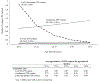
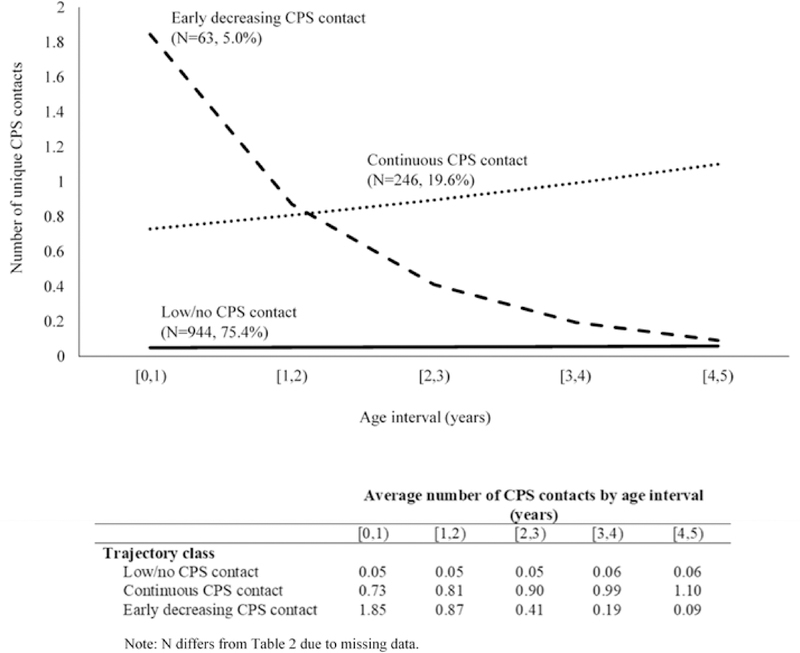
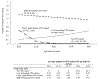
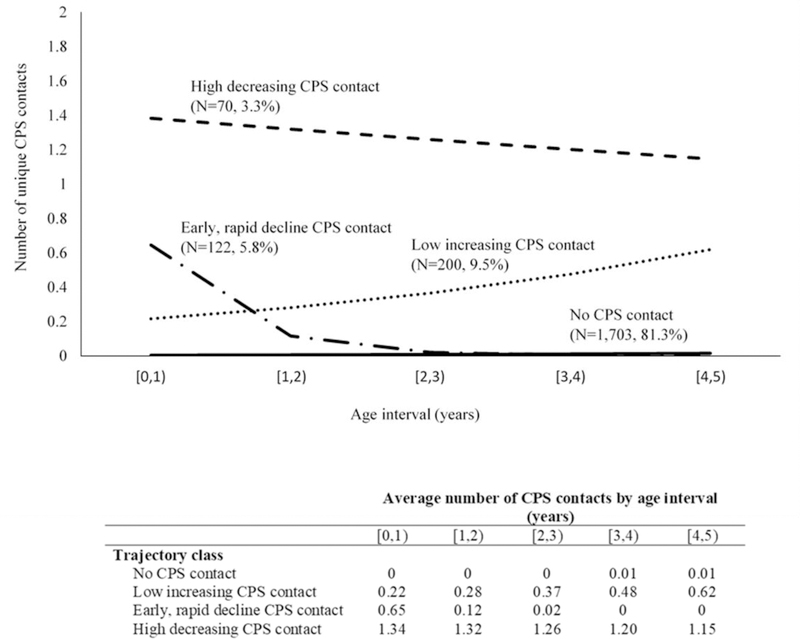
Among AN/AI children, we identified three classes: 1) no/low CPS contact (75.4%); 2) continuous CPS contact (19.6%), and 3) early, decreasing CPS contact (5.0%). Among non-Native children, we identified four classes: 1) no CPS contact (81.3%); 2) low, increasing CPS contact (9.5%); 3) early, rapid decline CPS contact (5.8%); and 4) high, decreasing CPS contact (3.3%). Maternal substance use had the largest impact on probabilities of class membership, increasing the probability of membership in classes characterized by CPS contact, among both AN/AI and non-Native children.
Conclusions
Results reveal heterogeneity in longitudinal patterns CPS contact across early childhood among Alaska children and identify maternal substance use as an important target for primary prevention. -
Keywords:
- child protective services
- child welfare
- child maltreatment
- racial disparities
- Alaska
- Alaska Natives
- Child
- Child Abuse
- Child Protective Services
- Child, Preschool
- Ethnicity
- Female
- Humans
- Indians, North American
- Longitudinal Studies
- Male
- Maternal Age
- Mothers
- Pregnancy
- Risk Assessment
- Risk Factors
- Substance-Related Disorders
-
Source:Child Abuse Negl. 95:104044
-
Pubmed ID:31254951
-
Pubmed Central ID:PMC6667300
-
Document Type:
-
Funding:
-
Volume:95
-
Download URL:
-
File Type:
 [PDF - 671.71 KB]
 -
Collection(s):
-
Main Document Checksum:urn:sha256:a423e7cdba0e072e05dfa4ddc08d16c5dc633fcb1016a679bb698c9f588d61be
Supporting Files


File Language:
English
 Was this page helpful?
 Found an issue?

CDC STACKS serves as an archival repository of CDC-published products including
scientific findings, journal articles, guidelines, recommendations, or other public health information authored or
co-authored by CDC or funded partners.
As a repository, CDC STACKS retains documents in their original published format to ensure public access to scientific information.
As a repository, CDC STACKS retains documents in their original published format to ensure public access to scientific information.
You May Also Like
COLLECTION
CDC Public Access