



Socio-economic, demographic and clinical correlates of poor glycaemic control within insulin regimens among children with Type 1 diabetes: the SEARCH for Diabetes in Youth study
Supporting Files

-
July 04 2019
-
File Language:
English
Details
-
Alternative Title:Diabet Med
-
Personal Author:
-
Description:Aim
To examine the distribution and association of sociodemographic, adherence and barriers-to-care factors in relation to glycaemic control within insulin regimens in US children with Type 1 diabetes in the SEARCH for Diabetes in Youth study.
Methods
Self- or parent-reported data from 1095 children with Type 1 diabetes aged 10–17 years were collected on insulin regimen, sociodemographics, diabetes self-management, diabetes-related family conflict and barriers to care. Multivariable logistic regression analysis identified poor glycaemic control correlates within each insulin regimen.
Results
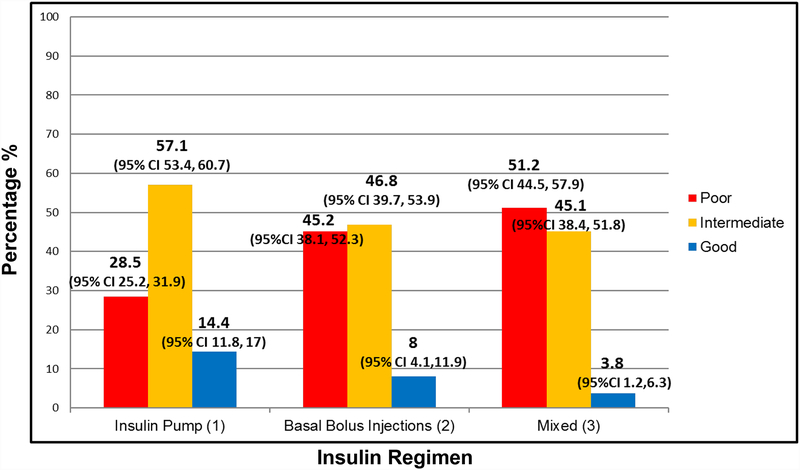
Participants included 694 children on insulin pump therapy, 188 receiving basal–bolus injections, and 213 on a mixed insulin regimen. Of these, 28.5%, 45.2% and 51.2%, respectively, had poor glycaemic control [HbA1c ≥ 80 mmol/mol (9.5%)]. Family conflict between parent and child regarding diabetes management was the only factor significantly associated with poor glycaemic control in all insulin regimens (insulin pump, P≤ 0.0001; basal–bolus injections, P=0.0002; mixed insulin regimen, P=0.0103). For children on insulin pump, poor control was significantly associated with non-white race (P=0.0008), living in multiple households (P=0.0331), having Medicaid insurance (P=0.0090), and low insulin adherence (P<0.0001). For children on a mixed insulin regimen, living in multiple households (P=0.0256) and not spending enough time with healthcare provider (P=0.0058) correlated with poor control.
Conclusions
A high percentage of US children with Type 1 diabetes had poor glycaemic control, especially those not using an insulin pump. Early identification of children with risk factors associated with poor glycaemic control within insulin regimens and addressing diabetes-related family conflict may allow interventions to improve diabetes management.
-
Subjects:
-
Source:Diabet Med. 36(8):1028-1036
-
Pubmed ID:31050009
-
Pubmed Central ID:PMC6635011
-
Document Type:
-
Funding:P30 DK057516/DK/NIDDK NIH HHS/United States ; U01 DP000247/DP/NCCDPHP CDC HHS/United States ; U18 DP002710/DP/NCCDPHP CDC HHS/United States ; U18 DP006134/DP/NCCDPHP CDC HHS/United States ; U18 DP006138/DP/NCCDPHP CDC HHS/United States ; U18DP006138/ACL/ACL HHS/United States ; UL1 TR000154/TR/NCATS NIH HHS/United States ; U18 DP002714/DP/NCCDPHP CDC HHS/United States ; U01 DP000248/DP/NCCDPHP CDC HHS/United States ; U01 DP000244/DP/NCCDPHP CDC HHS/United States ; UL1 TR000062/TR/NCATS NIH HHS/United States ; U18DP006134/ACL/ACL HHS/United States ; U18DP006131/ACL/ACL HHS/United States ; P30 DK056350/DK/NIDDK NIH HHS/United States ; UL1 TR000423/TR/NCATS NIH HHS/United States ; P30 DK017047/DK/NIDDK NIH HHS/United States ; U18DP006139/ACL/ACL HHS/United States ; UC4 DK108173/DK/NIDDK NIH HHS/United States ; U18 DP006136/DP/NCCDPHP CDC HHS/United States ; U18 DP002709/DP/NCCDPHP CDC HHS/United States ; U18 DP006133/DP/NCCDPHP CDC HHS/United States ; UL1 TR001425/TR/NCATS NIH HHS/United States ; UL1 TR002319/TR/NCATS NIH HHS/United States ; U18 DP006139/DP/NCCDPHP CDC HHS/United States ; UL1 TR000077/TR/NCATS NIH HHS/United States ; U18DP006136/ACL/ACL HHS/United States ; U01 DP000250/DP/NCCDPHP CDC HHS/United States ; U01 DP000246/DP/NCCDPHP CDC HHS/United States ; U01 DP000254/DP/NCCDPHP CDC HHS/United States ; U18DP006133/ACL/ACL HHS/United States ; U18 DP002708/DP/NCCDPHP CDC HHS/United States
-
Place as Subject:
-
Volume:36
-
Issue:8
-
Collection(s):
-
Main Document Checksum:urn:sha256:f33a5806c3f2265d857d64ace6dc3095faaf22c1a27bfdaacb6477391e3f5576
-
Download URL:
-
File Type:
 [PDF
- 248.98 KB
]
[PDF
- 248.98 KB
]
Supporting Files


File Language:
English
 Was this page helpful?
 Found an issue?
CDC STACKS serves as an archival repository of CDC-published products including
scientific findings,
journal articles, guidelines, recommendations, or other public health information authored or
co-authored by CDC or funded partners.
As a repository, CDC STACKS retains documents in their original published format to ensure public access to scientific information.
As a repository, CDC STACKS retains documents in their original published format to ensure public access to scientific information.
You May Also Like
COLLECTION
CDC Public Access