



Epidemiology of Invasive Early-Onset and Late-Onset Group B Streptococcal Disease in the United States, 2006 to 2015
Supporting Files

-
2019/03/01
-
Available in CDC Stacks on 2020-03-01T00:00:00Z
File Language:
English
Details
-
Alternative Title:JAMA Pediatr
-
Personal Author:Nanduri, Srinivas Acharya ; Petit, Susan ; Smelser, Chad ; Apostol, Mirasol ; Alden, Nisha B. ; Harrison, Lee H. ; Lynfield, Ruth ; Vagnone, Paula S. ; Burzlaff, Kari ; Spina, Nancy L. ; Dufort, Elizabeth M. ; Schaffner, William ; Thomas, Ann R. ; Farley, Monica M. ; Jain, Jennifer H. ; Pondo, Tracy ; McGee, Lesley ; Beall, Bernard W. ; Schrag, Stephanie J.
-
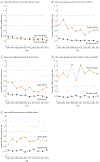
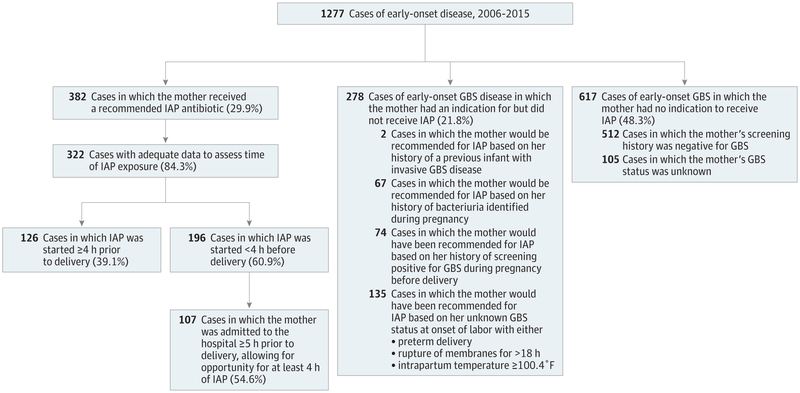
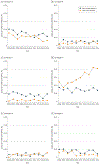
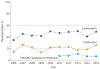
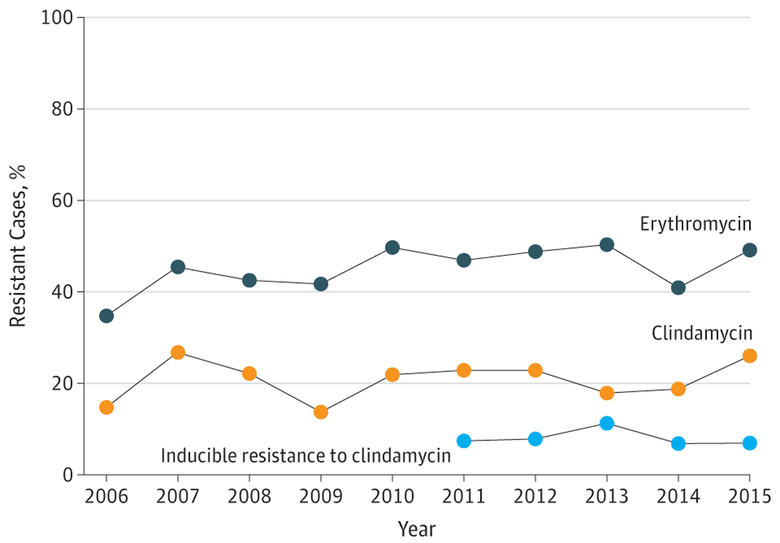
Description:IMPORTANCE ; Invasive disease owing to group B Streptococcus (GBS) remains an important cause of illness and death among infants younger than 90 days in the United States, despite declines in early-onset disease (EOD; with onset at 0-6 days of life) that are attributed to intrapartum antibiotic prophylaxis (IAP). Maternal vaccines to prevent infant GBS disease are currently under development. ; OBJECTIVE ; To describe incidence rates, case characteristics, antimicrobial resistance, and serotype distribution of EOD and late-onset disease (LOD; with onset at 7-89 days of life) in the United States from 2006 to 2015 to inform IAP guidelines and vaccine development. ; DESIGN, SETTING, AND PARTICIPANTS ; This study used active population-based and laboratory-based surveillance for invasive GBS disease conducted through Active Bacterial Core surveillance in selected counties of 10 states across the United States. Residents of Active Bacterial Core surveillance areas who were younger than 90 days and had invasive GBS disease in 2006 to 2015 were included. Data were analyzed from December 2017 to April 2018. ; EXPOSURES ; Group B Streptococcus isolated from a normally sterile site. ; MAIN OUTCOMES AND MEASURES ; Early-onset disease and LOD incidence rates and associated GBS serotypes and antimicrobial resistance. ; RESULTS ; The Active Bacterial Core surveillance program identified 1277 cases of EOD and 1387 cases of LOD. From 2006 to 2015, EOD incidence declined significantly from 0.37 to 0.23 per 1000 live births (P < .001), and LOD rates remained stable (mean, 0.31 per 1000 live births). Among the mothers of 1277 infants with EOD, 617 (48.3%) had no indications for IAP and did not receive it, and 278 (21.8%) failed to receive IAP despite having indications. Serotype data were available for 1743 of 1897 patients (91.3%) from 7 sites that collect GBS isolates. Among patients with EOD, serotypes Ia (242 27.3%) and III (242 27.3%) were most common. Among patients with LOD, serotype III was most common (481 56.2%), and this increased from 2006 to 2015 from 0.12 to 0.20 cases per 1000 live births (P < .001). Serotype IV caused 53 cases (6.2%) of EOD and LOD combined. The 6 most common serotypes (Ia, Ib, II, III, IV, and V) caused 881 EOD cases (99.3%) and 853 LOD cases (99.7%). No β-lactam resistance was identified; 359 isolates (20.8%) tested showed constitutive clindamycin resistance. In 2015, an estimated 840 EOD cases and 1265 LOD cases occurred nationally. ; CONCLUSIONS AND RELEVANCE ; The rates of LOD among US infants are now higher than EOD rates. Combined with addressing IAP implementation gaps, an effective vaccine covering the most common serotypes might further reduce EOD rates and help prevent LOD, for which there is no current public health intervention.
-
Subjects:
-
Source:JAMA Pediatr. 173(3):224-233
-
Pubmed ID:30640366
-
Pubmed Central ID:PMC6439883
-
Document Type:
-
Funding:
-
Genre:
-
Volume:173
-
Issue:3
-
Download URL:
-
File Type:
 [PDF - 882.44 KB]
 -
Collection(s):
-
Main Document Checksum:urn:sha-512:18305ed1c29a935a9ddf9c62adb8f8860dc1c540eb22a006a5120f6fb18e7db1623911301eea91d8784d545e17541d68d06fa9dc7b79f04e9b058f21cb128d9c
Supporting Files


File Language:
English
 Was this page helpful?
 Found an issue?




CDC STACKS serves as an archival repository of CDC-published products including
scientific findings, journal articles, guidelines, recommendations, or other public health information authored or
co-authored by CDC or funded partners.
As a repository, CDC STACKS retains documents in their original published format to ensure public access to scientific information.
As a repository, CDC STACKS retains documents in their original published format to ensure public access to scientific information.
You May Also Like
COLLECTION
CDC Public Access