



Comparison of 3 Infrared Thermal Detection Systems and Self-Report for Mass Fever Screening
Supporting Files
Public Domain

-
Nov 2010
File Language:
English
Details
-
Alternative Title:Emerg Infect Dis
-
Personal Author:
-
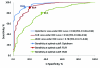
Description:Despite limited evidence regarding their utility, infrared thermal detection systems (ITDS) are increasingly being used for mass fever detection. We compared temperature measurements for 3 ITDS (FLIR ThermoVision A20M FLIR Systems Inc., Boston, MA, USA, OptoTherm Thermoscreen OptoTherm Thermal Imaging Systems and Infrared Cameras Inc., Sewickley, PA, USA, and Wahl Fever Alert Imager HSI2000S Wahl Instruments Inc., Asheville, NC, USA) with oral temperatures (≥ 100 °F = confirmed fever) and self-reported fever. Of 2,873 patients enrolled, 476 (16.6%) reported a fever, and 64 (2.2%) had a confirmed fever. Self-reported fever had a sensitivity of 75.0%, specificity 84.7%, and positive predictive value 10.1%. At optimal cutoff values for detecting fever, temperature measurements by OptoTherm and FLIR had greater sensitivity (91.0% and 90.0%, respectively) and specificity (86.0% and 80.0%, respectively) than did self-reports. Correlations between ITDS and oral temperatures were similar for OptoTherm (ρ = 0.43) and FLIR (ρ = 0.42) but significantly lower for Wahl (ρ = 0.14; p < 0.001). When compared with oral temperatures, 2 systems (OptoTherm and FLIR) were reasonably accurate for detecting fever and predicted fever better than self-reports.
-
Subjects:
-
Source:Emerg Infect Dis. 16(11):1710-1717.
-
Document Type:
-
Volume:16
-
Issue:11
-
Download URL:
-
File Type:
 [PDF - 302.32 KB]
 -
Collection(s):
-
Main Document Checksum:urn:sha256:c524340cc6618b6dec77fa20df405010c8f422b2b036c381b229767311b0f332
Supporting Files


File Language:
English
 Was this page helpful?
 Found an issue?




CDC STACKS serves as an archival repository of CDC-published products including
scientific findings, journal articles, guidelines, recommendations, or other public health information authored or
co-authored by CDC or funded partners.
As a repository, CDC STACKS retains documents in their original published format to ensure public access to scientific information.
As a repository, CDC STACKS retains documents in their original published format to ensure public access to scientific information.
You May Also Like
COLLECTION
Emerging Infectious Diseases