



Evaluation of the Association of Maternal Pertussis Vaccination With Obstetric Events and Birth Outcomes
Supporting Files

-
Nov 12 2014 ; 11-12-
-
Available in CDC Stacks on 2019-06-30T00:00:00Z
File Language:
English
Details
-
Alternative Title:JAMA
-
Personal Author:Kharbanda, Elyse O. ; Vazquez-Benitez, Gabriela ; Lipkind, Heather S. ; Klein, Nicola P. ; Cheetham, T.Craig ; Naleway, Allison ; Omer, Saad B. ; Hambidge, Simon J. ; Lee, Grace M. ; Jackson, Michael L. ; McCarthy, Natalie L. ; DeStefano, Frank ; Nordin, James D.
-
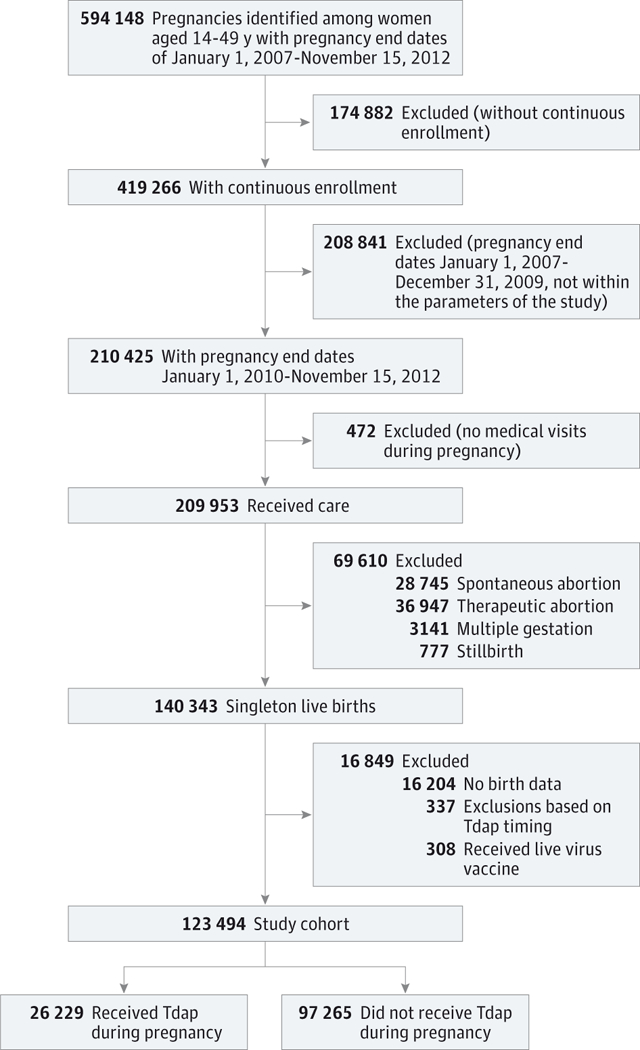
Description:IMPORTANCE ; In 2010, due to a pertussis outbreak and neonatal deaths, the California Department of Health recommended that the tetanus toxoid, reduced diphtheria toxoid, and acellular pertussis vaccine (Tdap) be administered during pregnancy. Tdap is now recommended by the Advisory Committee on Immunization Practices for all pregnant women, preferably between 27 and 36 weeks’ gestation. Limited data exist on Tdap safety during pregnancy. ; OBJECTIVE ; To evaluate whether maternal Tdap vaccination during pregnancy is associated with increased risks of adverse obstetric events or adverse birth outcomes. ; DESIGN AND SETTING ; Retrospective, observational cohort study using administrative health care databases from 2 California Vaccine Safety Datalink sites. ; PARTICIPANTS AND EXPOSURES ; Of 123 494 women with singleton pregnancies ending in a live birth between January 1, 2010, and November 15, 2012, 26 229 (21%) received Tdap during pregnancy and 97 265 did not. ; MAIN OUTCOMES AND MEASURES ; Risks of small-for-gestational-age (SGA) births (<10th percentile), chorioamnionitis, preterm birth (<37 weeks’ gestation), and hypertensive disorders of pregnancy were evaluated. Relative risk (RR) estimates were adjusted for site, receipt of another vaccine during pregnancy, and propensity to receive Tdap during pregnancy. Cox regression was used for preterm delivery, and Poisson regression for other outcomes. ; RESULTS ; Vaccination was not associated with increased risks of adverse birth outcomes: crude estimates for preterm delivery were 6.3% of vaccinated and 7.8% of unvaccinated women (adjusted RR, 1.03; 95% CI, 0.97–1.09); 8.4% of vaccinated and 8.3% of unvaccinated had an SGA birth (adjusted RR, 1.00; 95% CI, 0.96–1.06). Receipt of Tdap before 20 weeks was not associated with hypertensive disorder of pregnancy (adjusted RR, 1.09; 95% CI, 0.99–1.20); chorioamnionitis was diagnosed in 6.1% of vaccinated and 5.5% of unvaccinated women (adjusted RR, 1.19; 95% CI, 1.13–1.26). ; CONCLUSIONS AND RELEVANCE ; In this cohort of women with singleton pregnancies that ended in live birth, receipt of Tdap during pregnancy was not associated with increased risk of hypertensive disorders of pregnancy or preterm or SGA birth, although a small but statistically significant increased risk of chorioamnionitis diagnosis was observed.
-
Subjects:
- Article
- Adolescent
- Adult
- California
- Chorioamnionitis
- Cohort Studies
- Diphtheria-Tetanus-acellular Pertussis Vaccines
- Female
- Humans
- Hypertension, Pregnancy-Induced
- Infant, Newborn
- Infant, Small for Gestational Age
- Pregnancy
- Premature Birth
- Retrospective Studies
- Risk
- Vaccination
- Whooping Cough
- Young Adult
-
Source:JAMA. 312(18):1897-1904
-
Pubmed ID:25387187
-
Pubmed Central ID:PMC6599584
-
Document Type:
-
Funding:
-
Volume:312
-
Issue:18
-
Download URL:
-
File Type:
 [PDF - 444.21 KB]
 -
Collection(s):
-
Main Document Checksum:urn:sha256:228d9c983914752166c85bbc9de448032ae12c2a20fe8f3bb884fb0be8bace33
Supporting Files


File Language:
English
 Was this page helpful?
 Found an issue?


CDC STACKS serves as an archival repository of CDC-published products including
scientific findings, journal articles, guidelines, recommendations, or other public health information authored or
co-authored by CDC or funded partners.
As a repository, CDC STACKS retains documents in their original published format to ensure public access to scientific information.
As a repository, CDC STACKS retains documents in their original published format to ensure public access to scientific information.
You May Also Like
COLLECTION
CDC Public Access