


Enhancement of Risk for Lyme Disease by Landscape Connectivity, New York, New York, USA
Supporting Files

-
June 2019
-
File Language:
English
Details
-
Alternative Title:Emerg Infect Dis
-
Personal Author:
-
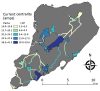
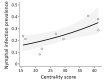
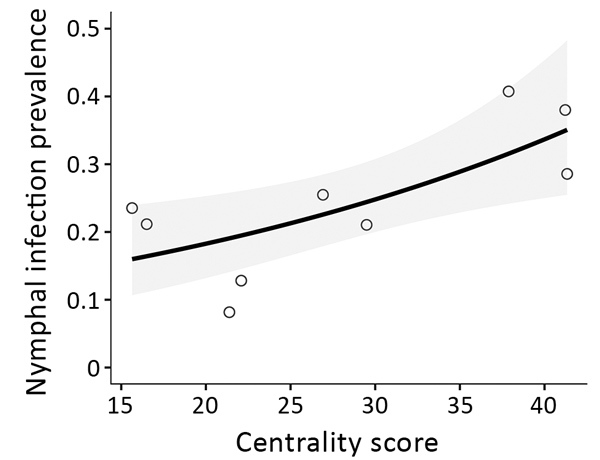
Description:Most tickborne disease studies in the United States are conducted in low-intensity residential development and forested areas, leaving much unknown about urban infection risks. To understand Lyme disease risk in New York, New York, USA, we conducted tick surveys in 24 parks throughout all 5 boroughs and assessed how park connectivity and landscape composition contribute to Ixodes scapularis tick nymphal densities and Borrelia burgdorferi infection. We used circuit theory models to determine how parks differentially maintain landscape connectivity for white-tailed deer, the reproductive host for I. scapularis ticks. We found forested parks with vegetated buffers and increased connectivity had higher nymph densities, and the degree of park connectivity strongly determined B. burgdorferi nymphal infection prevalence. Our study challenges the perspective that tickborne disease risk is restricted to suburban and natural settings and emphasizes the need to understand how green space design affects vector and host communities in areas of emerging urban tickborne disease.
-
Subjects:
-
Source:Emerg Infect Dis. 25(6):1136-1143
-
Pubmed ID:31107213
-
Pubmed Central ID:PMC6537717
-
Document Type:
-
Funding:
-
Place as Subject:
-
Volume:25
-
Issue:6
-
Collection(s):
-
Main Document Checksum:urn:sha256:01699173b48e0029b1113ba73339a2090e7af33ec9a2c8987f7c1a265220b070
-
Download URL:
-
File Type:
 [PDF
- 1.76 MB
]
[PDF
- 1.76 MB
]
Supporting Files


File Language:
English
ON THIS PAGE



CDC STACKS serves as an archival repository of CDC-published products including
scientific findings,
journal articles, guidelines, recommendations, or other public health information authored or
co-authored by CDC or funded partners.
As a repository, CDC STACKS retains documents in their original published format to ensure public access to scientific information.
As a repository, CDC STACKS retains documents in their original published format to ensure public access to scientific information.
You May Also Like
COLLECTION
Emerging Infectious Diseases