



Serologic Prevalence of Ebola Virus in Equatorial Africa
Supporting Files

-
May 2019
-
File Language:
English
Details
-
Alternative Title:Emerg Infect Dis
-
Personal Author:Steffen, Imke ; Lu, Kai ; Yamamoto, Lauren K. ; Hoff, Nicole A. ; Mulembakani, Prime ; Wemakoy, Emile O. ; Muyembe-Tamfum, Jean-Jacques ; Ndembi, Nicaise ; Brennan, Catherine A. ; Hackett, John ; Stramer, Susan L. ; Switzer, William M. ; Saragosti, Sentob ; Mbensa, Guy O. ; Laperche, Syria ; Rimoin, Anne W. ; Simmons, Graham
-
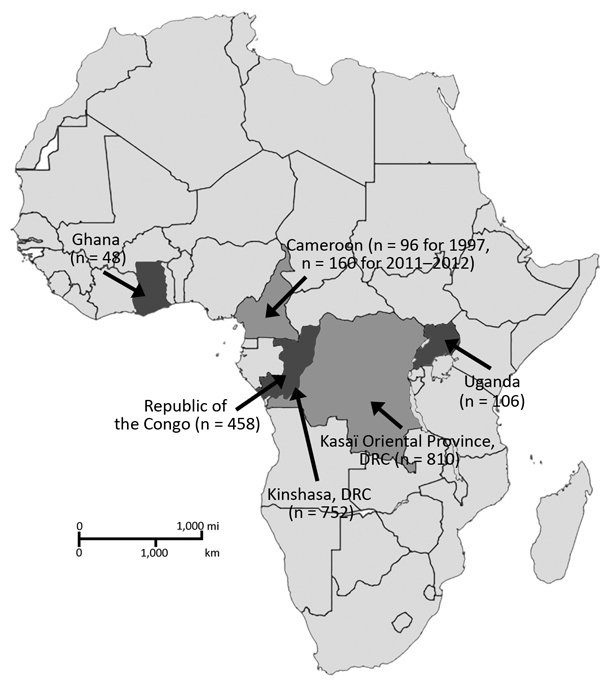
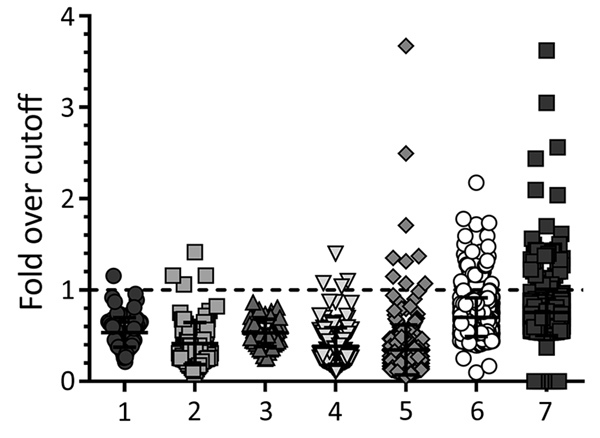
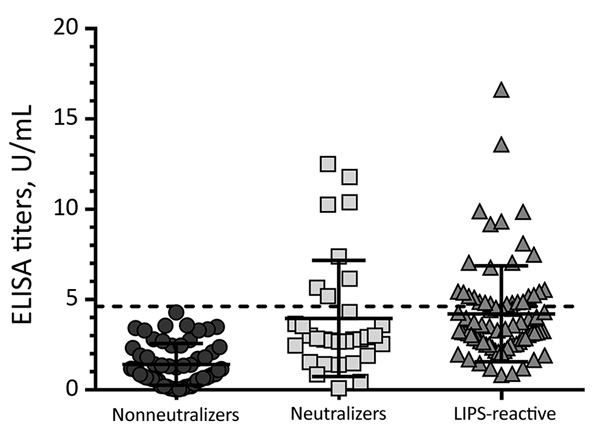
Description:We conducted a serologic survey of 2,430 serum samples collected during 1997-2012 for various studies to determine the prevalence of the hemorrhagic fever virus Ebola virus (EBOV) in equatorial Africa. We screened serum samples for neutralizing antibodies by using a pseudotype microneutralization assay and a newly developed luciferase immunoprecipitation system assay. Specimens seroreactive for EBOV were confirmed by using an ELISA. Our results suggest a serologic prevalence of 2%-3.5% in the Republic of the Congo and the Democratic Republic of the Congo, which have reported outbreaks of infection with EBOV. In addition we detected a seroprevalence of 1.3% in southern Cameroon, which indicated a low risk for exposure in this region.
-
Subjects:
-
Source:Emerg Infect Dis. 25(5):911-918
-
Pubmed ID:31002071
-
Pubmed Central ID:PMC6478206
-
Document Type:
-
Funding:
-
Place as Subject:
-
Volume:25
-
Issue:5
-
Collection(s):
-
Main Document Checksum:urn:sha256:4633257e0b4d3b68a8c1917b60b9116f3d865367be05d799e8f8bdf585558ab3
-
Download URL:
-
File Type:
 [PDF
- 1.24 MB
]
[PDF
- 1.24 MB
]
Supporting Files


File Language:
English
 Was this page helpful?
 Found an issue?





CDC STACKS serves as an archival repository of CDC-published products including
scientific findings,
journal articles, guidelines, recommendations, or other public health information authored or
co-authored by CDC or funded partners.
As a repository, CDC STACKS retains documents in their original published format to ensure public access to scientific information.
As a repository, CDC STACKS retains documents in their original published format to ensure public access to scientific information.
You May Also Like
COLLECTION
Emerging Infectious Diseases