



Parent-Perceived Stress and Its Association With Children’s Weight and Obesity-Related Behaviors
Supporting Files

-
March 28 2019
File Language:
English
Details
-
Journal Article:Preventing Chronic Disease (PCD)
-
Personal Author:
-
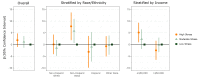
Description:Introduction ; Psychosocial stress is associated with obesity in adult and pediatric populations, but few studies have examined the relationship between parent-perceived stress and risk of child obesity and related behaviors. ; Methods ; We studied 689 pairs of parents and children aged 2 to 12 in Massachusetts with a body mass index (BMI) at or above the 85th percentile. Recruitment occurred from June 2014 to March 2015, and data collection ended in March 2016. We asked parents about their perceived stress and categorized responses as low, moderate, or high. We examined associations of parents’ stress with children’s BMI, expressed as a percentage of the 95th percentile (%BMIp95), and obesity-related behaviors by using multivariable regression models adjusted for child and parent characteristics. We stratified results by race/ethnicity, annual household income, and the child’s age. ; Results ; In fully adjusted models, the association between high versus low parent-reported stress and children’s %BMIp95 remained significant only for children in low-income households (β = 5.12; 95% confidence interval CI, 0.94–9.30) and for non-Hispanic black children (β = 7.76; 95% CI, 1.85–13.66). Parents with high or moderate stress versus low stress were less likely to report that their children met recommendations for fast-food consumption (high stress, prevalence ratio PR = 0.79; 95% CI, 0.65–0.96; moderate stress, PR = 0.70; 95% CI, 0.59–0.82), but parents with high versus low stress were more likely to report meeting daily physical activity recommendations (PR = 1.21; 95% CI, 1.01–1.45). ; Conclusion ; Among children with overweight or obesity, parent-perceived stress was associated with fast-food consumption and physical activity. Parent-perceived stress was associated with child %BMIp95 among children in low-income households and non-Hispanic black children. Obesity interventions should consider parent-perceived stress and potential differences in the nature of stress experienced by parents of different racial/ethnic and socioeconomic backgrounds.
-
Subjects:
-
Source:Prev Chronic Dis. 16
-
DOI:
-
ISSN:1545-1151
-
Pubmed ID:30925139
-
Pubmed Central ID:PMC6464048
-
Document Type:
-
Funding:
-
Volume:16
-
Download URL:
-
File Type:
 [PDF - 459.58 KB]
 -
Collection(s):
-
Main Document Checksum:urn:sha-512:133deffd7d43c531a6e8f016fd854caaf23a16453463d6c6b0a49a43a29a950ee5349d6ef4aefd982b9c4c1efbaffa9677ef28e3173ead756b5d91363b0810ba
Supporting Files


File Language:
English
 Was this page helpful?
 Found an issue?


CDC STACKS serves as an archival repository of CDC-published products including
scientific findings, journal articles, guidelines, recommendations, or other public health information authored or
co-authored by CDC or funded partners.
As a repository, CDC STACKS retains documents in their original published format to ensure public access to scientific information.
As a repository, CDC STACKS retains documents in their original published format to ensure public access to scientific information.
You May Also Like
COLLECTION
Preventing Chronic Disease