



Low Frequency of Poultry-to-Human H5N1 Transmission, Southern Cambodia, 2005
Supporting Files
Public Domain

-
Oct 2006
File Language:
English
Details
-
Alternative Title:Emerg Infect Dis
-
Personal Author:Vong, Sirenda ; Coghlan, Benjamin ; Mardy, Sek ; Holl, Davun ; Seng, Heng ; Ly, Sovann ; Miller, Megge J. ; Buchy, Philippe ; Froehlich, Yves ; Dufourcq, Jean Baptiste ; Uyeki, Timothy M. ; Lim, Wilina ; Sok, Touch
-
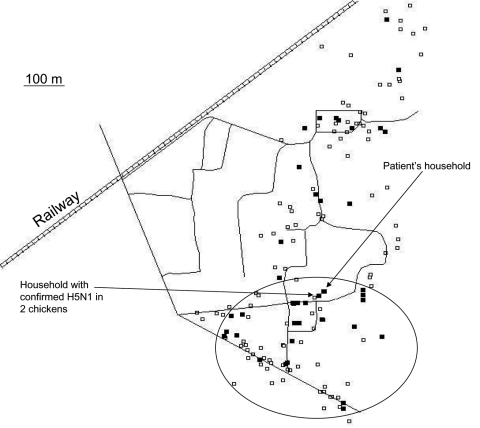
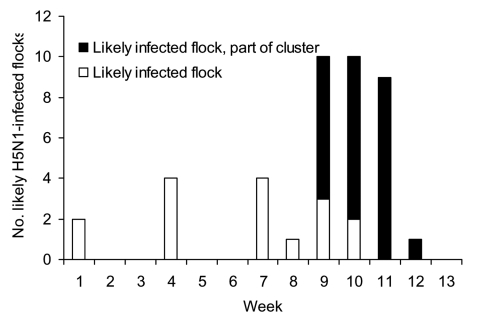
Description:To understand transmission of avian influenza A (H5N1) virus, we conducted a retrospective survey of poultry deaths and a seroepidemiologic investigation in a Cambodian village where a 28-year-old man was infected with H5N1 virus in March 2005. Poultry surveys were conducted within a 1-km radius of the patient's household. Forty-two household flocks were considered likely to have been infected from January through March 2005 because >60% of the flock died, case-fatality ratio was 100%, and both young and mature birds died within 1 to 2 days. Two sick chickens from a property adjacent to the patient's house tested positive for H5N1 on reverse transcription-PCR. Villagers were asked about poultry exposures in the past year and tested for H5N1 antibodies. Despite frequent, direct contact with poultry suspected of having H5N1 virus infection, none of 351 participants from 93 households had neutralizing antibodies to H5N1. H5N1 virus transmission from poultry to humans remains low in this setting.
-
Subjects:
-
Source:Emerg Infect Dis. 12(10):1542-1547.
-
Document Type:
-
Place as Subject:
-
Location:
-
Volume:12
-
Issue:10
-
Download URL:
-
File Type:
 [PDF - 108.84 KB]
 -
Collection(s):
-
Main Document Checksum:urn:sha256:efc5e458328802ecd3fd223fdbff5edc78d7f169d918462abe52f3bcc00ae5fa
Supporting Files


File Language:
English
 Was this page helpful?
 Found an issue?

CDC STACKS serves as an archival repository of CDC-published products including
scientific findings, journal articles, guidelines, recommendations, or other public health information authored or
co-authored by CDC or funded partners.
As a repository, CDC STACKS retains documents in their original published format to ensure public access to scientific information.
As a repository, CDC STACKS retains documents in their original published format to ensure public access to scientific information.
You May Also Like
COLLECTION
Emerging Infectious Diseases