


Economic impact of the 2015 MERS outbreak on the Republic of Korea’s tourism-related industries
Supporting Files

-
2019
-
File Language:
English
Details
-
Journal Article:Health Secur
-
Personal Author:
-
Description:Background
The 2015 Middle East respiratory syndrome (MERS) outbreak in the Republic of Korea (ROK) is an example of an infectious disease outbreak initiated by international travelers to a high-income country.
Objective
To determine the economic impact of the MERS outbreak on the tourism and travel-related service sectors, including accommodation, food and beverage, and transportation, in the ROK.
Methods
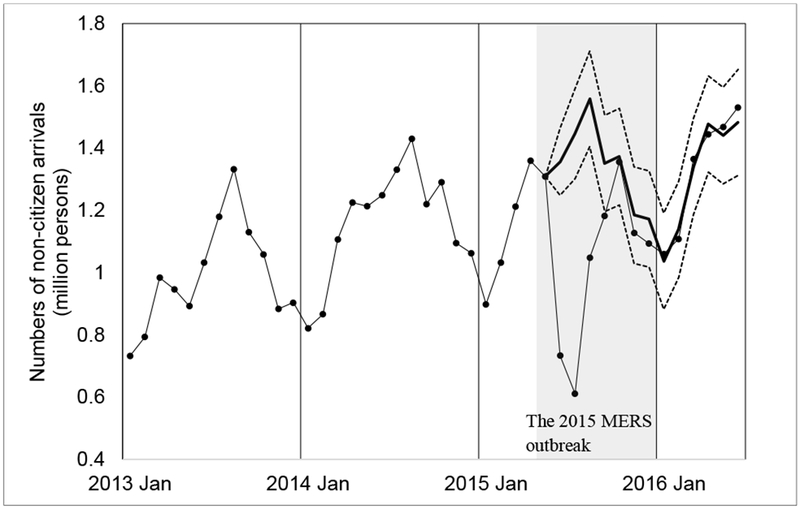
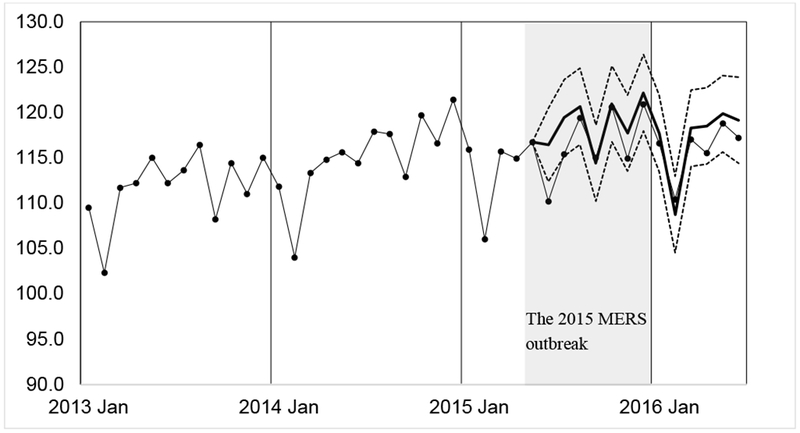
We projected monthly numbers of non-citizen arrivals and indices of services for three travel-related service sectors during and after the MERS outbreak (June 2015–June 2016) using seasonal autoregressive integrated moving average models. Tourism losses were estimated by multiplying the monthly differences between projected and actual numbers of non-citizen arrivals by average tourism expenditure per capita. Estimated tourism losses were allocated to travel-related service sectors to understand the distribution of losses across service sectors.
Results
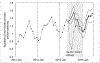
The MERS outbreak was correlated with a reduction of 2.1 million non-citizen visitors corresponding with US $2.6 billion in tourism loss for the ROK. Estimated losses in the accommodation, food and beverage service, and transportation sectors associated with the decrease of non-citizen visitors were US $542 million, US $359 million, and US $106 million, respectively. The losses were demonstrated by lower than expected indices of services for the accommodation, and food and beverage service sectors in June and July 2015 and for the transportation sector in June 2015.
Conclusions
The results support previous findings that public health emergencies due to traveler-associated outbreaks of infectious diseases can cause significant losses to the broader economies of affected countries.
-
Subjects:
-
Keywords:
-
Source:Health Secur. 17(2):100-108
-
DOI:
-
Pubmed ID:30969152
-
Pubmed Central ID:PMC6560634
-
Document Type:
-
Funding:
-
Genre:
-
Volume:17
-
Issue:2
-
Collection(s):
-
Main Document Checksum:urn:sha-512:2a012ea2e2dd9700614b0fee4987845d7321e6b99789430938b828d1aa391dd1cd1bb959d6f4f7b976c41bfafaf14643a1b0c2bf96ea704b97159c044d7507a6
-
Download URL:
-
File Type:
 [PDF
- 591.85 KB
]
[PDF
- 591.85 KB
]
Supporting Files


File Language:
English
ON THIS PAGE



CDC STACKS serves as an archival repository of CDC-published products including
scientific findings,
journal articles, guidelines, recommendations, or other public health information authored or
co-authored by CDC or funded partners.
As a repository, CDC STACKS retains documents in their original published format to ensure public access to scientific information.
As a repository, CDC STACKS retains documents in their original published format to ensure public access to scientific information.
You May Also Like
COLLECTION
CDC Public Access