



Canine Visceral Leishmaniasis, United States and Canada, 2000–2003
Supporting Files
Public Domain

-
Mar 2006
File Language:
English
Details
-
Alternative Title:Emerg Infect Dis
-
Personal Author:
-
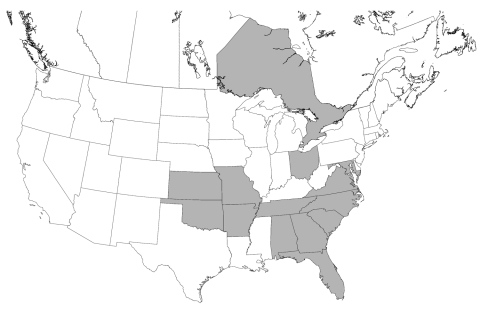
Description:Visceral leishmaniasis, caused by protozoa of the genus Leishmania donovani complex, is a vectorborne zoonotic infection that infects humans, dogs, and other mammals. In 2000, this infection was implicated as causing high rates of illness and death among foxhounds in a kennel in New York. A serosurvey of >12,000 foxhounds and other canids and 185 persons in 35 states and 4 Canadian provinces was performed to determine geographic extent, prevalence, host range, and modes of transmission within foxhounds, other dogs, and wild canids and to assess possible infections in humans. Foxhounds infected with Leishmania spp. were found in 18 states and 2 Canadian provinces. No evidence of infection was found in humans. The infection in North America appears to be widespread in foxhounds and limited to dog-to-dog mechanisms of transmission; however, if the organism becomes adapted for vector transmission by indigenous phlebotomines, the probability of human exposure will be greatly increased.
-
Subjects:
-
Source:Emerg Infect Dis. 12(3):440-446.
-
Document Type:
-
Place as Subject:
-
Location:
-
Volume:12
-
Issue:3
-
Download URL:
-
File Type:
 [PDF - 142.46 KB]
 -
Collection(s):
-
Main Document Checksum:urn:sha256:02f7384cf9229d42d35b8fb0b8e55891b6145ff76f225b48bdd691b0e67e667c
Supporting Files


File Language:
English
 Was this page helpful?
 Found an issue?


CDC STACKS serves as an archival repository of CDC-published products including
scientific findings, journal articles, guidelines, recommendations, or other public health information authored or
co-authored by CDC or funded partners.
As a repository, CDC STACKS retains documents in their original published format to ensure public access to scientific information.
As a repository, CDC STACKS retains documents in their original published format to ensure public access to scientific information.
You May Also Like
COLLECTION
Emerging Infectious Diseases