



Short-term Effects and Long-term Cost-Effectiveness of Universal Hepatitis C Testing in Prenatal Care
Supporting Files

-
2 2019
-
Available in CDC Stacks on 2020-02-01T00:00:00Z
File Language:
English
Details
-
Journal Article:Obstet Gynecol
-
Personal Author:
-
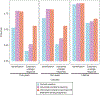
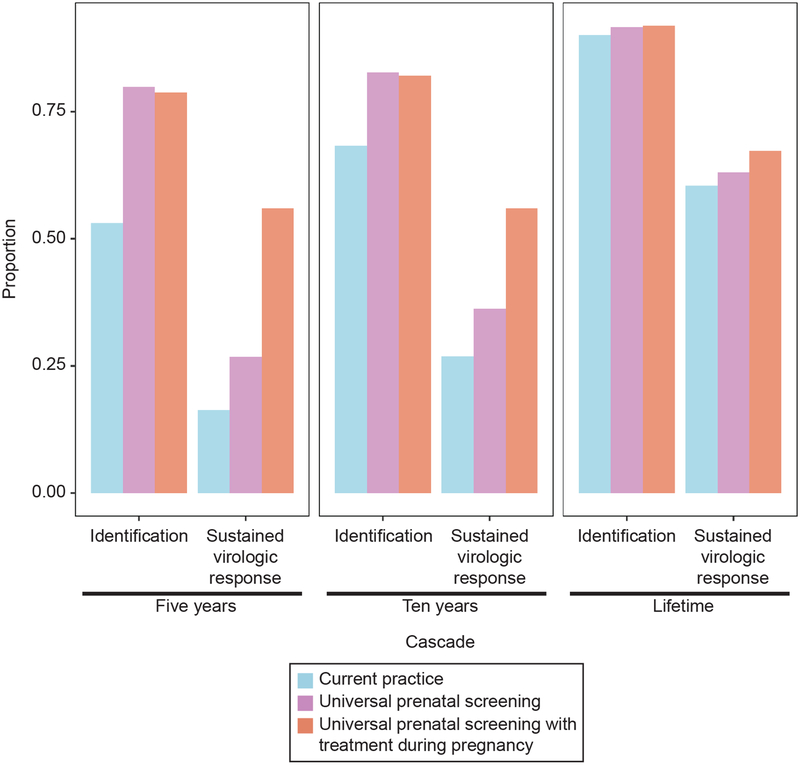
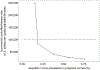
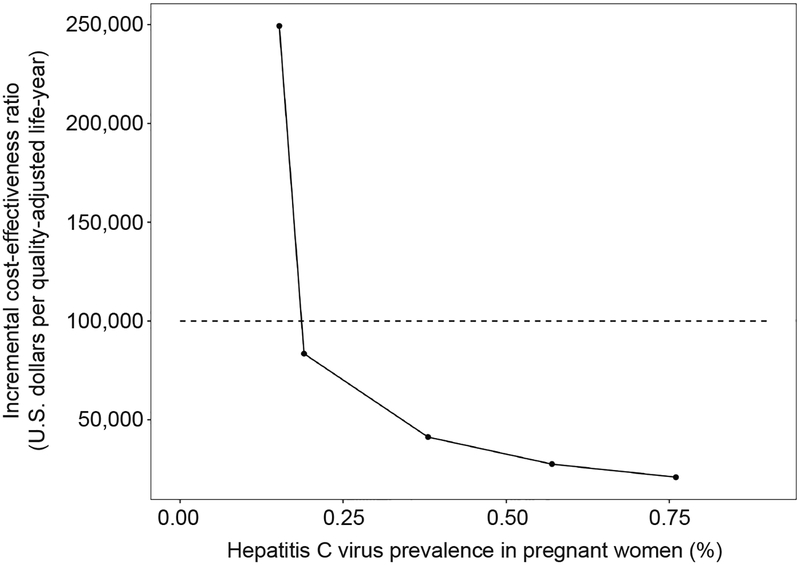
Description:Objective ; To estimate the clinical effects and cost-effectiveness of universal prenatal hepatitis C screening, and to calculate potential life expectancy, quality of life, and health care costs associated with universal prenatal hepatitis C screening and linkage to treatment. ; Methods ; Using a stochastic individual-level microsimulation model, we simulated the lifetimes of 250 million pregnant women matched at baseline with the U.S. childbearing population on age, injection drug use behaviors, and hepatitis C virus (HCV) infection status. Modeled outcomes included hepatitis C diagnosis, treatment and cure, lifetime health care costs, quality-adjusted life years (QALY) and incremental cost-effectiveness ratios (ICERs) comparing universal prenatal hepatitis C screening to current practice. We modeled whether infants exposed to maternal hepatitis C virus (HCV) at birth were identified as such. ; Results ; Hepatitis C virus–infected pregnant women lived 1.21 years longer and had 16% lower HCV-attributable mortality with universal prenatal hepatitis C screening, which had an ICER of $41,000 per QALY gained compared to current practice. Incremental cost-effectiveness ratios remained below $100,000 per QALY gained in most sensitivity analyses; notable exceptions included ICERs above $100,000 when assuming mean time to cirrhosis of 70 years, a cost greater than $500,000 per false positive diagnosis, or population HCV infection prevalence below 0.16%. Universal prenatal hepatitis C screening increased identification of infants exposed to HCV at birth from 44% to 92%. ; Conclusions ; In our model, universal prenatal hepatitis C screening improves health outcomes in HCV-infected women, improves identification of HCV exposure in infants born at risk, and is cost-effective.
-
Subjects:
-
Source:Obstet Gynecol. 133(2):289-300
-
DOI:
-
Pubmed ID:30633134
-
Pubmed Central ID:PMC6501827
-
Document Type:
-
Funding:
-
Genre:
-
Volume:133
-
Issue:2
-
Download URL:
-
File Type:
 [PDF - 416.33 KB]
 -
Collection(s):
-
Main Document Checksum:urn:sha-512:93f1cac20f7b932fd11cfdf745ded23f21675bbfba140b5f3b797762c3f34f11e64efee75bef43ed3ca3172be14407778a8a77414cd78219ecfab97d94ebeccc
Supporting Files


File Language:
English
 Was this page helpful?
 Found an issue?

CDC STACKS serves as an archival repository of CDC-published products including
scientific findings, journal articles, guidelines, recommendations, or other public health information authored or
co-authored by CDC or funded partners.
As a repository, CDC STACKS retains documents in their original published format to ensure public access to scientific information.
As a repository, CDC STACKS retains documents in their original published format to ensure public access to scientific information.
You May Also Like
COLLECTION
CDC Public Access