



Early lead exposure and pubertal development in a Mexico City population
Supporting Files

-
February 11 2019
-
Available in CDC Stacks on 2020-04-01T00:00:00Z
File Language:
English
Details
-
Alternative Title:Environ Int
-
Personal Author:
-
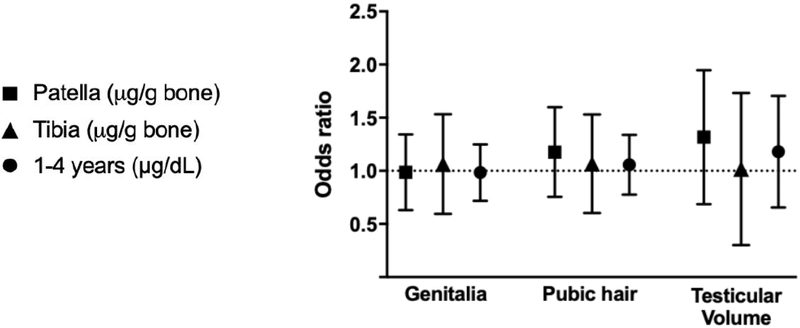
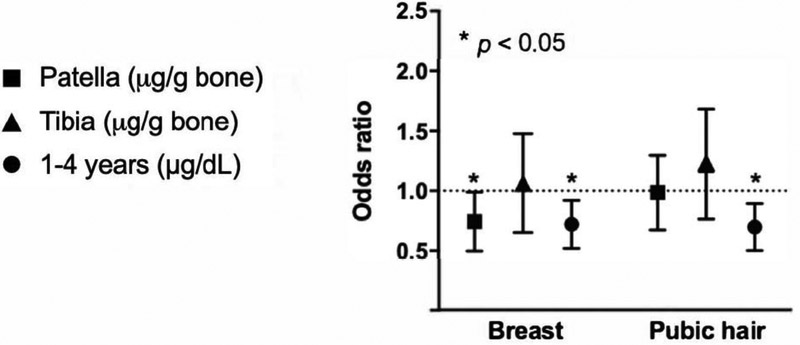
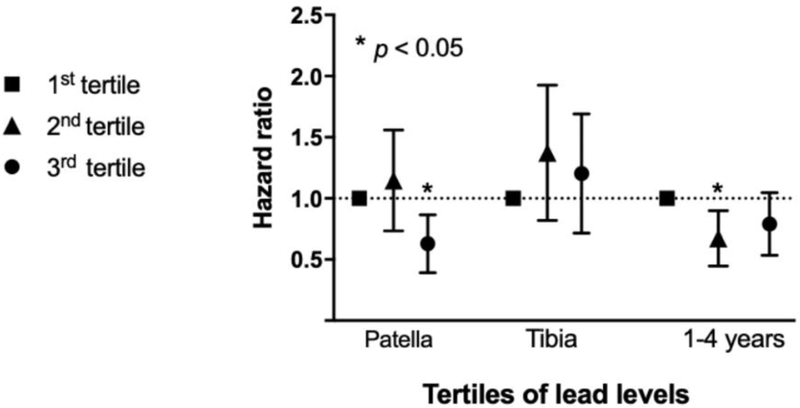
Description:Background: ; Previous studies have examined the association between blood lead levels and pubertal timing in adolescent girls; however, the evidence is lacking on the role of lead exposure during sensitive developmental periods on sexual maturation. ; Objectives: ; To examine the association of prenatal and early childhood lead exposure with pubertal stages among 264 boys and 283 girls aged 9.8-18.0 years in Mexico City. ; Methods: ; We measured maternal bone lead (a proxy for cumulative fetal exposure to lead from maternal bone stores mobilized during pregnancy) at 1 month postpartum. Blood lead was measured annually from 1-4 years. Pubertal stage was assessed by a pediatrician. We examined the association between lead and pubertal stages of breast, pubic hair and genitalia using ordinal regression. Age at menarche was evaluated using Cox proportional-hazard models. ; Results: ; Multivariate models showed that maternal patella lead and early childhood blood lead were inversely associated with breast growth (patella OR=0.72, 95% CI: 0.51–1.00; blood OR=0.70, 95% CI: 0.53–0.93) in girls. Girls with maternal patella lead in the 3rd tertile and child blood lead in the 2nd tertile had a later age at menarche compared with girls in the 1st tertile (patella HR=0.60, 95% CI: 0.41–0.88; blood HR=0.65, 95% CI 0.46–0.91). Additionally, early childhood blood lead was negatively associated with pubic hair growth (OR=0.68, 95% CI: 0.51–0.90) in girls. No associations were found in boys. ; Conclusions: ; These data suggest that higher prenatal and early childhood exposure to lead may be associated with delayed pubertal development in girls but not boys. Our findings are consistent with previous analyses and reinforce the reproductive effects of lead for girls.
-
Subjects:
- Article
- bone lead
- blood lead
- pregnancy
- early childhood
- puberty
- age at menarche
- Adolescent
- Bone and Bones
- Child
- Environmental Exposure
- Environmental Pollutants
- Female
- Humans
- Lead
- Longitudinal Studies
- Male
- Maternal Exposure
- Menarche
- Mexico
- Mothers
- Pregnancy
- Prenatal Exposure Delayed Effects
- Puberty
- Sexual Maturation
-
Source:Environ Int. 125:445-451
-
Pubmed ID:30763831
-
Pubmed Central ID:PMC6472946
-
Document Type:
-
Funding:T42 OH008455/OH/NIOSH CDC HHS/United States ; P20 ES018171/ES/NIEHS NIH HHS/United States ; R01 ES021446/ES/NIEHS NIH HHS/United States ; R01 ES007821/ES/NIEHS NIH HHS/United States ; P42 ES005947/ES/NIEHS NIH HHS/United States ; P01 ES022844/ES/NIEHS NIH HHS/United States ; P30 ES017885/ES/NIEHS NIH HHS/United States
-
Place as Subject:
-
Volume:125
-
Download URL:
-
File Type:
 [PDF - 309.03 KB]
 -
Collection(s):
-
Main Document Checksum:urn:sha256:b9476f09bbb1f13269cbf0a216bfb8aba717e23211dab3190df9a97ae31183eb
Supporting Files


File Language:
English
 Was this page helpful?
 Found an issue?


CDC STACKS serves as an archival repository of CDC-published products including
scientific findings, journal articles, guidelines, recommendations, or other public health information authored or
co-authored by CDC or funded partners.
As a repository, CDC STACKS retains documents in their original published format to ensure public access to scientific information.
As a repository, CDC STACKS retains documents in their original published format to ensure public access to scientific information.
You May Also Like
COLLECTION
CDC Public Access