



SARS Surveillance during Emergency Public Health Response, United States, March–July 2003
Supporting Files
Public Domain

-
Feb 2004
File Language:
English
Details
-
Alternative Title:Emerg Infect Dis
-
Personal Author:Schrag, Stephanie J. ; Brooks, John T. ; Van Beneden, Chris ; Parashar, Umesh D. ; Griffin, Patricia M. ; Anderson, Larry J. ; Bellini, William J. ; Benson, Robert F. ; Erdman, Dean D. ; Klimov, Alexander ; Ksiazek, Thomas G. ; Peret, Teresa C.T. ; Talkington, Deborah F. ; Thacker, W. Lanier ; Tondella, Maria L. ; Sampson, Jacquelyn S. ; Hightower, Allen W. ; Nordenberg, Dale F. ; Plikaytis, Brian D. ; Khan, Ali S. ; Rosenstein, Nancy E. ; Treadwell, Tracee A. ; Whitney, Cynthia G. ; Fiore, Anthony E. ; Durant, Tonji M. ; Perz, Joseph F. ; Wasley, Annemarie ; Feikin, Daniel ; Herndon, Joy L. ; Bower, William A. ; Kilbourn, Barbara W. ; Levy, Deborah A. ; Coronado, Victor G. ; Buffington, Joanna ; Dykewicz, Clare A. ; Khabbaz, Rima F. ; Chamberland, Mary E.
-
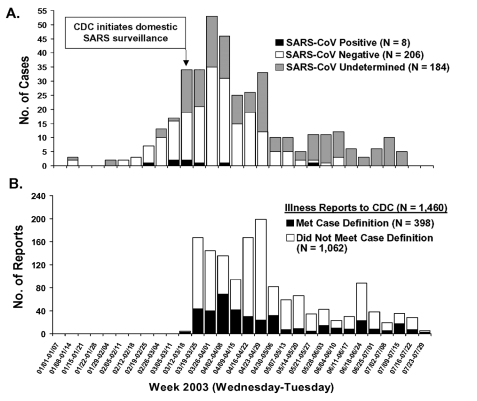
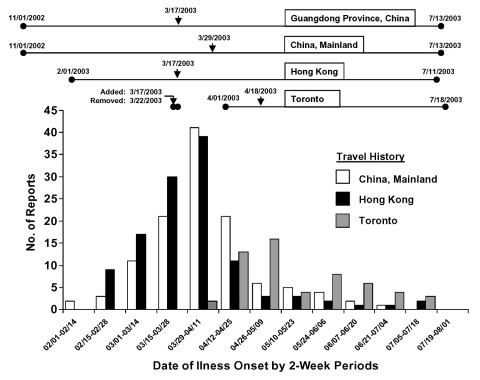
Description:In response to the emergence of severe acute respiratory syndrome (SARS), the United States established national surveillance using a sensitive case definition incorporating clinical, epidemiologic, and laboratory criteria. Of 1,460 unexplained respiratory illnesses reported by state and local health departments to the Centers for Disease Control and Prevention from March 17 to July 30, 2003, a total of 398 (27%) met clinical and epidemiologic SARS case criteria. Of these, 72 (18%) were probable cases with radiographic evidence of pneumonia. Eight (2%) were laboratory-confirmed SARS-coronavirus (SARS-CoV) infections, 206 (52%) were SARS-CoV negative, and 184 (46%) had undetermined SARS-CoV status because of missing convalescent-phase serum specimens. Thirty-one percent (124/398) of case-patients were hospitalized; none died. Travel was the most common epidemiologic link (329/398, 83%), and mainland China was the affected area most commonly visited. One case of possible household transmission was reported, and no laboratory-confirmed infections occurred among healthcare workers. Successes and limitations of this emergency surveillance can guide preparations for future outbreaks of SARS or respiratory diseases of unknown etiology.
-
Subjects:
- Research
- Adolescent
- Adult
- Aged
- Aged, 80 and over
- Base Sequence
- Child
- Child, Preschool
- DNA, Viral
- Diagnosis, Differential
- Disease Outbreaks
- Emergencies
- Female
- Humans
- Infant
- Male
- Middle Aged
- Population Surveillance
- Public Health
- Respiratory Tract Infections
- SARS Virus
- Severe Acute Respiratory Syndrome
-
Source:Emerg Infect Dis. 10(2):185-194.
-
Document Type:
-
Corporate as Subject:
-
Place as Subject:
-
Location:
-
Volume:10
-
Issue:2
-
Download URL:
-
File Type:
 [PDF - 194.75 KB]
 -
Collection(s):
-
Main Document Checksum:urn:sha256:f3cd61a9fbfec7fc11821a8b8fb826e44c267c918f466e7da37239988c093e1c
Supporting Files


File Language:
English
 Was this page helpful?
 Found an issue?




CDC STACKS serves as an archival repository of CDC-published products including
scientific findings, journal articles, guidelines, recommendations, or other public health information authored or
co-authored by CDC or funded partners.
As a repository, CDC STACKS retains documents in their original published format to ensure public access to scientific information.
As a repository, CDC STACKS retains documents in their original published format to ensure public access to scientific information.
You May Also Like
COLLECTION
Emerging Infectious Diseases