


Rapid quantification of two chemical nerve agent metabolites in serum
Supporting Files

-
January 31 2019
-
File Language:
English
Details
-
Alternative Title:Biosens Bioelectron
-
Personal Author:
-
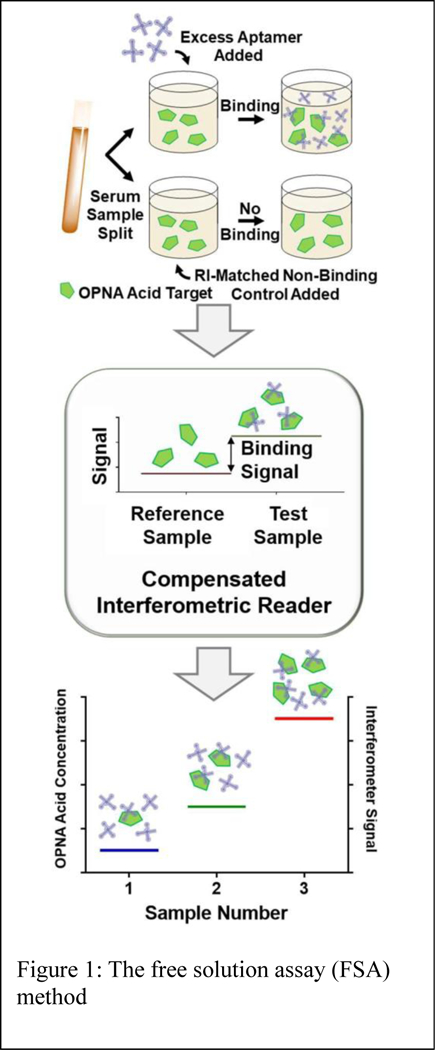
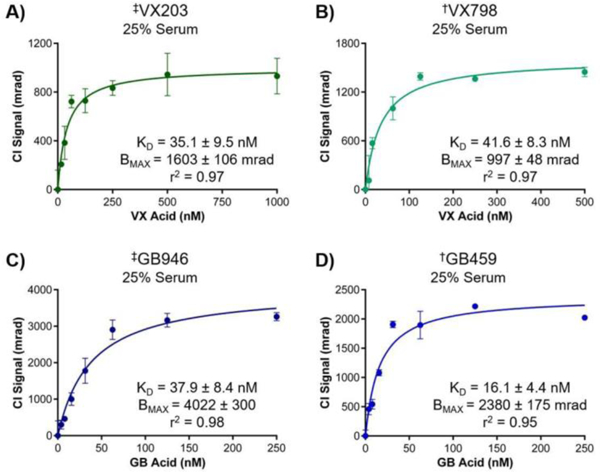
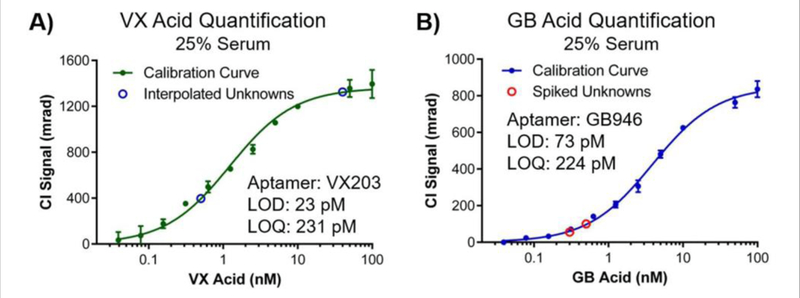
Description:Organophosphorus compounds (OPs) continue to represent a significant chemical threat to humans due to exposures from their use as weapons, their potential storage hazards, and from their continued use agriculturally. Existing methods for detection include ELISA and mass spectrometry. The new approach presented here provides an innovative first step toward a portable OP quantification method that surmounts conventional limitations involving sensitivity, selectivity, complexity, and portability. DNA affinity probes, or aptamers, represent an emerging technology that, when combined with a mix-and-read, free-solution assay (FSA) and a compensated interferometer (CI) can provide a novel alternative to existing OP nerve agent (OPNA) quantification methods. Here it is shown that FSA can be used to rapidly screen prospective aptamers in the biological matrix of interest, allowing the identification of a 'best-in-class' probe. It is also shown that combining aptamers with FSA-CI enables quantification of the OPNA metabolites, Sarin (NATO designation "G-series, B", or GB) and Venomous Agent X (VX) acids, rapidly with high selectivity at detection limits of sub-10 pg/mL in 25% serum (by volume in PBS). These results suggest there is potential to directly impact diagnostic specificity and sensitivity of emergency response testing methods by both simplifying sample preparation procedures and making a benchtop reader available for OPNA metabolite quantification.
-
Subjects:
-
Source:Biosens Bioelectron. 131:119-127
-
Pubmed ID:30826646
-
Pubmed Central ID:PMC6457360
-
Document Type:
-
Funding:
-
Volume:131
-
Collection(s):
-
Main Document Checksum:urn:sha256:82a353368b18303492f599eeaf0e22589fe68f67f5b7235d3dd3b4bc2a815fb5
-
Download URL:
-
File Type:
 [PDF
- 360.62 KB
]
[PDF
- 360.62 KB
]
Supporting Files


File Language:
English
ON THIS PAGE







CDC STACKS serves as an archival repository of CDC-published products including
scientific findings,
journal articles, guidelines, recommendations, or other public health information authored or
co-authored by CDC or funded partners.
As a repository, CDC STACKS retains documents in their original published format to ensure public access to scientific information.
As a repository, CDC STACKS retains documents in their original published format to ensure public access to scientific information.
You May Also Like
COLLECTION
CDC Public Access