



Antimicrobial Resistance Incidence and Risk Factors among Helicobacter pylori–Infected Persons, United States
Supporting Files
Public Domain

-
Jun 2004
File Language:
English
Details
-
Alternative Title:Emerg Infect Dis
-
Personal Author:Duck, William M. ; Sobel, Jeremy ; Pruckler, Janet M. ; Song, Qunsheng ; Swerdlow, David ; Friedman, Cindy ; Sulka, Alana ; Swaminathan, Balasubra ; Taylor, Tom ; Hoekstra, Mike ; Griffin, Patricia M. ; Smoot, Duane ; Peek, Rick ; Metz, David C. ; Bloom, Peter B. ; Goldschmid, Steven ; Parsonnet, Julie ; Triadafilopoulos, George ; Perez-Perez, Guillermo I. ; Vakil, Nimish ; Ernst, Peter ; Czinn, Steve ; Dunne, Donald ; Gold, Ben D.
-
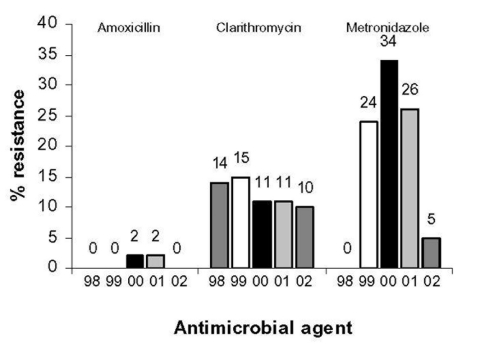
Description:Helicobacter pylori is the primary cause of peptic ulcer disease and an etiologic agent in the development of gastric cancer. H. pylori infection is curable with regimens of multiple antimicrobial agents, and antimicrobial resistance is a leading cause of treatment failure. The Helicobacter pylori Antimicrobial Resistance Monitoring Program (HARP) is a prospective, multicenter U.S. network that tracks national incidence rates of H. pylori antimicrobial resistance. Of 347 clinical H. pylori isolates collected from December 1998 through 2002, 101 (29.1%) were resistant to one antimicrobial agent, and 17 (5%) were resistant to two or more antimicrobial agents. Eighty-seven (25.1%) isolates were resistant to metronidazole, 45 (12.9%) to clarithromycin, and 3 (0.9%) to amoxicillin. On multivariate analysis, black race was the only significant risk factor (p < 0.01, hazard ratio 2.04) for infection with a resistant H. pylori strain. Formulating pretreatment screening strategies or providing alternative therapeutic regimens for high-risk populations may be important for future clinical practice.
-
Subjects:
- Research
- Adult
- Aged
- Aged, 80 and over
- Anti-Bacterial Agents
- Child
- Child, Preschool
- Drug Resistance, Multiple, Bacterial
- Female
- Helicobacter Infections
- Humans
- Incidence
- Logistic Models
- Longitudinal Studies
- Male
- Microbial Sensitivity Tests
- Middle Aged
- Multivariate Analysis
- Prospective Studies
- Risk Factors
- Stomach Diseases
-
Source:Emerg Infect Dis. 10(6):1088-1094.
-
Document Type:
-
Place as Subject:
-
Location:
-
Volume:10
-
Issue:6
-
Download URL:
-
File Type:
 [PDF - 330.89 KB]
 -
Collection(s):
-
Main Document Checksum:urn:sha256:e5492b69d1061656dcb63302e25d7a4d1c9847e9ac92a47ee0a71318bebe38de
Supporting Files


File Language:
English
 Was this page helpful?
 Found an issue?

CDC STACKS serves as an archival repository of CDC-published products including
scientific findings, journal articles, guidelines, recommendations, or other public health information authored or
co-authored by CDC or funded partners.
As a repository, CDC STACKS retains documents in their original published format to ensure public access to scientific information.
As a repository, CDC STACKS retains documents in their original published format to ensure public access to scientific information.
You May Also Like
COLLECTION
Emerging Infectious Diseases