


Incidence Trends in Pathogen-specific, Central Line-associated Bloodstream Infections in US Intensive Care Units, 1990–2010
Supporting Files

-
July 16 2013
-
File Language:
English
Details
-
Journal Article:Infect Control Hosp Epidemiol
-
Personal Author:
-
Description:Objective
To quantify historical trends in rates of central line-associated bloodstream infections (CLABSIs) in U.S. intensive care units (ICUs) caused by major pathogen groups, including Candida spp., Enterococcus spp., specified Gram-negative rods, and Staphylococcus aureus.
Design
Active surveillance in a cohort of participating ICUs through the U.S. Centers for Disease Control and Prevention (CDC), National Nosocomial Infections Surveillance (NNIS) system during 1990–2004 and the National Healthcare Safety Network (NHSN) during 2006–2010.
Setting
ICUs
Patients or participants
Patients who were admitted to participating ICUs
Interventions
None
Results
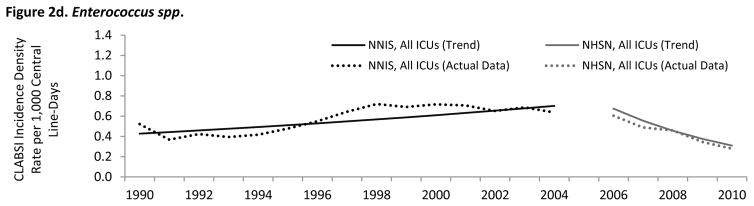
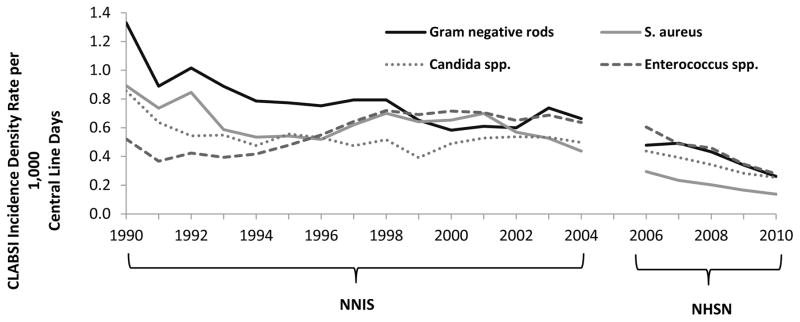
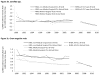
The CLABSI incidence density rate for S. aureus decreased annually starting in 2002 and remained lower than for other pathogen groups. Since 2006, the annual decrease for S. aureus CLABSIs in non-pediatric ICU types was −18.3% (95% CI, −20.8% to −15.8%), whereas the incidence density rate for S. aureus among pediatric ICUs did not change. The annual decrease for all ICUs combined since 2006 was −17.8% (95% CI, −19.4% to −16.1%) for Enterococcus spp., −16.4% (95% CI, −18.2% to −14.7%) for Gram-negative rods, and −13.5% (95% CI, −15.4% to −11.5%) for Candida spp.
Conclusions
Patterns of ICU CLABSI incidence density rates among major pathogen groups have changed considerably during recent decades. CLABSI incidence declined steeply since 2006, except for CLABSI due to S. aureus in pediatric ICUs. There is a need to better understand CLABSIs that still do occur based on microbiological and patient characteristics. New prevention approaches may be needed in addition to central line insertion and maintenance practices.
-
Subjects:
-
Source:Infect Control Hosp Epidemiol. 34(9):893-899
-
DOI:
-
Pubmed ID:23917902
-
Pubmed Central ID:PMC6452856
-
Document Type:
-
Funding:
-
Genre:
-
Place as Subject:
-
Volume:34
-
Issue:9
-
Collection(s):
-
Main Document Checksum:urn:sha-512:e7822c3435c503d2e6925b829f54ce89d089a91a1ccabc8931dd07933ff7692903e32363c51c45445f7e1764ed645ddaa538d019a0f3b1f2ffeebd80b4d3045a
-
Download URL:
-
File Type:
 [PDF
- 604.28 KB
]
[PDF
- 604.28 KB
]
Supporting Files


File Language:
English
ON THIS PAGE




CDC STACKS serves as an archival repository of CDC-published products including
scientific findings,
journal articles, guidelines, recommendations, or other public health information authored or
co-authored by CDC or funded partners.
As a repository, CDC STACKS retains documents in their original published format to ensure public access to scientific information.
As a repository, CDC STACKS retains documents in their original published format to ensure public access to scientific information.
You May Also Like
COLLECTION
CDC Public Access